Open access

Papers, explained

338 open-access papers, free to watch.

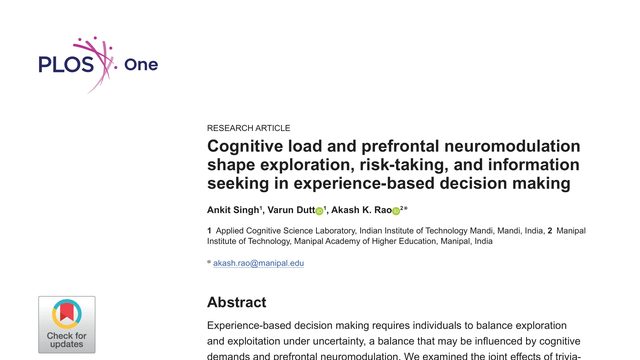
Cognitive load and prefrontal neuromodulation shape exploration, risk-taking, and information seeking in experience-based decision making 3:54

Cognitive load and prefrontal neuromodulation shape exploration, risk-taking, and information seeking in experience-based decision making

Everyday choices ask us to balance a safe option against a tempting gamble, and sometimes to pay for more information. This study finds that mental busyness and mild brain stimulation can shift those choices in different ways.

Predictive Multiplicity in Cell-Fate Assignment: Label-Free Rashomon Sets and the Limits of Per-Cell Certification 4:24

Predictive Multiplicity in Cell-Fate Assignment: Label-Free Rashomon Sets and the Limits of Per-Cell Certification

A cell can receive radically different fate confidence from models that fit the same data equally well. The unsettling part is that adding more plausible models does not necessarily make any one cell’s fate call more trustworthy.

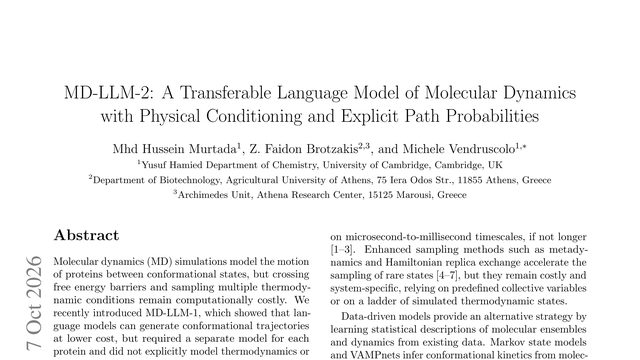
MD-LLM-2: A Transferable Language Model of Molecular Dynamics with Physical Conditioning and Explicit Path Probabilities 4:22

MD-LLM-2: A Transferable Language Model of Molecular Dynamics with Physical Conditioning and Explicit Path Probabilities

Proteins are constantly changing shape, but watching every tiny movement can take far longer than the movement itself. This study asks whether a language model can learn those motions and predict what happens under new physical conditions.

The Hill numbers synthesize and generalize measures of trait polygenicity 3:36

The Hill numbers synthesize and generalize measures of trait polygenicity

A trait can be shaped by many genetic variants, but counting them is not enough: tiny contributors and powerful ones should not necessarily count the same. This paper turns that problem into one adjustable picture.

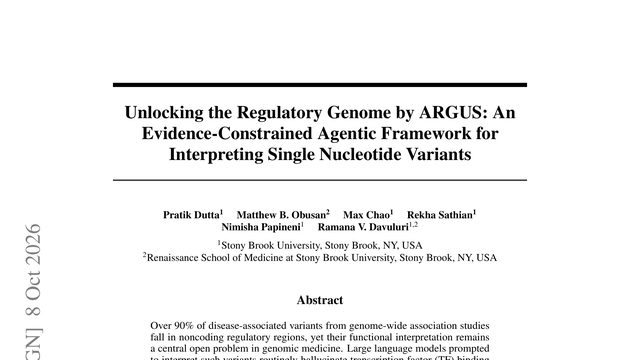
Unlocking the Regulatory Genome by ARGUS: An Evidence-Constrained Agentic Framework for Interpreting Single Nucleotide Variants 3:46

Unlocking the Regulatory Genome by ARGUS: An Evidence-Constrained Agentic Framework for Interpreting Single Nucleotide Variants

Most disease-linked changes in DNA sit outside genes, where their effects are hard to read. An AI can sound confident about them, and still invent the evidence, so this system is designed to stop and say when the evidence is not enough.

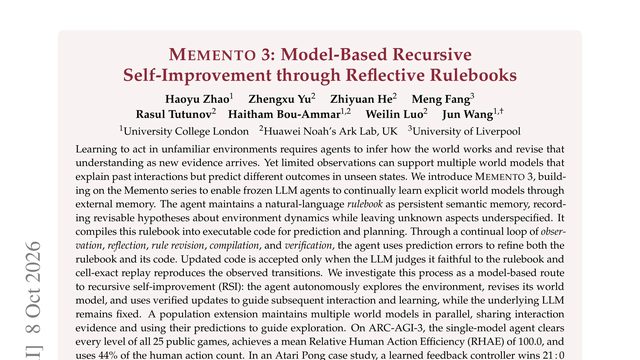
Memento 3: Model-Based Recursive Self-Improvement through Reflective Rulebooks 3:59

Memento 3: Model-Based Recursive Self-Improvement through Reflective Rulebooks

What if an AI could enter a world it does not understand, write down its best guess about the rules, test that guess, and steadily replace it with something better, without changing the language model underneath?

Autoregressive Retriever: Improving Query Understanding from Item Feedback for Universal Multimodal Retrieval 3:32

Autoregressive Retriever: Improving Query Understanding from Item Feedback for Universal Multimodal Retrieval

Most search engines decide what you mean before they show you anything. This system lets the first results help rewrite the search itself, so a vague request can become clearer while the search is happening.

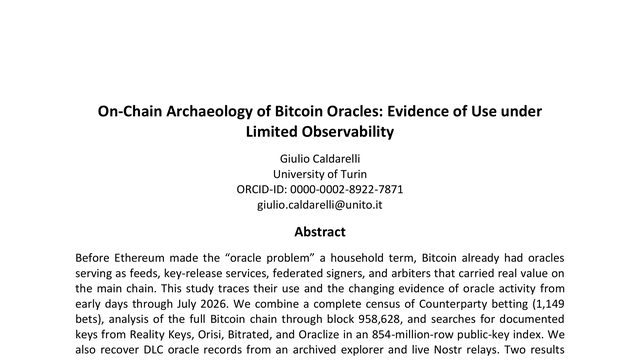
On-Chain Archaeology of Bitcoin Oracles: Evidence of Use under Limited Observability 4:17

On-Chain Archaeology of Bitcoin Oracles: Evidence of Use under Limited Observability

Bitcoin was already using outside information to settle valuable agreements before most people had heard of the problem. But much of that history is now missing, and the surviving record can point researchers in the wrong direction.

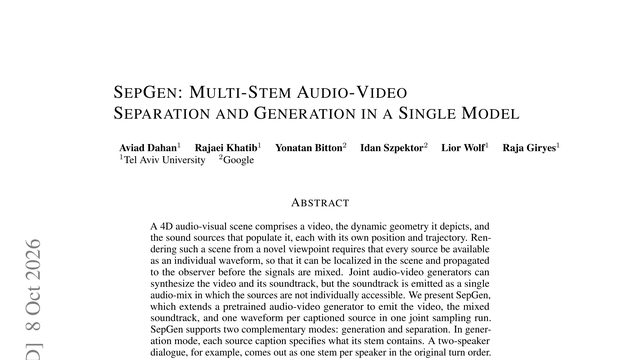
SepGen: Multi-Stem Audio-Video Separation and Generation in a Single Model 4:12

SepGen: Multi-Stem Audio-Video Separation and Generation in a Single Model

Imagine changing the camera angle in a video and having the sound change with it. That only works if every voice and sound exists on its own track, and this system creates those tracks as the scene is made.

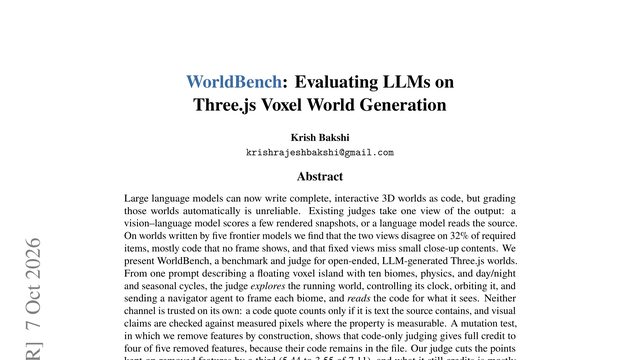
WorldBench: Evaluating LLMs on Three.js Voxel World Generation 3:59

WorldBench: Evaluating LLMs on Three.js Voxel World Generation

An AI can write an entire interactive world, yet a judge may give credit to a forest, storm, or animal that never appears, and miss one that is really there. The problem is not making the world; it is knowing what exists.

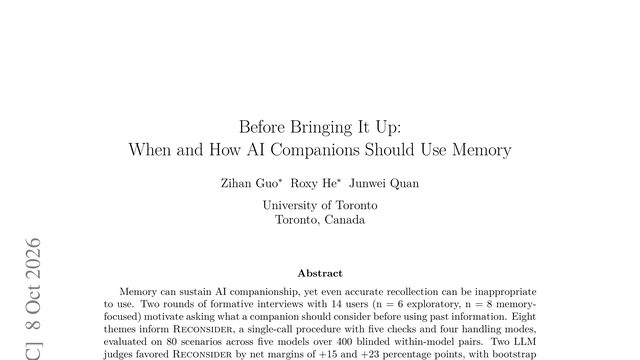
Before Bringing It Up: When and How AI Companions Should Use Memory 3:39

Before Bringing It Up: When and How AI Companions Should Use Memory

An AI can remember something about you perfectly and still bring it up at exactly the wrong moment. The real challenge is not remembering more, it is knowing when a memory belongs in the conversation.

FreeLoc: Online Floorplan Localization via Diffusion-Aided Pose Refinement 4:04

FreeLoc: Online Floorplan Localization via Diffusion-Aided Pose Refinement

A robot may have a floorplan, yet still need a huge prepared database before it can tell where it is. FreeLoc asks a simpler question: can the robot query the map directly, as it moves?