MD-LLM-2: A Transferable Language Model of Molecular Dynamics with Physical Conditioning and Explicit Path Probabilities
Overview4:22CCAI
paperi.ai
0:00 / 0:00
Mhd Hussein Murtada, Z. Faidon Brotzakis, Michele Vendruscolo
Proteins are constantly changing shape, but watching every tiny movement can take far longer than the movement itself. This study asks whether a language model can learn those motions and predict what happens under new physical conditions.
Proteins are constantly changing shape, but watching every tiny movement can take far longer than the movement itself. This study asks whether a language model can learn those motions and predict what happens under new physical conditions. A protein’s different shapes, and the rates at which it changes between them, depend on physical conditions and on the interactions inside the molecule.
The difficulty is that simulations must take extremely tiny steps, while meaningful shape changes may take much longer. Faster approaches can help find rare shapes, but they remain costly and tailored to particular systems. So MD-LLM-2 treats a protein’s motion much like reading a sentence: each new structural frame is predicted from what came before, while the model also receives the protein’s sequence and physical conditions.
Unlike a reader who sees only the last word, the model can look back at several recent frames. That lets it represent lingering effects from earlier shapes instead of pretending the latest frame tells the whole story. But predictions can drift when the model’s own outputs become the history it uses for its next predictions.
The model’s uncertainty rises as that structural drift grows. To limit the drift, a controller changes the randomness used for the next frame so the model’s average uncertainty returns to a reference level, while the physical conditions stay fixed. The model was trained across protein domains and generated trajectories for proteins absent from training.
It also predicted less compact shapes at higher temperature and reached backbone shapes near published structures from a transition region. These rarely occupied shapes matter for protein function and misfolding, but they are difficult to reach with direct simulation.
Keeping recent molecular history helped generated paths stay close to the protein’s native structure. The structure becomes compact less often as the training temperature rises, but at three hundred twenty kelvin it repeatedly leaves that shape and returns to it across a thousand generated frames.
So compactness is a recurring state, not a one-time accident. Across twelve mdCATH domains that were unseen during training, the generated trajectories reproduced the overall size, or spread, of the molecular-dynamics ensemble. Their median radius of gyration was within one angstrom of direct simulation in ten of the twelve domains, showing close agreement in typical ensemble size.
Direct simulations showed some proteins leaving and returning to compact shapes, and the generated trajectories reproduced that behavior in three of the five domains where it occurred. When the model was tested at a physical setting included in training, the uncertainty-controlled sampling brought the population of one shape basin close to the reference population, without using reference data at that setting.
By contrast, fixed randomness produced a basin-one population of zero point five three seven, farther from the reference value of zero point three nine six, while MBAR produced a much smaller zero point zero five eight. The stronger test was whether the model could predict not only which shapes occur, but how quickly the protein moves between them at physical settings held out from training.
It reproduced these first-arrival probabilities over time. Its average error was lower than that of a reversible state-based model built from the same training trajectories. The largest difference came when predicting transitions into one shape basin, which the comparison model predicted too quickly.
There is an important limit: the protein model generates only the main backbone, so events that depend on side chains can be inferred only indirectly. A model showing every atom would resolve those events directly. The study’s Hamiltonian conditioning was demonstrated only in alanine, leaving this part of the approach limited in scope and not broadly tested.
MD-LLM-2 learned protein motion across different proteins and responded to changes such as temperature and molecular forces. That could make rare, important protein states easier to explore when direct simulation is too costly.
A derivative work by Paperi · AI-generated script, voice and captions
· pages and figures unaltered
Made with Paperi.
Drop in a research PDF — get a narrated video walkthrough like this one,
with highlights that follow the narration. Free to start.
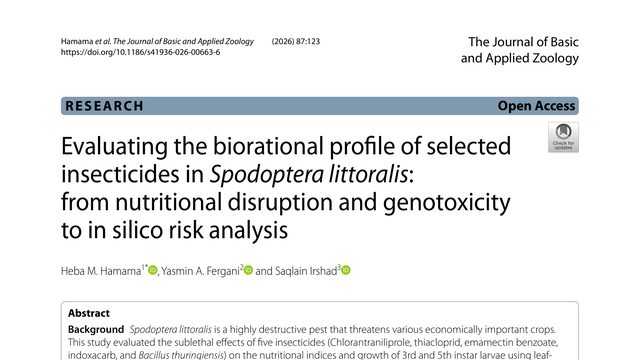
A pesticide can stop a caterpillar from eating, yet the more important warning may appear inside its cells. This study compares both effects instead of treating pest control as a single yes-or-no question.What if an insecticide can stop a crop pest from eating, yet another one leaves the strongest signal of DNA damage? This study compares both effects instead of treating pest control as a single question.
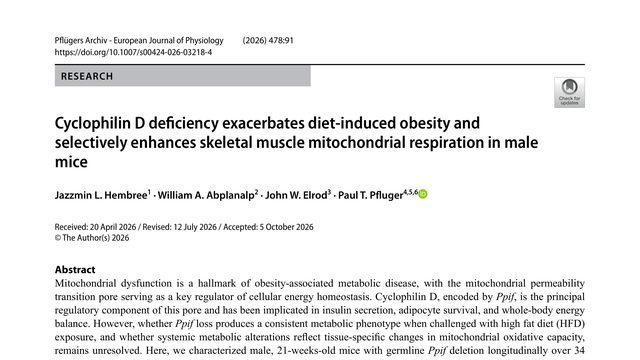
Jazzmin L. Hembree, William A. Abplanalp, John W. Elrod, Paul T. Pfluger
What if making one part of the body’s energy machinery work harder did not prevent weight gain, but actually came with more body fat? In male mice, that is exactly the puzzle this study found.Here is the surprising twist: deleting cyclophilin D made male mice more vulnerable to diet-induced obesity, yet it also increased ADP-stimulated mitochondrial respiration specifically in skeletal muscle.
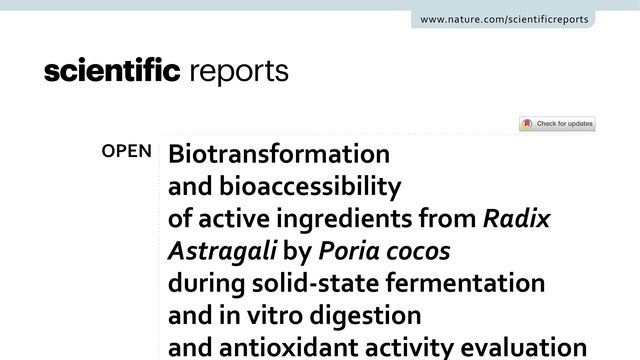
A traditional herbal root contains a valued protective compound, but only a small amount is normally available. This study found that growing a food fungus on the root could make much more of that compound accessible after digestion.A medicinal fungus turns a hard-to-access Astragalus compound into something far more abundant, and the fermented material still shows stronger antioxidant activity after simulated digestion.
 5:03