Physics and Astronomy

11 open-access papers in Physics and Astronomy, free to watch.

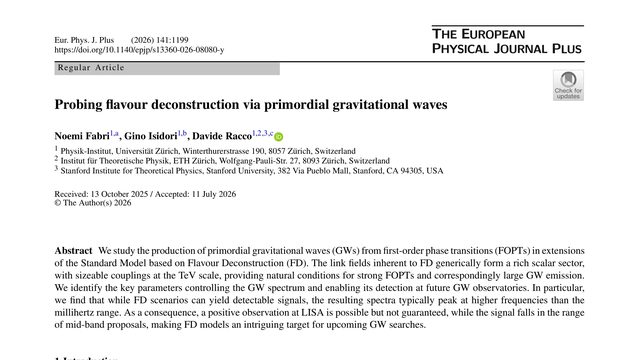
Probing flavour deconstruction via primordial gravitational waves 5:19

Probing flavour deconstruction via primordial gravitational waves

A faint ripple from the early Universe could reveal particles that no collider can reach. But this study finds the signal may be hiding at a higher pitch than the detector many people are counting on.

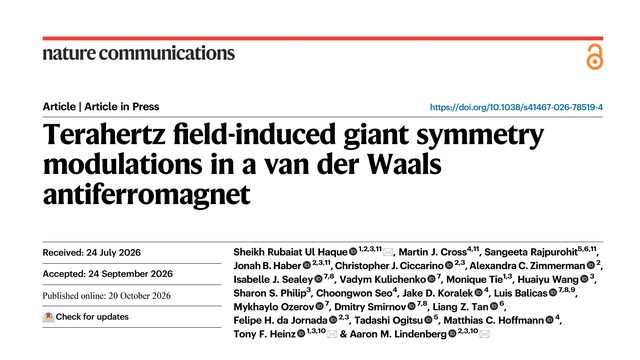
Terahertz field-induced giant symmetry modulations in a van der Waals antiferromagnet 3:31

Terahertz field-induced giant symmetry modulations in a van der Waals antiferromagnet

A flash of terahertz light makes a magnetic crystal move as though its hidden internal order has suddenly been rearranged. The striking part is that the crystal’s visible symmetry changes and keeps oscillating long after the flash.

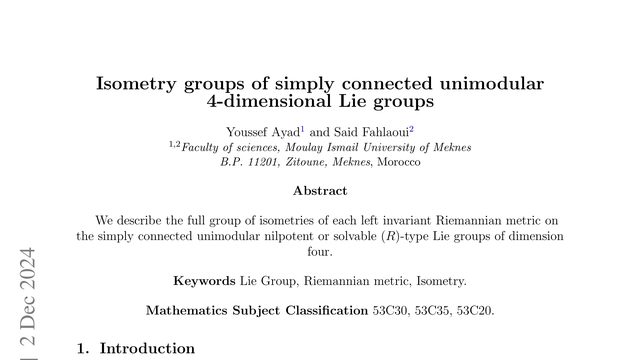
Isometry groups of simply connected unimodular 4-dimensional Lie groups 2:51

Isometry groups of simply connected unimodular 4-dimensional Lie groups

A space can look completely different after you move through it, yet some transformations leave every distance unchanged. This paper maps all such hidden symmetries for a broad family of four-dimensional spaces.

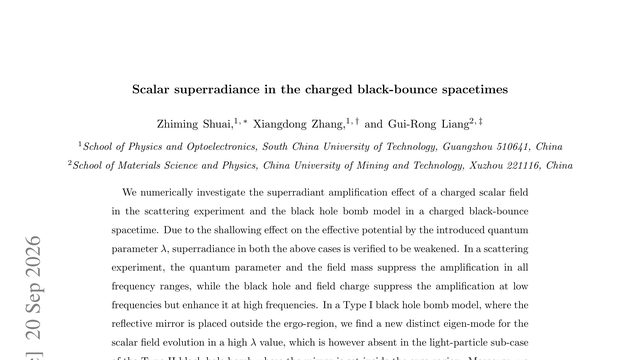
Scalar superradiance in the charged black-bounce spacetimes 3:52

Scalar superradiance in the charged black-bounce spacetimes

A black hole can act like a cosmic energy booster, making incoming waves leave stronger than they arrived. This study finds that a quantum-scale change to the black hole’s shape turns that booster down.

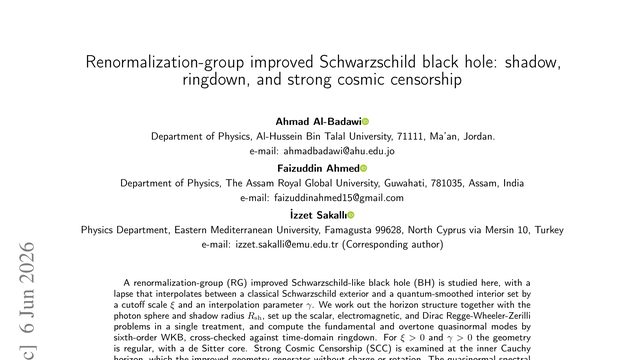
Renormalization-group improved Schwarzschild black hole: shadow, ringdown, and strong cosmic censorship 4:14

Renormalization-group improved Schwarzschild black hole: shadow, ringdown, and strong cosmic censorship

What if the center of a black hole is not an infinitely crushed point, but a smooth core? This study finds that smoothing the center can change the inside dramatically while leaving the outside looking remarkably familiar.

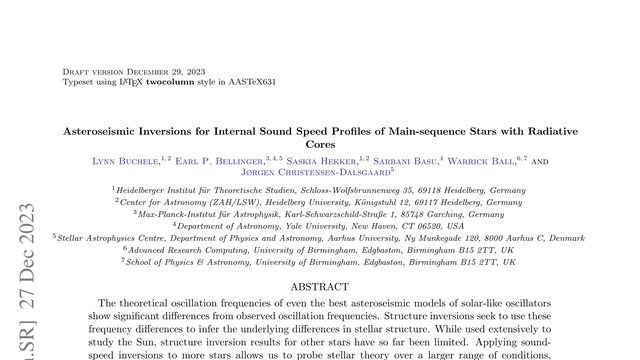
Asteroseismic Inversions for Internal Sound Speed Profiles of Main-sequence Stars with Radiative Cores 4:22

Asteroseismic Inversions for Internal Sound Speed Profiles of Main-sequence Stars with Radiative Cores

Stars ring like bells, and those faint vibrations let scientists look deep inside them. The surprise is that even our best pictures of stellar interiors can still be wrong at the core.

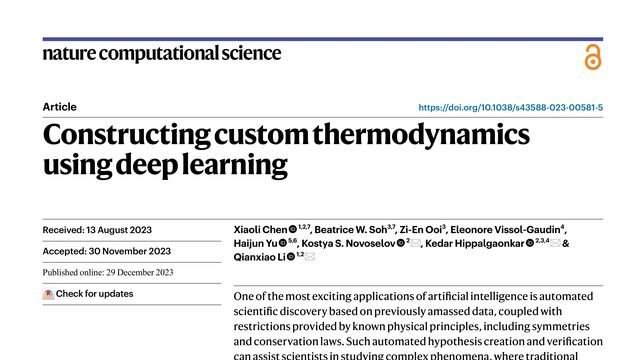
Constructing custom thermodynamics using deep learning 4:57

Constructing custom thermodynamics using deep learning

A molecule can look ready to stretch, yet take a very different path from another molecule that looks identical. This study teaches artificial intelligence to uncover the hidden information that explains why.

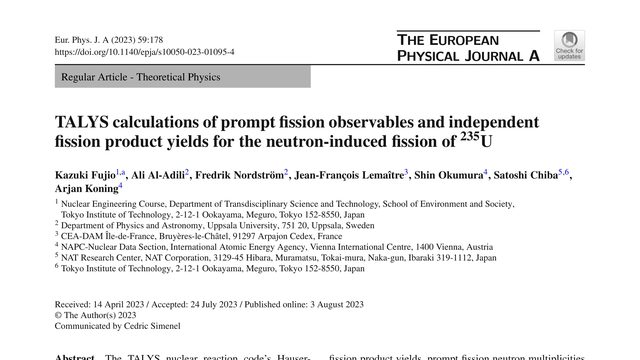
TALYS calculations of prompt fission observables and independent fission product yields for the neutron-induced fission of $$^{235}$$U 3:33

TALYS calculations of prompt fission observables and independent fission product yields for the neutron-induced fission of $$^{235}$$U

When uranium splits, the story is not over. The two pieces are born hot and unstable, then shed neutrons and light as they settle down, and predicting that aftermath matters for reactors, medicine, and nuclear waste.

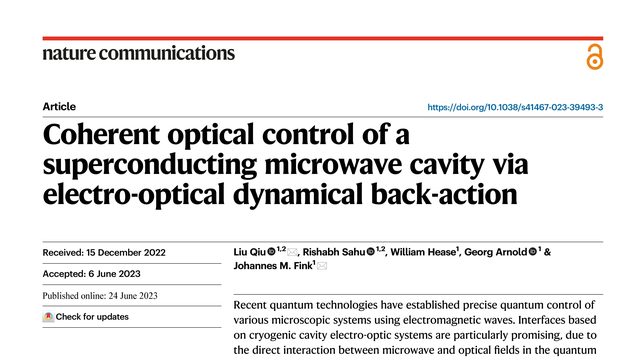
Coherent optical control of a superconducting microwave cavity via electro-optical dynamical back-action 3:50

Coherent optical control of a superconducting microwave cavity via electro-optical dynamical back-action

A laser pulse can now steer a superconducting microwave cavity, even though light and microwaves normally barely affect each other. The surprising part is how little unwanted disturbance comes along for the ride.

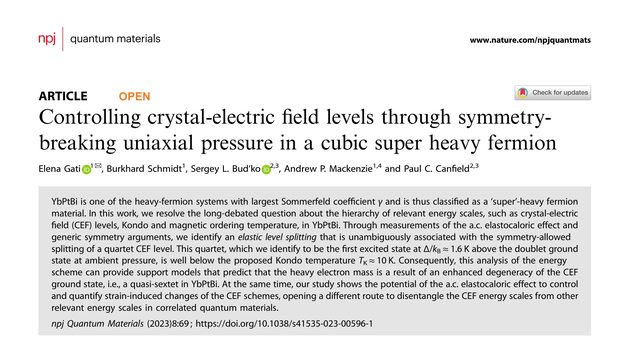
Controlling crystal-electric field levels through symmetry-breaking uniaxial pressure in a cubic super heavy fermion 4:07

Controlling crystal-electric field levels through symmetry-breaking uniaxial pressure in a cubic super heavy fermion

A tiny squeeze can reveal which hidden quantum states are making electrons behave as if they are enormously heavy. In this crystal, that pressure exposes a six-state secret.

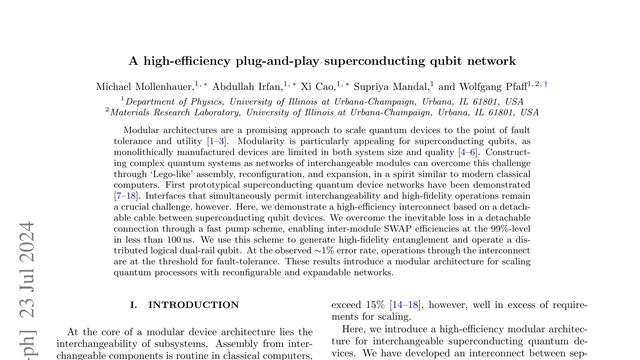
A high-efficiency elementary network of interchangeable superconducting qubit devices 3:33

A high-efficiency elementary network of interchangeable superconducting qubit devices

What if a quantum computer did not have to be built as one giant, delicate object? This experiment shows that separate quantum devices can be connected by a cable, unplugged, and still exchange information with about one percent loss.