The Hill numbers synthesize and generalize measures of trait polygenicity
Overview3:36CCAI
paperi.ai
0:00 / 0:00
Maike L. Morrison
A trait can be shaped by many genetic variants, but counting them is not enough: tiny contributors and powerful ones should not necessarily count the same. This paper turns that problem into one adjustable picture.
Characterizing the genetic architecture of phenotypic variation is central to human genetics, yet trait polygenicity—the diversity of genetic variants responsible for a heritable trait’s variation in a sample—is rarely quantified formally. O’Connor and Sella (2026) addressed this need by proposing four polygenicity measures that are quasi-arithmetic means and therefore satisfy a set of principles they argue are desirable for polygenicity measures. Here, I show that these four measures are points on a continuum corresponding to the Hill numbers, a family of ecological diversity statistics offering a tunable emphasis on variants with small versus large contributions. I further show that the Hill numbers are the only quasi-arithmetic means suitable for measuring polygenicity because they are the only ones that are “effective numbers” of variants. The connection to the Hill numbers clarifies the relationships among O’Connor and Sella’s four polygenicity measures: all four are effective numbers of variants, and those that give greater weight to variants with small contributions yield higher estimates of polygenicity. It also connects polygenicity to results in the ecological diversity literature, including the replication principle, a criterion for how such measures should behave when independent sets of variants are combined. Together, these results offer a unified framework for interpreting, comparing, and selecting measures of trait polygenicity.
Transcript
A trait can be shaped by many genetic variants, but counting them is not enough: tiny contributors and powerful ones should not necessarily count the same. This paper turns that problem into one adjustable picture. Most traits are shaped by a diverse combination of genetic variants across the genome, rather than by almost a single genetic location.
But each variant’s contribution depends on both its effect size and its frequency in the population, creating a wide range of relative contributions. So a useful measure must capture not only how many variants contribute, but also how much each one contributes.
A previous approach proposed using mathematical averages to measure polygenicity, because those averages satisfy properties considered desirable for the task. Four particular averages were used to summarize how many variants contribute to genetic variation.
Here is the key idea: imagine judging a crowd by asking how many people would count if everyone had an equal voice. A loud few matter more when the rule emphasizes major contributors; quieter people matter more when it emphasizes minor contributors. The four measures that looked unrelated are actually four points along this continuum of effective numbers of contributing variants.
Measures that give more weight to minor variants produce higher polygenicity estimates, while measures emphasizing major variants are more conservative because they downweight many very small contributors. The connection also makes the mathematical parallel between the earlier measures and Hill numbers explicit.
It supports the conclusion that Hill numbers are the only averages of this type suitable for measuring polygenicity. Together, these examples show that Hill numbers unify the proposed measures and let them be understood by how much emphasis they place on major or minor variants.
The framework is not limited to four measures: it defines a continuous family, allowing researchers to plot a trait’s polygenicity profile across different levels of emphasis. A trait with equal contributions has a horizontal profile, while other genetic patterns have profiles that decline as the emphasis shifts toward major variants.
The contrast is stark: one profile stays flat, another falls smoothly, and a third drops almost immediately, revealing how differently contribution patterns respond to changing emphasis. The four focal measures correspond to four orders of the Hill numbers, revealing them as points along a continuum from emphasizing minor variants to emphasizing major variants.
The continuous family enables polygenicity profiles that facilitate comparisons across traits and provides a way to address variants with contributions that are vanishingly small. Two different lines of reasoning support Hill numbers as measures of polygenicity: among the proposed averages, only they measure polygenicity as an effective number of variants.
More broadly, they are the only diversity measures satisfying the replication principle together with five further conditions, providing a unified framework for measuring and understanding trait polygenicity. Hill numbers show that several apparently different ways to measure trait polygenicity are points on one continuum.
That makes comparisons clearer and lets researchers see whether a trait depends broadly on many variants or mainly on a few.
A derivative work by Paperi · AI-generated script, voice and captions
· pages and figures unaltered
Made with Paperi.
Drop in a research PDF — get a narrated video walkthrough like this one,
with highlights that follow the narration. Free to start.
Maria Izadora Oliveira Cardoso, João Alfredo Teodoro, Tales Alexandre Costa-Silva, Danilo Trabuco Amaral
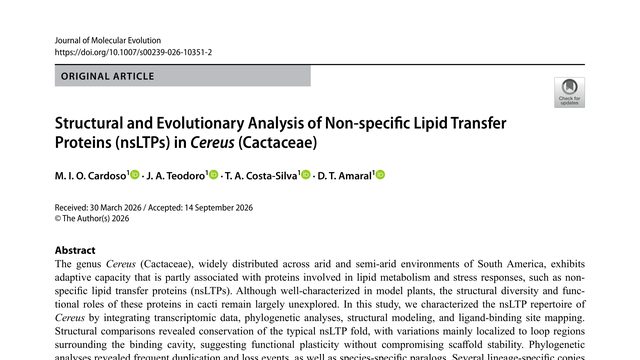
A cactus survives harsh heat and drought with proteins that may act like tiny gates: their main structure stays stable, while the entrances subtly change what can pass through.What if cactus lipid-transfer proteins keep the same sturdy molecular core, but evolve by changing the flexible “gates” around their lipid tunnel? This study finds exactly that pattern in Cereus, while carefully stopping short of claiming proven ecological adaptation.
Marcio Viana Ramos, Rayanne Farias da Silva, Cristina P. S. Carvalho, Arlete Aparecida Soares, José Francisco C. Gonçalves, Patrícia M. S. Carvalho, Pedro A. V. R. Júnior, Joao Maria Matos-Neto, Cléverson D.T. Freitas
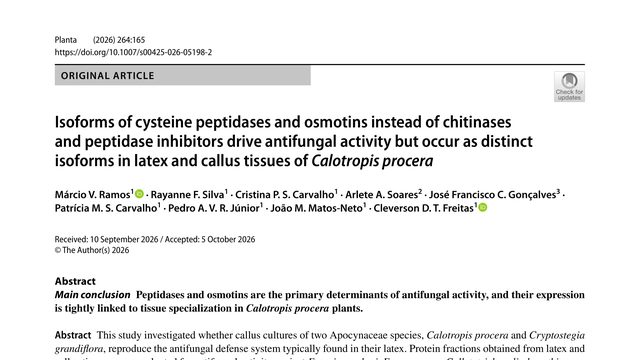
A plant's wound-sealing liquid can fight fungi, but when researchers grew plant tissue outside that liquid, the defense survived in one species and vanished in another. The surprise was not just which proteins worked, but where their versions came from.What if a plant tissue that lacks latex can still make a powerful antifungal mixture, but uses different molecular versions of the same defense proteins? That is the puzzle this study tests.
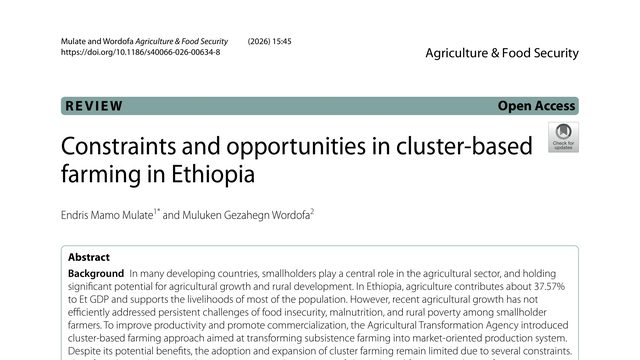
What if neighboring farmers could gain more power simply by farming side by side? In Ethiopia, bringing small plots together promises better harvests and stronger markets, but cooperation itself may be the hardest crop to grow.What if the route from subsistence farming to commercial agriculture is not a bigger farm, but neighboring smallholders working together? In Ethiopia, cluster farming promises gains across five dimensions, but the same review finds serious barriers to making it work.
 3:22