On-Chain Archaeology of Bitcoin Oracles: Evidence of Use under Limited Observability
Overview4:17CCAI
paperi.ai
0:00 / 0:00
Giulio Caldarelli
Bitcoin was already using outside information to settle valuable agreements before most people had heard of the problem. But much of that history is now missing, and the surviving record can point researchers in the wrong direction.
Before Ethereum made the “oracle problem” a household term, Bitcoin already had oracles serving as feeds, key-release services, federated signers, and arbiters that carried real value on the main chain. This study traces their use and the changing evidence of oracle activity from early days through July 2026. We combine a complete census of Counterparty betting (1,149 bets), analysis of the full Bitcoin chain through block 958,628, and searches for documented keys from Reality Keys, Orisi, Bitrated, and Oraclize in an 854-million-row public-key index. We also recover DLC oracle records from an archived explorer and live Nostr relays. Two results emerge. First, early contracts remain on-chain, but many event descriptions have disappeared, and protocol encoding and API limitations complicate access to the surviving record. However, for modern DLCs, public oracle announcements can survive even when the contracts using them cannot be identified on-chain. In the script classes examined, the share of spends that reveal no script peaks at 81.9% in 2024 after excluding spends containing inscription data. Second, public registries can give a misleading picture of oracle use. In Counterparty, 95% of pre-2018 sources declaring an oracle fee were never bet on. In Bitrated, 0.1% of archived keys appear on-chain overall, compared with 10 of 19 keys captured in 2014. Sport dominates Counterparty’s matched volume, while a daily price series dominates the archived DLC announcements. These findings show how protocol design and data preservation shape the historical record of Bitcoin oracle use. Keywords: Bitcoin, blockchain oracles, prediction markets, Counterparty, discreet log contracts, on-chain analysis
Transcript
Bitcoin was already using outside information to settle valuable agreements before most people had heard of the problem. But much of that history is now missing, and the surviving record can point researchers in the wrong direction. Before Ethereum made the “oracle problem” a household term, Bitcoin already had oracles serving as feeds, key-release services, federated signers, and arbiters that carried real value on the main chain.
Before Ethereum made the oracle problem a household term, Bitcoin already had oracles serving as feeds, key-release services, federated signers, and arbiters carrying real value on the main chain. This study traces their use and the changing evidence of oracle activity from early days through July 2026.
The study combines betting records, the Bitcoin blockchain, documented service keys, archived websites, and later public announcements and attestations. Two findings stand out. Activity depended not only on what happened, but also on the role of public keys, the information disclosed by transactions, and the external records available.
The first recorded bet was placed on 2 February 2014. It was a one-unit wager on whether Seattle won the Super Bowl. The activity was concentrated in 2014, with only 44 bets recorded after that year, and the last recorded bet appearing on 12 June 2017. The activity arrives in sharp bursts rather than a steady stream: one towering surge, a smaller cluster later in twenty fourteen, and only isolated traces afterward.
Activity was also concentrated among a small number of services. The largest individual feed accounted for 22.5 percent of matched value. Two services together accounted for 98.2 percent of matched value, showing that the visible market was dominated by a very small part of the system.
The later records came from archived announcement and event pages captured between 2019 and 2023. They produced 911 distinct announcement records. Of those records, 73.9 percent were associated with attestation records in the recovered pages, and recorded event dates were concentrated in 2021 and 2022.
But the historical trail is incomplete. Early contracts remain on-chain, while many descriptions of the events they concerned have disappeared, making the surviving record harder to interpret. For modern contracts, public announcements can survive even when the contracts using them cannot be identified on-chain.
Public registries can also give a misleading picture of use. In Counterparty, 95 percent of pre-2018 sources that declared an oracle fee were never bet on. So a published service may show that information was offered, without showing that anyone actually used it in a contract.
The findings show how contract design shapes the evidence available for measuring use. Revealed scripts and documented keys can connect transactions to particular services, while spending paths that disclose no script affect attribution.
Announcements and attestations provide a complementary record of the information published by oracles, beyond the bets and settlements visible in older systems. Interpreting the evidence requires distinguishing publication activity from the contracts that consume it, and considering how that relationship changes across implementations.
For people trying to understand Bitcoin’s economic history, attribution depends on what scripts and keys are revealed, because shared structures and undisclosed spending paths can obscure which service was involved. DLC announcements and attestations add a complementary record of what oracles published, but researchers must distinguish that publication from contracts that actually consume it.
Bitcoin’s past oracle use was real, but the chain alone cannot show the whole story. What survives depends on how contracts were built, what transactions reveal, and whether the surrounding records were preserved.
A derivative work by Paperi · AI-generated script, voice and captions
· pages and figures unaltered
Made with Paperi.
Drop in a research PDF — get a narrated video walkthrough like this one,
with highlights that follow the narration. Free to start.
Jianfei Zhao, Yifan Wang, Feng Zhang, Xin Sun, Chong Feng, Zhixing Tan, Yang Luo, Boyuan Pan, Xu Kai, Yao Hu
Most search engines decide what you mean before they show you anything. This system lets the first results help rewrite the search itself, so a vague request can become clearer while the search is happening.Most retrievers ask a query to explain itself before seeing the search results. ARR flips that sequence: it retrieves an item, learns from the feedback, and then searches again.
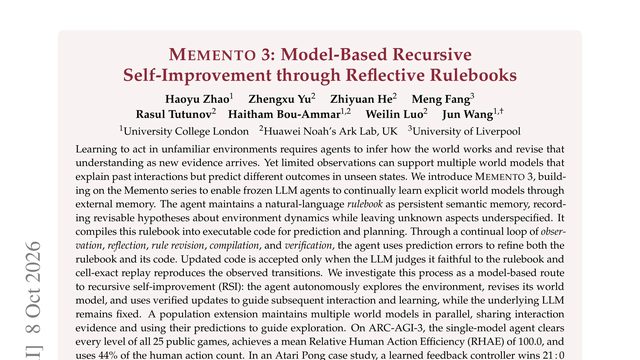
Haoyu Zhao, Zhengxu Yu, Zhiyuan He, Meng Fang, Rasul Tutunov, Haitham Bou-Ammar, Weilin Luo, Jun Wang
What if an AI could enter a world it does not understand, write down its best guess about the rules, test that guess, and steadily replace it with something better, without changing the language model underneath?What if an LLM could keep its language model completely frozen, yet still learn how an unfamiliar world works? MEMENTO 3 gives it a rulebook, turns that rulebook into code, and lets prediction errors rewrite both.
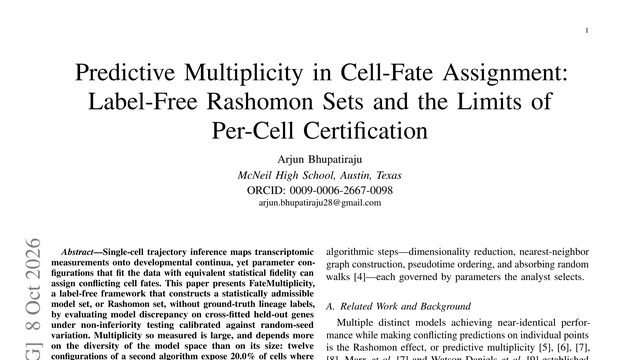
A cell can receive radically different fate confidence from models that fit the same data equally well. The unsettling part is that adding more plausible models does not necessarily make any one cell’s fate call more trustworthy.What if several cell-fate models fit the data equally well, yet disagree about individual cells? This paper finds that model multiplicity is real, and that certifying a fate across all those models can make predictions worse.
 3:32