Autoregressive Retriever: Improving Query Understanding from Item Feedback for Universal Multimodal Retrieval
Overview3:32CCAI
paperi.ai
0:00 / 0:00
Jianfei Zhao, Yifan Wang, Feng Zhang, Xin Sun, Chong Feng, Zhixing Tan, Yang Luo, Boyuan Pan, Xu Kai, Yao Hu
Most search engines decide what you mean before they show you anything. This system lets the first results help rewrite the search itself, so a vague request can become clearer while the search is happening.
Universal multimodal retrieval typically encodes a query once and ranks independently indexed items by embedding similarity. This design supports efficient search, but leaves the query representation unchanged even when retrieved items could help clarify the information need. We introduce the AutoRegressive Retriever (ARR), a multimodal retrieval model that learns both to select informative items and to use their content to refine subsequent retrieval. ARR alternates between retrieving an item and updating the query embedding, then uses the final embedding to rank the collection. Supervised fine-tuning teaches the encoder to use feedback through stepwise contrastive supervision. Reinforcement learning treats feedback items as actions and optimizes their selection using the final reciprocal rank of a relevant item. A query-side adapter enables this optimization against a fixed item index. ARR demonstrates strong retrieval performance on both in-domain and zero-shot benchmarks, outperforming the compared baselines on average. Further analyses show that feedback improves retrieval at inference time and that training with feedback also improves the initial query embedding, before any item is observed.
Transcript
Most search engines decide what you mean before they show you anything. This system lets the first results help rewrite the search itself—so a vague request can become clearer while the search is happening. People increasingly need search that can handle text, images, and combinations of the two, across services such as shopping and media platforms.
A single system maps different kinds of requests and items into a shared space, where they can be compared. The item side can be prepared in advance and reused, making large collections searchable. But this efficiency creates a problem: the search request cannot use the collection it is searching to clarify what the person meant.
A request may leave out important details or mix clues whose importance is unclear. Its meaning must be settled before any possible matches are seen, so the request stays fixed instead of adapting to what turns up. The paper calls this missing ability to adapt to the candidates the query–item gap.
The AutoRegressive Retriever, or ARR, handles this like checking a travel plan with a helpful friend: read the request, look at one possible answer, then use that answer to sharpen the next search. At each step, ARR retrieves an item, adds its text and images to the running context, and creates an updated search representation for the next step.
The final representation ranks the collection, while the items themselves remain prepared for independent searching as before. Training teaches the encoder to use retrieved content while preserving the original query intent. The training stage uses a feedback pool prepared in advance, avoiding repeated searches through the full collection while the system is learning.
In the reported test, ARR-RL achieves the highest average score among the compared methods at both model scales. At the larger scale, ARR-RL exceeds the strongest comparison system’s average, TRACE’s fifty-eight point eight, by two point two points in the reported comparison.
The results show that feedback use must be learned: simply appending retrieved content can harm a model that was not trained to use it. By contrast, the version trained with four feedback steps improves from its initial state to its extended state. Most of that gain appears after the first feedback item, with smaller changes afterward.
Without task-specific fine-tuning, ARR-RL obtains the highest reported average compared with the strongest baseline average. Its results also indicate transfer to dialogue and interactive retrieval, suggesting that the same feedback-driven search can help across different kinds of conversations and search tasks.
ARR learns to select and use retrieved items as feedback while preserving independently indexed items, so the collection can still be searched through the usual interface. The experiments show better average performance both on familiar retrieval settings and on settings the system was not specially tuned for.
For a person searching with an incomplete description, the practical promise is twofold: early results can improve later results, and learning from feedback can also make the very first search better before any feedback appears. The central lesson is that search can improve when it learns from the items it finds, not just from the words or images in the original request.
That can make mixed text-and-image search more useful when intent is incomplete or unclear.
A derivative work by Paperi · AI-generated script, voice and captions
· pages and figures unaltered
Made with Paperi.
Drop in a research PDF — get a narrated video walkthrough like this one,
with highlights that follow the narration. Free to start.
Haoyu Zhao, Zhengxu Yu, Zhiyuan He, Meng Fang, Rasul Tutunov, Haitham Bou-Ammar, Weilin Luo, Jun Wang
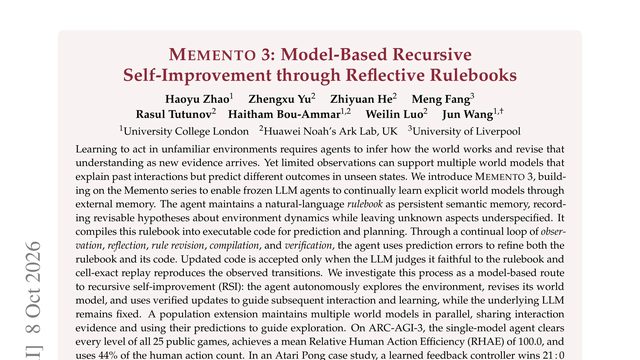
What if an AI could enter a world it does not understand, write down its best guess about the rules, test that guess, and steadily replace it with something better, without changing the language model underneath?What if an LLM could keep its language model completely frozen, yet still learn how an unfamiliar world works? MEMENTO 3 gives it a rulebook, turns that rulebook into code, and lets prediction errors rewrite both.
A cell can receive radically different fate confidence from models that fit the same data equally well. The unsettling part is that adding more plausible models does not necessarily make any one cell’s fate call more trustworthy.What if several cell-fate models fit the data equally well, yet disagree about individual cells? This paper finds that model multiplicity is real, and that certifying a fate across all those models can make predictions worse.
Teaching a computer to find the exact object described in a sentence usually demands vast amounts of carefully labeled pictures. This paper shows how carefully made artificial examples can help when those pictures are scarce.What if the safest way to generate a labeled object image is not to redraw the object at all? This paper paints outside the box, then filters the synthetic examples before training.
 3:59