Energy

5 open-access papers in Energy, free to watch.

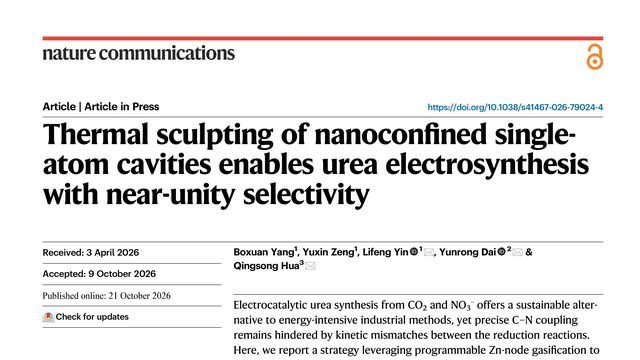
Thermal sculpting of nanoconfined single-atom cavities enables urea electrosynthesis with near-unity selectivity 4:26

Thermal sculpting of nanoconfined single-atom cavities enables urea electrosynthesis with near-unity selectivity

Fertilizer production helps feed nearly half the world, but it consumes huge amounts of energy and creates carbon dioxide. This study turns waste gases and wastewater into fertilizer inside a space far smaller than a human hair is wide.

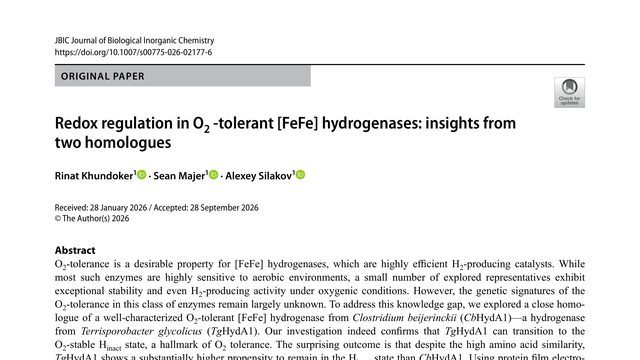
Redox regulation in O2 -tolerant [FeFe] hydrogenases: insights from two homologues 4:33

Redox regulation in O2 -tolerant [FeFe] hydrogenases: insights from two homologues

Most hydrogen-making enzymes fail when they meet air. But two nearly matching versions of one enzyme behave very differently: one recovers quickly, while the other gets stuck in a protected inactive state.

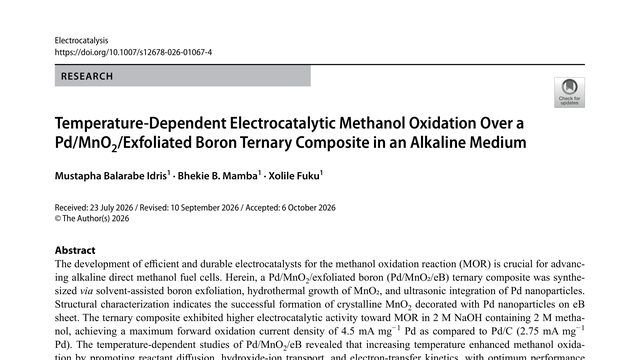
Temperature-Dependent Electrocatalytic Methanol Oxidation Over a Pd/MnO2/Exfoliated Boron Ternary Composite in an Alkaline Medium 4:16

Temperature-Dependent Electrocatalytic Methanol Oxidation Over a Pd/MnO2/Exfoliated Boron Ternary Composite in an Alkaline Medium

A fuel cell may run on methanol, but its most expensive working surface can become clogged by leftover carbon. This study combines three materials so each one handles a different part of the problem.

A robust multi-objective optimization algorithm for accurate parameter estimation for solar cell models 3:41

A robust multi-objective optimization algorithm for accurate parameter estimation for solar cell models

A solar panel can be physically perfect yet mathematically misunderstood. This study finds a way to estimate the hidden numbers inside a panel more accurately, helping models predict how much power it can produce.

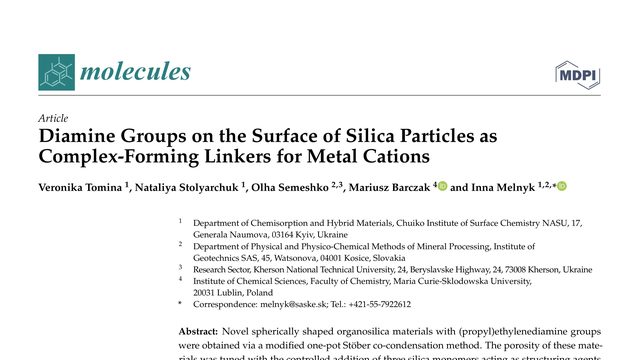
Diamine Groups on the Surface of Silica Particles as Complex-Forming Linkers for Metal Cations 4:14

Diamine Groups on the Surface of Silica Particles as Complex-Forming Linkers for Metal Cations

Cleaning industrial water is not only about removing toxic metals. It can also recover valuable metals for reuse. This study finds that a particle with more metal-catching groups is not always the better catcher.