Cognitive load and prefrontal neuromodulation shape exploration, risk-taking, and information seeking in experience-based decision making
Overview3:54CCAI
paperi.ai
0:00 / 0:00
Ankit Singh, Varun Dutt, Akash K Rao
Everyday choices ask us to balance a safe option against a tempting gamble, and sometimes to pay for more information. This study finds that mental busyness and mild brain stimulation can shift those choices in different ways.
Experience-based decision making requires individuals to balance exploration and exploitation under uncertainty, a balance that may be influenced by cognitive demands and prefrontal neuromodulation. We examined the joint effects of triviabased cognitive load and anodal transcranial direct current stimulation (tDCS) over the left dorsolateral prefrontal cortex (DLPFC) in 60 healthy adults. The primary 2 × 2 between-subjects design crossed Stimulation (anodal tDCS vs sham) with CognitiveLoad Condition (Trivia-Based Load vs No-Trivia Control). Within the Trivia-Based Load subgroup, Lower-Load and Higher-Load Trivia were presented across trials for a secondary trial-level analysis. Participants completed 50 decisions involving a safe choice, a probabilistic high-reward choice, and a costly information-seeking choice. Primary analyses showed that Trivia-Based Load slowed responses and reduced risky choice. Anodal tDCS increased risky choice, information seeking, and alternation between choice types, but did not significantly affect reaction time. Stimulation × Cognitive-Load Condition interactions were significant for information seeking and alternation, reflecting different load-related patterns under anodal tDCS and sham, whereas interactions were not significant for reaction time or risky choice. Secondary analyses indicated longer decision times following Higher-Load than Lower-Load Trivia, without corresponding trial-level load effects on the choice outcomes. These findings show that cognitive load and anodal DLPFC tDCS have outcome-specific joint effects on experience-based decision making, including both additive and context-dependent patterns.
Transcript
Everyday choices ask us to balance a safe option against a tempting gamble—and sometimes to pay for more information. This study finds that mental busyness and mild brain stimulation can shift those choices in different ways. Human decision making in uncertain environments requires a continuous balance between exploring new alternatives and exploiting familiar options that have yielded favorable outcomes in the past.
In ordinary life, it is like choosing whether to keep ordering the meal you already know you like or try something unfamiliar that might be better. Previous studies have generally examined cognitive load and prefrontal stimulation separately.
Consequently, it remains unclear whether concurrent cognitive demand and stimulation produce broadly additive effects or whether the effect of stimulation changes when decision making is performed under additional cognitive demand. The study addressed this question with repeated choices between safe, risky, and information-seeking alternatives.
The experiment compared stimulation with sham stimulation, and trivia-based mental demand with no-trivia control. Within the trivia condition, lower-load and higher-load trivia were presented across trials. The study examined response time, risky choice, information seeking, and switching between choice types as distinct signs of decision behavior under uncertainty.
In the no-trivia control condition, the trial began directly with the decision screen. The figure illustrates the task sequence, including the decision screen and outcome feedback, while the control condition began directly with that decision screen.
The sequence makes the added mental burden visible: a knowledge question and correction come before the choice, followed by the decision and its consequence, while the participant performs it at a computer. Cognitive load affected response time and risky choice, while stimulation affected risky choice, information seeking, and switching between choice types.
The combination was not the same across outcomes: the interaction between stimulation and cognitive load appeared for information seeking and switching, but not for response time or risky choice. The findings therefore did not support one uniform additive pattern across all outcomes.
Information seeking was higher overall under stimulation than under sham stimulation. The overall effect of cognitive-load condition was not significant, but the interaction between stimulation and cognitive load was significant.
The means showed a crossover pattern: under sham stimulation, information seeking was lower with trivia-based load than with no-trivia control. Trial-level cognitive load primarily influenced response time, while risky choice, information seeking, and switching were largely unaffected.
There was no evidence that trial-level cognitive load systematically modified the behavioral effects of stimulation. Concurrent trivia slowed responses and reduced risky choice, while stimulation was associated with greater risky choice, information seeking, and exploratory switching.
The joint pattern was not uniform: response time and risky choice showed no significant interaction, whereas information seeking and switching showed significant crossover interactions. For someone making decisions under uncertainty, this means mental demand and stimulation may change different parts of behavior rather than simply making every choice more cautious or more daring.
A crowded mind does not change every decision in the same way. Cognitive demand slowed choices and reduced risk, while stimulation increased risk, information seeking, and switching—but the combination depended on the kind of choice.
A derivative work by Paperi · AI-generated script, voice and captions
· pages and figures unaltered
Made with Paperi.
Drop in a research PDF — get a narrated video walkthrough like this one,
with highlights that follow the narration. Free to start.
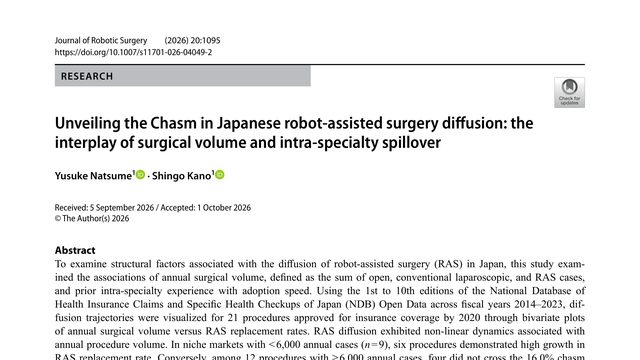
Robotic surgery is spreading, but not like a wave reaching every hospital. Some operations catch on quickly, while others stall at a narrow gap, and the size of the surgical market helps explain why.Robot-assisted surgery is spreading quickly, but not in a straight line. In Japan, some low-volume procedures accelerate, while several larger markets remain stuck below a sixteen-percent adoption boundary.
A stormy patch of water can make bubbles in two very different ways: surfactants may leave the larger bubbles untouched while creating up to five times as many tiny ones. The key is not just what the surfactant is, but how fast it arrives.A little chemistry can multiply the number of tiny bubbles produced when turbulence tears apart a large air cavity. But the surprise is that surface tension alone does not explain it: the surfactant's adsorption speed matters.
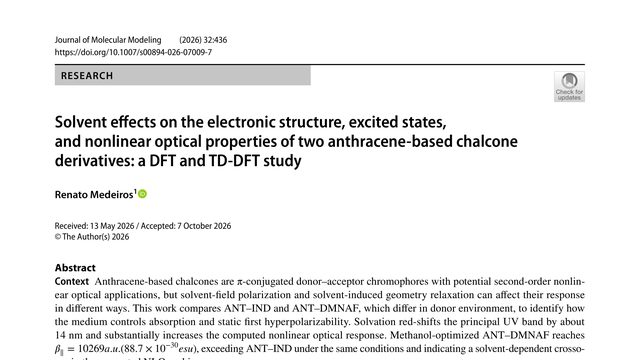
What if the liquid around a molecule could change not just how it absorbs light, but which of two molecules appears more powerful? This study finds that the answer can switch with the solvent.What happens when the same light-responsive molecule is placed in different solvents? In these anthracene-based chalcones, the solvent does more than shift an absorption peak, it can reverse which molecule has the stronger computed nonlinear optical response.
 4:18