Unlocking the Regulatory Genome by ARGUS: An Evidence-Constrained Agentic Framework for Interpreting Single Nucleotide Variants
Overview3:46CCAI
paperi.ai
0:00 / 0:00
Pratik Dutta, Matthew B. Obusan, Max Chao, Rekha Sathian, Nimisha Papineni, Ramana V. Davuluri
Most disease-linked changes in DNA sit outside genes, where their effects are hard to read. An AI can sound confident about them, and still invent the evidence, so this system is designed to stop and say when the evidence is not enough.
Over 90% of disease-associated variants from genome-wide association studies fall in noncoding regulatory regions, yet their functional interpretation remains a central open problem in genomic medicine. Large language models prompted to interpret such variants routinely hallucinate transcription factor (TF) binding changes, fabricate experimental support, and assign biological significance to statistically negligible signals. We present ARGUS (Agentic Regulatory Genomics for an Uncertainty-aware Scientist), which strictly separates deterministic biological computation from LLM-mediated reasoning. ARGUS wraps 458 DNABERT-based TF binding models in a hypothesis-directed investigation loop where a planner selects evidence sources based on current uncertainty, a verifier deterministically interprets each observation, and intermediate results change the investigation path. On variant rs6983267 at the 8q24 cancer risk locus, the same planner produces four divergent trajectories for four TFs. FOXA1 is rescued in 3 steps when real ADASTRA allele-specific binding data (15 experiments, FDR = 0.030) reveals a model false negative masked by saturation (both alleles predicted at near-maximal binding, leaving the model unable to resolve allelic differences). KLF6 traverses 8 steps across ADASTRA, JASPAR motif analysis, and ENCODE cCRE regulatory annotation before abstaining due to mixed indirect evidence. RAD21 abstains in 8 steps after ADASTRA returns a powered but nonsignificant allelic test (5 experiments, FDR = 0.65), and SP1, which shares FOXA1’s saturated retained prediction, abstains because no direct experimental evidence exists at this locus. All trajectories are produced from real data against local ADASTRA, JASPAR, and ENCODE cCRE evidence sources, with no simulated observations. A comparison of fixed-priority and LLM-mediated planning shows that the LLM planner reaches identical verdicts with fewer tool calls by declining evidence that cannot resolve the claim under test.
Transcript
Most disease-linked changes in DNA sit outside genes, where their effects are hard to read. An AI can sound confident about them—and still invent the evidence, so this system is designed to stop and say when the evidence is not enough.
More than 90 percent of disease-associated variants fall in regulatory regions outside genes, yet interpreting what they do remains a central problem in genomic medicine. Large language models can hallucinate changes in DNA-binding proteins, fabricate experimental support, and assign importance to signals that are statistically negligible.
ARGUS separates biological computation from language-model reasoning, then lets a planner choose evidence sources according to the uncertainty that remains. The central rule is simple: auditable, rule-based code classifies the biological evidence, while the language model may choose the next investigation or write the report, but cannot assign the verdict.
This works like a careful detective: each observation changes what ARGUS does next, rather than sending it through a fixed checklist. ARGUS has two stages: one makes deterministic predictions, and the other subjects each prediction to evidence-based scrutiny. So the system does not treat its first prediction as the answer; it opens an investigation around that prediction.
The system was evaluated on one variant at a cancer-risk region, with four DNA-binding proteins investigated from the same starting point. Every observation came from real local database queries; none of the results were simulated. For one protein, both DNA versions received nearly maximal predicted binding, triggering a saturation warning: the prediction could not distinguish the two versions.
The planner therefore checked experimental evidence, which found significant allele-specific binding and contradicted the model’s prediction that there was no difference. ARGUS called this a rescued case—a possible model false negative—and stopped once the evidence settled the hypothesis.
The same planner produced structurally different investigation paths because the intermediate observations differed, even though the starting variant and available tools were the same. One case resolved with a single tool call, while another required all three tools because the evidence stayed incomplete: one source had no data, another contradicted the claim, and a third offered only partial support.
The important point is that each next decision depended on the previous verdict, not on a predetermined sequence. The evaluation shows how the system behaves and how its investigation paths diverge, but it is not a predictive-accuracy benchmark or a controlled measurement of reduced hallucination.
The starting predictions were precomputed, and the investigation loop was not evaluated as a complete system that turns natural language directly into biological conclusions. ARGUS shows that using a language model for biological interpretation does not inevitably require accepting hallucinated conclusions.
Because each verdict is separated from the language model’s reasoning and tied to a specific observation, the conclusions are actively tested rather than merely plausible. For someone facing an uncertain genetic clue, that means a clearer record of what the evidence supports—and where it still does not.
ARGUS makes an AI investigate one claim at a time, changing course when each piece of evidence demands it. That can make genetic clues more traceable and help prevent uncertain interpretations from being mistaken for medical facts.
A derivative work by Paperi · AI-generated script, voice and captions
· pages and figures unaltered
Made with Paperi.
Drop in a research PDF — get a narrated video walkthrough like this one,
with highlights that follow the narration. Free to start.
Mhd Hussein Murtada, Z. Faidon Brotzakis, Michele Vendruscolo
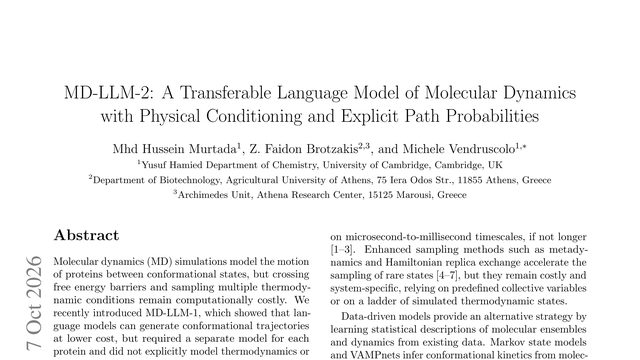
Proteins are constantly changing shape, but watching every tiny movement can take far longer than the movement itself. This study asks whether a language model can learn those motions and predict what happens under new physical conditions.What if molecular dynamics could be treated like language: structures become tokens, trajectories become sentences, and every generated path comes with an explicit probability? This paper tests that idea across proteins, temperatures, and force-field conditions.
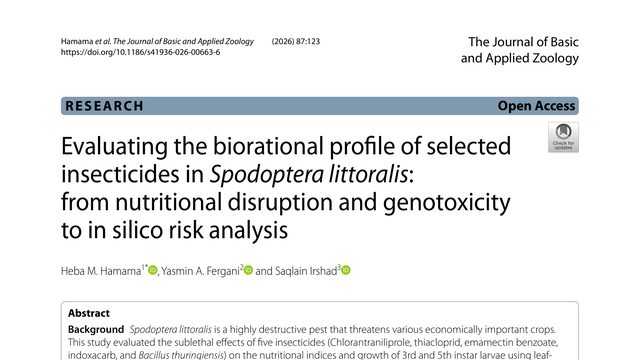
A pesticide can stop a caterpillar from eating, yet the more important warning may appear inside its cells. This study compares both effects instead of treating pest control as a single yes-or-no question.What if an insecticide can stop a crop pest from eating, yet another one leaves the strongest signal of DNA damage? This study compares both effects instead of treating pest control as a single question.
Jazzmin L. Hembree, William A. Abplanalp, John W. Elrod, Paul T. Pfluger
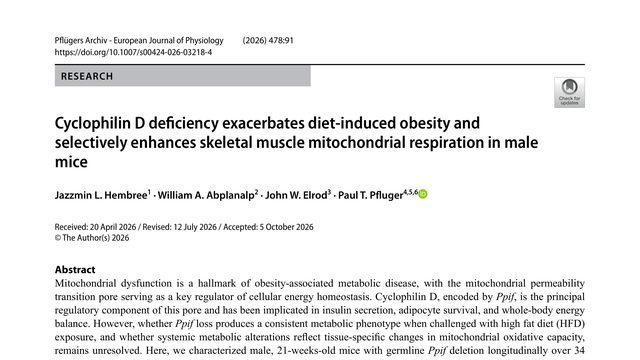
What if making one part of the body’s energy machinery work harder did not prevent weight gain, but actually came with more body fat? In male mice, that is exactly the puzzle this study found.Here is the surprising twist: deleting cyclophilin D made male mice more vulnerable to diet-induced obesity, yet it also increased ADP-stimulated mitochondrial respiration specifically in skeletal muscle.
 4:22