Probing flavour deconstruction via primordial gravitational waves
Overview5:19CCAI
paperi.ai
0:00 / 0:00
Noemi Fabri, Gino Isidori, Davide Racco
A faint ripple from the early Universe could reveal particles that no collider can reach. But this study finds the signal may be hiding at a higher pitch than the detector many people are counting on.
We study the production of primordial gravitational waves (GWs) from first-order phase transitions (FOPTs) in extensions of the Standard Model based on Flavour Deconstruction (FD). The link fields inherent to FD generically form a rich scalar sector, with sizeable couplings at the TeV scale, providing natural conditions for strong FOPTs and correspondingly large GW emission. We identify the key parameters controlling the GW spectrum and enabling its detection at future GW observatories. In particular, we find that while FD scenarios can yield detectable signals, the resulting spectra typically peak at higher frequencies than the millihertz range. As a consequence, a positive observation at LISA is possible but not guaranteed, while the signal falls in the range of mid-band proposals, making FD models an intriguing target for upcoming GW searches.
Transcript
A faint ripple from the early Universe could reveal particles that no collider can reach. But this study finds the signal may be hiding at a higher pitch than the detector many people are counting on. Primordial gravitational waves provide a unique window into the early Universe.
Waves made during a rapid change in the early cosmos can carry indirect information about particles and interactions beyond the Standard Model, at energies far beyond those reached by colliders. A new generation of gravitational-wave observatories is expected in the next decade.
One especially important mission is designed to explore the millihertz range, where signals from phase changes around the TeV scale are expected to lie. The study examines gravitational waves from first-order phase transitions in extensions of the Standard Model based on flavour deconstruction.
Its link fields form a rich scalar sector with sizable TeV-scale couplings, supporting strong transitions and large emission. The key question is whether those signals can be detected. The study finds that they can, but their spectra usually peak above the millihertz range.
That creates the central tension: detection by LISA is possible but not guaranteed, while the signal may instead fall within the range planned for mid-band observatories. Here is the core idea. The transition is generated when a set of scalar fields acquires a nonzero background value, changing the symmetry of the theory.
It is like a building whose rooms are rearranged when movable walls lock into place. In these models, the transition is the last step in a chain leading from a completely flavour-non-universal gauge group in the ultraviolet to the Standard Model.
The setup represents a generic benchmark for a broad class of flavour-deconstruction models, with many broken generators around the TeV scale. The study maps regions of the parameter space where the gravitational-wave background from the phase transition could be detectable, with lambda denoting the effective quartic coupling controlling the transition.
So the search is not about every possible detail separately. It focuses on the regions where these two combined ingredients make the cosmic transition strong enough to leave an observable trace. The map shows that a sizeable signal at LISA requires force strengths around unity and relatively small scalar self-interactions.
Those are the conditions under which the predicted signal becomes strong enough to stand out. In most of the region producing a strong transition, quantum corrections contribute more to the scalar interaction than the direct, tree-level contribution.
That competition helps create the stronger transition. When the transition happens at a much higher energy scale, the peak frequency moves into the sensitivity window of future ground-based interferometers. In that regime, the prospects for detection are promising.
At higher transition scales, the peak frequency can fall within the sensitivity window of third-generation ground-based interferometers such as ET and CE. The predicted signals form broad, bell-shaped humps, while the shaded sensitivity regions reveal how each energy scale lines up with different future detectors.
The higher-frequency detection prospects are promising, although the corresponding ways of building the model carry greater theoretical uncertainties. That result is consistent with earlier findings. The study finds that an observable signal is less likely in the case involving a single Abelian force.
Even so, observable regions exist for both Abelian and non-Abelian forces. That creates a serious limit: if a signal were detected, gravitational-wave data alone might not reveal which underlying theory produced it.
The models offer another route to an answer. Because they place the transition around the TeV scale, colliders could provide complementary evidence through direct searches and precision measurements. Across these models, the strength of the transition is controlled mainly by two effective combinations: one built from scalar self-interactions and one from force strengths.
Large gravitational-wave signals appear where quantum corrections controlled by the force strengths compete with direct contributions controlled by the scalar interaction. The matching between force strengths also matters, especially for transitions around the TeV scale.
A gravitational-wave signal alone may not identify the underlying theory, because both Abelian and non-Abelian scenarios can produce observable signals. Collider searches and precision measurements could provide complementary evidence.
The models make that comparison possible because they predict a transition around the TeV scale, where colliders can search for complementary evidence. These models can create detectable primordial gravitational waves, but their strongest signals usually sit above the millihertz range.
Future searches may need more than one kind of detector—and a detection alone may not identify the underlying theory.
A derivative work by Paperi · AI-generated script, voice and captions
· pages and figures unaltered
Made with Paperi.
Drop in a research PDF — get a narrated video walkthrough like this one,
with highlights that follow the narration. Free to start.
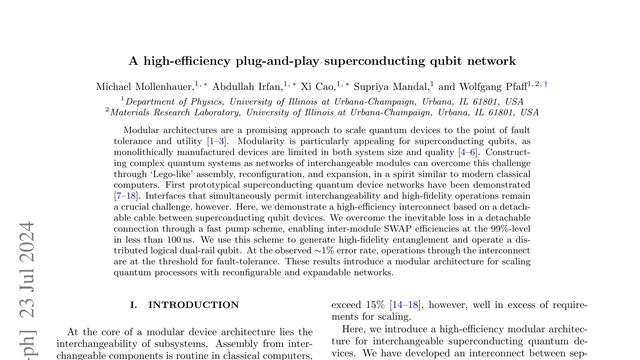
Michael Mollenhauer, Abdullah Irfan, Xi Cao, Supriya Mandal, Wolfgang Pfaff
What if a quantum computer did not have to be built as one giant, delicate object? This experiment shows that separate quantum devices can be connected by a cable, unplugged, and still exchange information with about one percent loss.What if scaling a quantum computer looked less like fabricating one enormous chip, and more like plugging together replaceable modules? This paper shows a detachable cable moving quantum information with roughly one-percent loss in under one hundred nanoseconds.
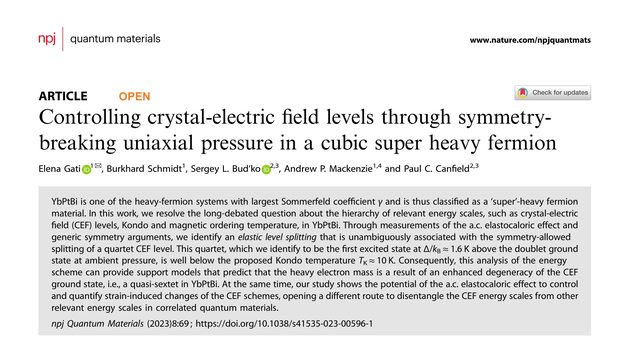
Elena Gati, Burkhard Schmidt, Sergey L. Bud’ko, A. P. Mackenzie, P. C. Canfield
A tiny squeeze can reveal which hidden quantum states are making electrons behave as if they are enormously heavy. In this crystal, that pressure exposes a six-state secret.A tiny squeeze reveals that YbPtBi may effectively behave as though six crystal-field states are available to its electrons. The surprising part is that the key excited quartet sits below the Kondo scale.
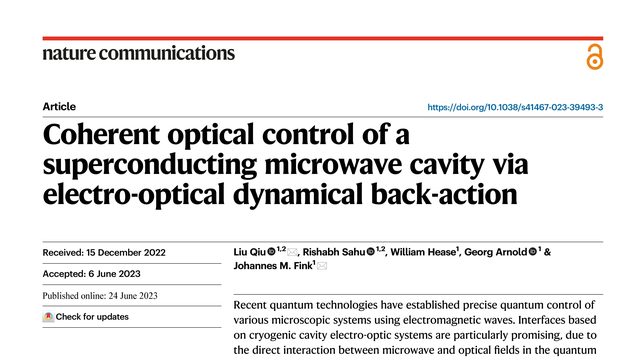
Liu Qiu, Rishabh Sahu, William Hease, Georg Arnold, J. M. Fink
A laser pulse can now steer a superconducting microwave cavity, even though light and microwaves normally barely affect each other. The surprising part is how little unwanted disturbance comes along for the ride.A laser pulse can reshape the behavior of a superconducting microwave cavity, even though optical photons carry far more energy than microwave photons. This experiment shows that the control can remain remarkably coherent at millikelvin temperatures.
 3:33