Controlling crystal-electric field levels through symmetry-breaking uniaxial pressure in a cubic super heavy fermion
In depth8:30CCAI
paperi.ai
0:00 / 0:00
Elena Gati, Burkhard Schmidt, Sergey L. Bud’ko, A. P. Mackenzie, P. C. Canfield
A tiny squeeze reveals that YbPtBi may effectively behave as though six crystal-field states are available to its electrons. The surprising part is that the key excited quartet sits below the Kondo scale.
YbPtBi is one of the heavy-fermion systems with largest Sommerfeld coefficient γ and is thus classified as a ‘super’-heavy fermion material. In this work, we resolve the long-debated question about the hierarchy of relevant energy scales, such as crystal-electric field (CEF) levels, Kondo and magnetic ordering temperature, in YbPtBi. Through measurements of the a.c. elastocaloric effect and generic symmetry arguments, we identify an elastic level splitting that is unambiguously associated with the symmetry-allowed splitting of a quartet CEF level. This quartet, which we identify to be the first excited state at Δ/kB ≈1.6 K above the doublet ground state at ambient pressure, is well below the proposed Kondo temperature TK ≈10 K. Consequently, this analysis of the energy scheme can provide support models that predict that the heavy electron mass is a result of an enhanced degeneracy of the CEF ground state, i.e., a quasi-sextet in YbPtBi. At the same time, our study shows the potential of the a.c. elastocaloric effect to control and quantify strain-induced changes of the CEF schemes, opening a different route to disentangle the CEF energy scales from other relevant energy scales in correlated quantum materials.
Transcript
A tiny squeeze reveals that YbPtBi may effectively behave as though six crystal-field states are available to its electrons. The surprising part is that the key excited quartet sits below the Kondo scale. YbPtBi is one of the heavy-fermion systems with largest Sommerfeld coefficient gamma and is thus classified as a super-heavy fermion material.
The central problem is the long-debated hierarchy of relevant energy scales, including crystal-electric-field levels, the Kondo scale, and the magnetic ordering temperature. Measurements of the a.c. elastocaloric effect and generic symmetry arguments identify an elastic level splitting associated with the symmetry-allowed splitting of a quartet crystal-electric-field level.
That quartet is identified as the first excited state, about one point six kelvin above the doublet ground state at ambient pressure, and well below the proposed Kondo temperature of about ten kelvin. The analysis also shows the potential of the a.c. elastocaloric effect to control and quantify strain-induced changes of crystal-electric-field schemes.
The hierarchy of energy scales becomes accessible through thermodynamic measurements of the elastocaloric effect under well-controlled, symmetry-breaking, uniaxial pressure. Unlike magnetic field, which breaks time-reversal symmetry and affects all Kramers-degenerate states, lattice strain can only lift degeneracies stabilized by crystallographic symmetries.
This elastic level splitting lets uniaxial pressure sensitively probe the single-ion physics associated with the Gamma eight state. The result is a separation between thermodynamic features from crystal-electric-field excitations and energy scales attributed to the Kondo scale.
Overall, the analysis places super-heavy YbPtBi in the limit where the Kondo temperature is greater than the first crystal-electric-field excitation temperature, supporting a quasi-sextet crystal-electric-field ground state. The a.c.
technique applies an oscillation with strain amplitude delta epsilon in a piezo-driven uniaxial pressure cell and measures the resulting temperature change delta T with a thermocouple. A capacitive displacement sensor determines delta epsilon, while a constant finite strain can be superimposed so delta T over delta epsilon can be mapped as a function of strain.
For YbPtBi, uniaxial pressure is applied along the crystallographic one-zero-zero direction, producing a finite strain. The pressure cell includes a force sensor because applied pressure is a better control parameter than conjugated strain in these devices. The free-standing sample carrier allows only compression, marked by a negative pressure, and makes the neutral point at zero pressure and zero strain precise at each temperature.
Figure one maps the ambient-pressure thermodynamics of YbPtBi across its proposed energy scales, including magnetic ordering, Kondo behavior, and crystal-electric-field levels. The setup schematic shows a thermocouple-equipped sample compressed uniaxially, while the data compare specific heat, thermal expansion, and the elastocaloric temperature change.
The shared highlighted temperature range emphasizes how these measurements capture related entropy changes and help identify the material’s underlying energy scales. Under finite, symmetry-breaking uniaxial pressure, the experiments apply compression as high as about minus one point eight gigapascals.
The temperature-dependent and pressure-dependent data reveal significant changes in the absolute value of the elastocaloric temperature change. As the absolute pressure increases, a low-temperature extremum emerges at about two point seven kelvin for pressure near minus zero point three gigapascals, and it increases to four point zero kelvin.
Figure two shows the elastocaloric temperature amplitude of YbPtBi under compressive, symmetry-breaking uniaxial pressure. In panel a, increasing the magnitude of pressure produces a low-temperature extremum near Text, about two point seven kelvin, while the feature near T-star, about seven point six kelvin, remains visible with little positional shift.
Panel b shows how the amplitude varies with pressure at fixed temperatures, motivating the authors’ conclusion that strain-induced splitting of the excited Gamma-eight crystal-field quartet dominates the effect. The elastocaloric data contain contributions from all relevant energy scales, particularly the crystal-electric-field and Kondo energy scales.
Generic qualitative arguments and explicit modeling of the elastocaloric effect of single-ion crystal-electric-field states are used to disentangle those contributions. The strong pressure-driven temperature change is attributed to the response of the first excited quartet crystal-electric-field level to symmetry breaking.
By contrast, the zero-pressure behavior, including the anomaly at T star, most likely originates from formation of the coherent Kondo state. Figure three models how strain changes the crystal-field levels in YbPtBi and, in turn, the elastocaloric response, delta T over delta epsilon.
Panel a contrasts a simple level shift with strain-induced splitting: the splitting scenario predicts a response that starts near zero at zero strain and grows with either tension or compression. Panel b supplies the model specific heat and strain dependence, while panel c compares experiment with two calculations; using delta CEF over kB equal to one point six kelvin and beta two equal to one thousand seven hundred fifty, model two reproduces much of the experimental response across the strain range.
Figure three c compares the experimental data for delta T over delta epsilon with calculations from model one and model two. Both models use a zero-strain crystal-electric-field energy difference divided by the Boltzmann constant of one point six kelvin and beta one equal to seventy.
Because the lowest experimental temperature is about one point two kelvin, the calculations are restricted to that temperature range. The model results therefore reflect effects associated with the higher-energy branch. The assigned hierarchy is that the second crystal-electric-field excitation temperature is greater than T star, which is greater than the first crystal-electric-field excitation temperature.
This opens the possibility that conduction electrons hybridize not only with the Yb three-plus Gamma seven doublet ground state, but also with the first excited Gamma eight quartet. Effectively, that hybridization takes place with an Yb quasi-sextet, with N equal to six.
The study also notes that the hybridization strength can depend on the symmetry of the underlying crystal-electric-field level, an aspect rarely considered so far. YbPtBi may therefore be an interesting reference system for quantifying symmetry-dependent hybridization strength.
The measurements and analyses of the elastocaloric effect establish the crystal-electric-field levels and the hierarchy of energy scales in super-heavy YbPtBi. The energy difference between the ground state and first excited quartet is about the Boltzmann constant times one point six kelvin, significantly smaller than the proposed Kondo scale of about the Boltzmann constant times ten kelvin.
Both the Gamma seven ground-state doublet and the Gamma eight quartet therefore lie below the Kondo scale. This allows conduction electrons to hybridize with a quasi-sextet Yb three-plus ground state and supports models that connect the anomalously large electron mass with enhanced crystal-electric-field degeneracy.
Symmetry-breaking uniaxial pressure separates crystal-electric-field effects from Kondo physics, placing the first excited quartet near one point six kelvin and supporting a quasi-sextet ground-state picture for YbPtBi.
A derivative work by Paperi · AI-generated script, voice and captions
· pages and figures unaltered
Made with Paperi.
Drop in a research PDF — get a narrated video walkthrough like this one,
with highlights that follow the narration. Free to start.
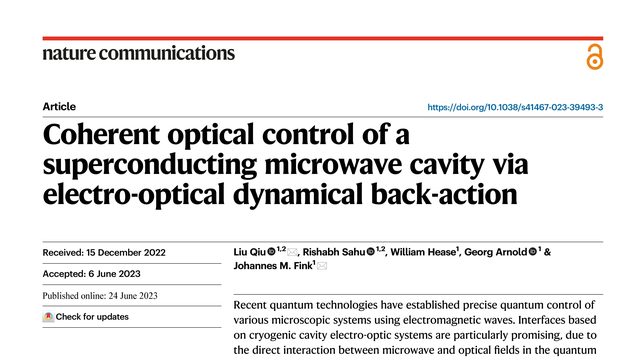
Liu Qiu, Rishabh Sahu, William Hease, Georg Arnold, J. M. Fink
A laser pulse can now steer a superconducting microwave cavity, even though light and microwaves normally barely affect each other. The surprising part is how little unwanted disturbance comes along for the ride.A laser pulse can reshape the behavior of a superconducting microwave cavity, even though optical photons carry far more energy than microwave photons. This experiment shows that the control can remain remarkably coherent at millikelvin temperatures.
Kazuki Fujio, Ali Al-Adili, Fredrik Nordström, Jean-François Lemaître, Shin Okumura, Satoshi Chiba, A. J. Koning
When uranium splits, the story is not over. The two pieces are born hot and unstable, then shed neutrons and light as they settle down, and predicting that aftermath matters for reactors, medicine, and nuclear waste.A single uranium fission event produces far more than two fragments: it launches a chain of neutron and gamma-ray emissions whose details matter for reactors, medicine, and nuclear astrophysics. This paper makes TALYS follow that chain fragment by fragment.
Xiaoli Chen, Beatrice W. Soh, Zi‐En Ooi, Eléonore Vissol-Gaudin, Haijun Yu, Kostya S. Novoselov, Kedar Hippalgaonkar, Qianxiao Li
A molecule can look ready to stretch, yet take a very different path from another molecule that looks identical. This study teaches artificial intelligence to uncover the hidden information that explains why.What if a neural network could turn hundreds of microscopic degrees of freedom into just three meaningful thermodynamic coordinates, and then use them to explain why some polymers stretch quickly while others get stuck?
 3:50