Terahertz field-induced giant symmetry modulations in a van der Waals antiferromagnet
In depth10:31CCAI
paperi.ai
0:00 / 0:00
Sheikh Rubaiat Ul Haque, Martin J. Cross, Sangeeta Rajpurohit, Jonah B. Haber, Christopher J. Ciccarino, Alexandra C. Zimmerman, Isabelle J. Sealey, V. A. Kulichenko, Monique Tie, Huaiyu Hugo Wang, Sharon S. Philip, Choongwon Seo, J. D. Koralek, Luis Balicas, Mykhaylo Ozerov, Dmitry S. Smirnov, Liang Zheng Tan, Felipe H. da Jornada, Tadashi Ogitsu, Matthias C. Hoffmann, Tony F. Heinz, Aaron M. Lindenberg
What if a burst of terahertz light could make a quantum magnet oscillate so strongly that its symmetry visibly breaks? In MnPS3, that is exactly the behavior these measurements reveal.
Strong-field terahertz (THz) excitations enable dynamic control over electronic, lattice and symmetry degrees of freedom in quantum materials. Here, we uncover pronounced terahertz-induced symmetry modulations and coherent phonon dynamics in the van der Waals antiferromagnet MnPS3, in which inversion symmetry is broken by its antiferromagnetic spin configuration. Our time-resolved second harmonic generation measurements reveal long-lived giant oscillations in the antiferromagnetic phase, with amplitudes comparable to the equilibrium signal, driven by phonons involving percent-level atomic displacements relative to the equilibrium bond lengths. The temporal evolution of the rotational anisotropy patterns indicates a dynamic breaking of mirror symmetry, modulated by two vibrational modes at 1.7 THz and 4.5 THz, with the former corresponding to a hidden mode not observed in equilibrium spectroscopy. These effects arise in part from a field-induced charge rearrangement mechanism that lowers the local crystal symmetry and couples to the phonon modes. We uncover a long-lived field-driven response with a complex THz polarization dependence, consistent with a metastable state of reduced symmetry. Through comparison with simulations, we interpret this response in terms of a potential antiferromagnetic-to-ferrimagnetic transition. Our results establish an effective field-tunable pathway for driving excitations otherwise weak in equilibrium.
Transcript
What if a burst of terahertz light could make a quantum magnet oscillate so strongly that its symmetry visibly breaks? In MnPS3, that is exactly the behavior these measurements reveal. Tailored intense laser pulses have emerged as a versatile tool to dynamically study quantum phenomena that are otherwise inaccessible by static tuning parameters such as pressure, voltage, strain, and temperature.
Strong-field THz excitation is especially useful because it can selectively drive low-energy collective modes. Examples include THz-induced superconductivity, ferroelectricity, metal-insulator transition, topological phase transition, chirality, and ferromagnetism.
MnPS3 contains a honeycomb lattice in the ab plane, formed by manganese atoms with alternating out-of-plane spins, producing Néel antiferromagnetic order below seventy-eight kelvin. Unlike zigzag antiferromagnets FePS3 and NiPS3, antiferromagnetic ordering in MnPS3 breaks inversion symmetry and produces non-zero second harmonic generation below the Néel temperature.
Because the crystal structure remains centrosymmetric at all temperatures, the second harmonic generation is primarily linked with the spin texture. That makes second harmonic generation combined with ultrafast techniques well-suited for monitoring magnetic order, symmetry, structural distortion, and electronic reconfiguration under strong-field excitation.
Time-resolved second harmonic generation measurements on MnPS3 single crystals excited by intense terahertz pulses demonstrate dynamic symmetry modulations with amplitudes comparable to the static second harmonic generation response. The measurements reveal long-lived coherent phonon mode oscillations in the antiferromagnetic phase.
A terahertz field-induced charge rearrangement is proposed as the driving mechanism, with the resulting modification of symmetry captured by time-resolved second harmonic generation rotational anisotropy patterns. The results also demonstrate the emergence of a field-induced antiferromagnetic-to-ferrimagnetic transition, highlighting symmetry modulation as a control knob for spin arrangements.
An eight-hundred-nanometer optical probe pulse, delayed after a terahertz excitation pulse, generates the second harmonic signal at four hundred nanometers. A time- and angle-resolved second harmonic generation system tracks the pump-induced response as a function of pump-probe delay and polarizer-analyzer angle.
The terahertz pump has a peak field of about five hundred kilovolts per centimeter, aligned along a lobe of the static rotational anisotropy pattern. The early-time response from zero to two picoseconds is terahertz field-induced second harmonic generation, an instantaneous response that is predominantly quadratic in the terahertz field.
At ninety kelvin, the signal remains featureless at later times, while at nine kelvin it exhibits pronounced oscillations with amplitudes on the same order as the equilibrium second harmonic generation intensity. The fast Fourier transform reveals pronounced peaks at one point seven terahertz and four point five terahertz.
The one point seven terahertz peak is attributed to a theoretically predicted weakly Raman-active phonon with B-g symmetry that has not been observed in equilibrium Raman spectroscopy. The four point five terahertz peak is associated with modes that are both infrared-active and Raman-active, as seen in equilibrium spectra.
As temperature increases, the one point seven and four point five terahertz mode amplitudes decrease and vanish near the Néel temperature. The mode amplitudes show order-parameter-like temperature dependence. These results indicate that the giant coherent phonon signal emerges only in the antiferromagnetic phase.
The supporting traces are clearest in panel d: the low-temperature blue signal shows pronounced oscillatory structure after the pump, while the red high-temperature trace remains close to a weak, nearly featureless baseline. Panel e reinforces this contrast, with distinct spectral peaks for the low-temperature measurement against the much smaller high-temperature response.
Figure two-a maps the pump-induced SHG intensity versus time and analyzer angle at nine kelvin. After the THz pulse arrives at zero picoseconds, an initial TFISH response gives way to long-lived oscillations, while the repeating sixty-degree angular structure reflects the six-lobe SHG pattern.
The polar plots in panel b show how this pattern evolves at selected delays, becoming visibly distorted before recovering a multi-lobed form—evidence that the strong-field excitation changes the material’s nonlinear optical response over time. Beyond the TFISH regime, clear long-lived coherent oscillations appear and persist for approximately fifteen picoseconds.
Vertical linecuts show second harmonic generation rotational anisotropy patterns at different pump-probe delays. Although six-lobe patterns reappear after two point five picoseconds, they deviate from the nearly symmetric equilibrium pattern, with unequal lobe intensities and distortions that break the original mirror symmetry.
Figure three shows that a THz field can dynamically break the mirror symmetry of the SHG rotational pattern. In panel a, the equilibrium pattern at minus two point zero one picoseconds is mirror-symmetric, while patterns after pumping at two point seven eight and ten point one one picoseconds show unequal paired lobes.
Panel b tracks this symmetry-breaking parameter over time, and panel c links its oscillations to spectral features at one point seven and four point five terahertz, identifying coherent phonons as the likely driver. The equilibrium second harmonic generation rotational-anisotropy pattern at minus two point zero one picoseconds is symmetric with respect to its mirror plane, corresponding to the ac-plane.
Under terahertz excitation, patterns at two point seventy-eight and ten point eleven picoseconds show clear mirror-symmetry breaking through unequal intensities between lobes connected by the mirror plane. Computed rotational-anisotropy patterns use atomic displacements frozen along the one point seven and four point five terahertz Raman-active modes.
Each mode induces pronounced deviations from the ground-state pattern and distinct modulations of the second harmonic generation symmetry. The computed patterns show uneven mirror-connected lobes, consistent with the experimental observations of dynamical symmetry modulation. The calculated second harmonic generation intensity scales linearly with phonon amplitude for all Raman modes.
At phonon amplitudes of two percent of the equilibrium manganese-sulfur bond length, the calculated intensity modulation closely matches the experiment. In panel b, the open-circle data follow nearly straight dashed guides, while the black and blue series separate progressively toward larger phonon amplitudes.
Panel c shows the red and blue manganese displacements oscillating largely in opposite directions, with irregular fine structure superimposed on the slower waveform. The terahertz field shifts the on-site energies of manganese d and sulfur p orbitals, modifies manganese-sulfur hybridization, and enables charge transfer between manganese and sulfur atoms.
This charge redistribution modulates local magnetic moments at manganese sites and dynamically distorts the crystal-field environment of surrounding sulfur atoms, driving phonons through electron-phonon coupling. Constrained density functional theory calculations transfer zero point zero four of the electrons from the top of the valence band to the bottom of the conduction band, primarily populating minority-spin manganese d orbitals.
The calculations confirm hybridization between valence and conduction states and a reduction in the magnitude of local magnetic moments. Because the second harmonic generation response is primarily sensitive to manganese-sulfur bond currents, the four point five terahertz response likely contains comparable contributions from directly driven infrared-active modes and Raman-active modes excited through field-induced charge transfer.
The small terahertz pump spectral weight around four point five terahertz is part of the basis for this interpretation. Time-resolved second harmonic generation measurements show that specific Raman-active phonons are efficiently excited through linear-in-field mechanisms linked to charge redistribution.
This modifies the nonlinear susceptibility, breaks mirror symmetry, and launches large-amplitude oscillations in the rotational-anisotropy patterns. The polarization dependence of the symmetry-modulation dynamics, the observation of the new one point seven terahertz phonon mode, and correlated first-principles theory support this mechanism.
The results point toward the possibility of accessing new metastable magnetic phases. Extending this framework to other quantum magnets or inversion-symmetry-broken systems may enable targeted control of phase transitions, coherent switching between magnetic states, or advanced nonlinear optical functionalities.
More broadly, strong-field vibrational control offers a versatile tool for tailoring symmetry and magnetism in quantum materials. Terahertz excitation drives long-lived coherent phonons in MnPS3, producing giant, dynamically broken symmetry and a possible antiferromagnetic-to-ferrimagnetic transition.
The result suggests a route to control magnetism through lattice motion.
A derivative work by Paperi · AI-generated script, voice and captions
· pages and figures unaltered
Made with Paperi.
Drop in a research PDF — get a narrated video walkthrough like this one,
with highlights that follow the narration. Free to start.
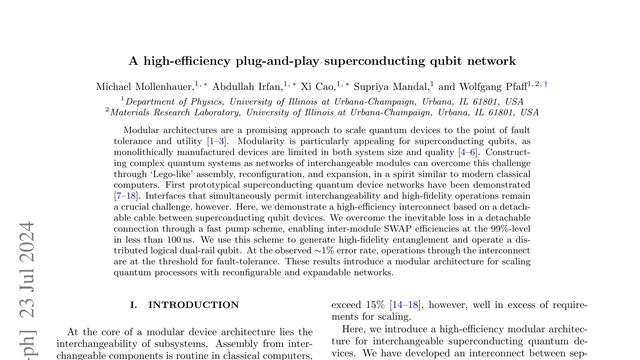
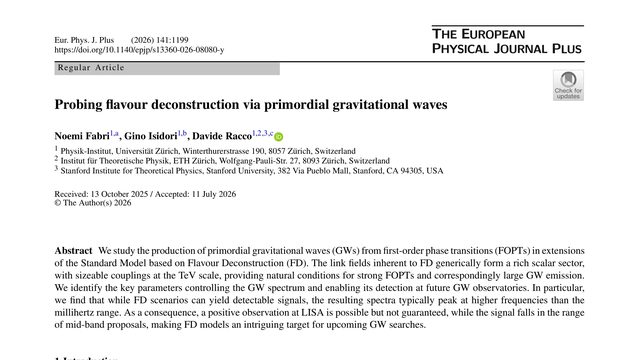
A faint ripple from the early Universe could reveal particles that no collider can reach. But this study finds the signal may be hiding at a higher pitch than the detector many people are counting on.A theory designed to explain the pattern of quark and lepton masses may also leave a signal in ripples from the early Universe. This paper asks whether flavour deconstruction can make gravitational waves loud enough to detect, and where in frequency we should listen.
Michael Mollenhauer, Abdullah Irfan, Xi Cao, Supriya Mandal, Wolfgang Pfaff
What if a quantum computer did not have to be built as one giant, delicate object? This experiment shows that separate quantum devices can be connected by a cable, unplugged, and still exchange information with about one percent loss.What if scaling a quantum computer looked less like fabricating one enormous chip, and more like plugging together replaceable modules? This paper shows a detachable cable moving quantum information with roughly one-percent loss in under one hundred nanoseconds.
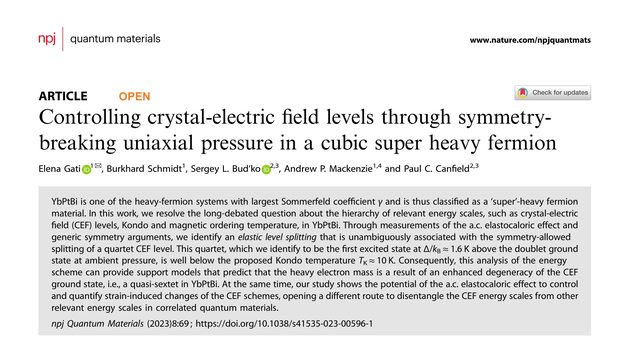
Elena Gati, Burkhard Schmidt, Sergey L. Bud’ko, A. P. Mackenzie, P. C. Canfield
A tiny squeeze can reveal which hidden quantum states are making electrons behave as if they are enormously heavy. In this crystal, that pressure exposes a six-state secret.A tiny squeeze reveals that YbPtBi may effectively behave as though six crystal-field states are available to its electrons. The surprising part is that the key excited quartet sits below the Kondo scale.
 5:19