Isometry groups of simply connected unimodular 4-dimensional Lie groups
Overview2:51CCAI
paperi.ai
0:00 / 0:00
Youssef Ayad, Saïd Fahlaoui
A space can look completely different after you move through it, yet some transformations leave every distance unchanged. This paper maps all such hidden symmetries for a broad family of four-dimensional spaces.
A space can look completely different after you move through it—yet some transformations leave every distance unchanged. This paper maps all such hidden symmetries for a broad family of four-dimensional spaces. The paper describes the full group of distance-preserving transformations for every left-invariant Riemannian metric on these four-dimensional groups under consideration.
The setting is four-dimensional, and the paper studies the full isometry group for each left-invariant Riemannian metric on these groups. The central question is simple to state: for each allowed metric, what is the full collection of transformations that preserves every distance?
The paper seeks every distance-preserving transformation, namely the full isometry group, for each allowed left-invariant Riemannian metric on these groups. The paper compares metrics by allowing structure-preserving changes of coordinates to act on them.
Metrics related by such a change belong to the same class for this purpose. It also singles out transformations that leave a chosen metric unchanged, rather than merely carrying it to another metric. This reduces the task: instead of studying every possible metric separately, it is enough to study representative metrics from the classes that are not equivalent to one another.
This theorem reduces the task to describing isometry groups for representative metrics from non-equivalent classes, rather than every metric individually. For the space called Nil three times a line, the paper states the complete isometry group: the full collection of transformations that preserve its distances.
The paper gives the isometry group of the space called Nil three times a line as part of its four-dimensional study. For Nil four, the automorphism contribution is a discrete two-way symmetry, and together with Nil four it gives the isometry group as a semidirect product.
The two components combine into the stated isometry group of Nil four, expressed as a semidirect product with the discrete two-way symmetry. The paper also gives the full isometry group for the solvable family called Sol four with parameters m and n. The paper therefore records explicitly the full isometry group for the family called Sol four with parameters m and n.
The same kind of complete description is given for the member called Sol four one. For Sol four one, the paper gives the isometry group, making the distance-preserving transformations available for study in this case. The paper gives a complete description of the distance-preserving transformations for each relevant space and metric.
That makes the spaces' symmetry visible, so later work can tell which geometric features are genuinely different and which are only different viewpoints.
A derivative work by Paperi · AI-generated script, voice and captions
· pages and figures unaltered
Made with Paperi.
Drop in a research PDF — get a narrated video walkthrough like this one,
with highlights that follow the narration. Free to start.
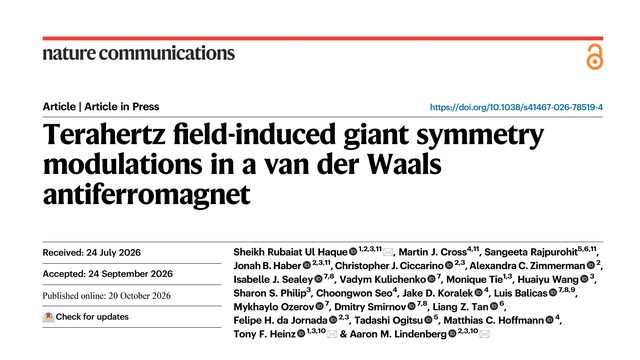
Sheikh Rubaiat Ul Haque, Martin J. Cross, Sangeeta Rajpurohit, Jonah B. Haber, Christopher J. Ciccarino, Alexandra C. Zimmerman, Isabelle J. Sealey, V. A. Kulichenko, Monique Tie, Huaiyu Hugo Wang, Sharon S. Philip, Choongwon Seo, J. D. Koralek, Luis Balicas, Mykhaylo Ozerov, Dmitry S. Smirnov, Liang Zheng Tan, Felipe H. da Jornada, Tadashi Ogitsu, Matthias C. Hoffmann, Tony F. Heinz, Aaron M. Lindenberg
A flash of terahertz light makes a magnetic crystal move as though its hidden internal order has suddenly been rearranged. The striking part is that the crystal’s visible symmetry changes and keeps oscillating long after the flash.What if a burst of terahertz light could make a quantum magnet oscillate so strongly that its symmetry visibly breaks? In MnPS3, that is exactly the behavior these measurements reveal.
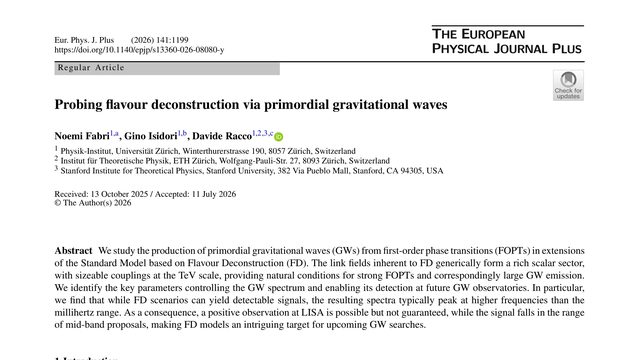
A faint ripple from the early Universe could reveal particles that no collider can reach. But this study finds the signal may be hiding at a higher pitch than the detector many people are counting on.A theory designed to explain the pattern of quark and lepton masses may also leave a signal in ripples from the early Universe. This paper asks whether flavour deconstruction can make gravitational waves loud enough to detect, and where in frequency we should listen.
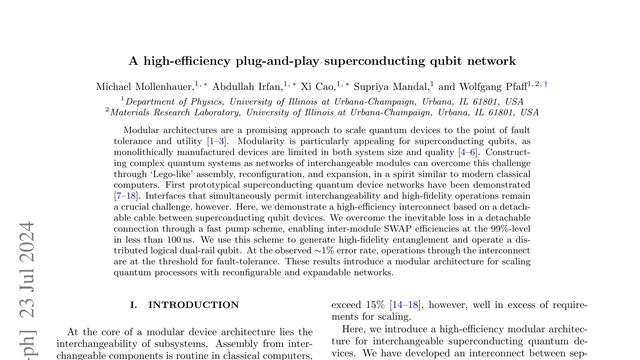
Michael Mollenhauer, Abdullah Irfan, Xi Cao, Supriya Mandal, Wolfgang Pfaff
What if a quantum computer did not have to be built as one giant, delicate object? This experiment shows that separate quantum devices can be connected by a cable, unplugged, and still exchange information with about one percent loss.What if scaling a quantum computer looked less like fabricating one enormous chip, and more like plugging together replaceable modules? This paper shows a detachable cable moving quantum information with roughly one-percent loss in under one hundred nanoseconds.
 3:31