Coherent optical control of a superconducting microwave cavity via electro-optical dynamical back-action
Overview3:50CCAI
paperi.ai
0:00 / 0:00
Liu Qiu, Rishabh Sahu, William Hease, Georg Arnold, J. M. Fink
A laser pulse can now steer a superconducting microwave cavity, even though light and microwaves normally barely affect each other. The surprising part is how little unwanted disturbance comes along for the ride.
Recent quantum technologies have established precise quantum control of various microscopic systems using electromagnetic waves. Interfaces based on cryogenic cavity electro-optic systems are particularly promising, due to the direct interaction between microwave and optical fields in the quantum regime. Quantum optical control of superconducting microwave circuits has been precluded so far due to the weak electro-optical coupling as well as quasiparticles induced by the pump laser. Here we report the coherent control of a superconducting microwave cavity using laser pulses in a multimode electrooptical device at millikelvin temperature with near-unity cooperativity. Both the stationary and instantaneous responses of the microwave and optical modes comply with the coherent electro-optical interaction, and reveal only minuscule amount of excess back-action with an unanticipated time delay. Our demonstration enables wide ranges of applications beyond quantum transductions, from squeezing and quantum non-demolition measurements of microwave fields, to entanglement generation and hybrid quantum networks.
Transcript
A laser pulse can now steer a superconducting microwave cavity, even though light and microwaves normally barely affect each other. The surprising part is how little unwanted disturbance comes along for the ride. Quantum technologies use electromagnetic waves for precise control of microscopic systems, while cryogenic cavity electro-optic interfaces directly couple microwave and optical fields in the quantum regime.
The obstacle is that light has usually interacted too weakly with these circuits, while the strong light needed for control can create unwanted effects. This experiment reports coherent control of a superconducting microwave cavity using laser pulses.
The device works like a carefully timed relay: a microwave signal meets a set of nearby optical resonances, and the spacing between those optical resonances matches the microwave frequency. That matching lets energy move coherently between them. An on-resonance optical pump enhances the electro-optic interaction, allowing resonant three-wave mixing between the microwave and adjacent optical modes.
To watch the control happen, a strong optical pulse is sent into the device while a weaker continuous signal gently probes either the microwave resonance or an optical resonance. During the pulse, a weak probing field measures the device response, and normalized reflection compares the pump on and off through input and output field amplitudes.
The control is not limited to moving the microwave resonance. It can also make that resonance narrower or broader, while the optical signal can experience either extra absorption or increased transparency. The observed coherent electro-optical response confirms that the multimode system can directly control and sense microwave fields through optical methods.
The same results also show that the demonstrated coherent response produces only a very small, and for many applications negligible, amount of excess back-action. This matters because proposed quantum applications need strong optical pulses: they aim to translate microwave signals into optical signals with very little added noise, or to create entanglement between systems.
Understanding what happens during the pulse is therefore essential for complicated measurements carried out at the quantum limit. The microwave mode does not simply respond and recover with the light pulse: a small disturbance can linger for several microseconds afterward.
That delayed response grows with longer pulses and appears even when the interaction is not resonant, pointing to an additional source of back-action. The shifts in microwave frequency and linewidth are tiny compared with the microwave resonance, and the device fully recovers only tens of microseconds after the pulse.
The measured coherent behavior remains independent of how often the pulses are repeated. Keeping the pulses widely separated also helps preserve the regime needed for creating entanglement between microwave and optical fields. The experiment demonstrates optical control of a microwave cavity with pulses in a multimode electro-optic device at millikelvin temperatures, while stationary and instantaneous responses agree with coherent theory.
The unwanted extra effect remains very small, despite the large optical photon energy compared with the small superconducting gap of aluminum. The experiment shows that optical pulses can control a microwave cavity in a clean, predictable way, opening a path toward quieter quantum measurements, linked quantum devices, and networks joined by light.
A derivative work by Paperi · AI-generated script, voice and captions
· pages and figures unaltered
Made with Paperi.
Drop in a research PDF — get a narrated video walkthrough like this one,
with highlights that follow the narration. Free to start.
Kazuki Fujio, Ali Al-Adili, Fredrik Nordström, Jean-François Lemaître, Shin Okumura, Satoshi Chiba, A. J. Koning
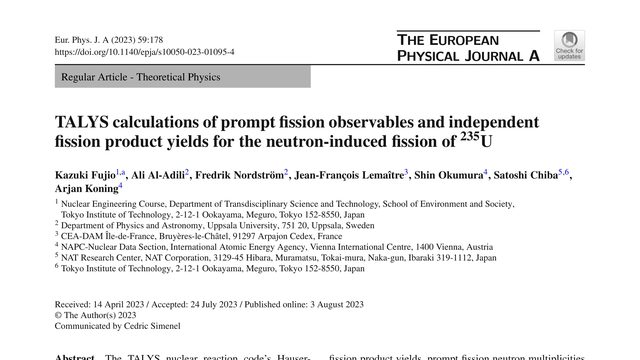
When uranium splits, the story is not over. The two pieces are born hot and unstable, then shed neutrons and light as they settle down, and predicting that aftermath matters for reactors, medicine, and nuclear waste.A single uranium fission event produces far more than two fragments: it launches a chain of neutron and gamma-ray emissions whose details matter for reactors, medicine, and nuclear astrophysics. This paper makes TALYS follow that chain fragment by fragment.
Xiaoli Chen, Beatrice W. Soh, Zi‐En Ooi, Eléonore Vissol-Gaudin, Haijun Yu, Kostya S. Novoselov, Kedar Hippalgaonkar, Qianxiao Li
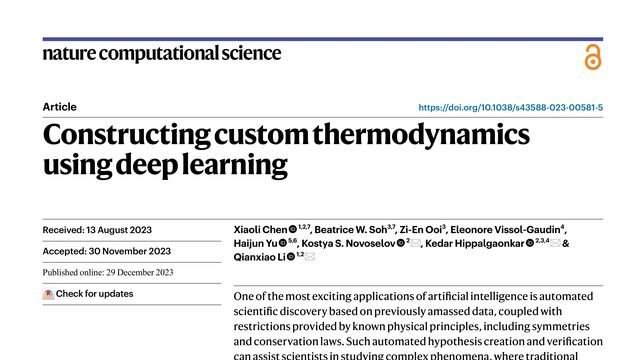
A molecule can look ready to stretch, yet take a very different path from another molecule that looks identical. This study teaches artificial intelligence to uncover the hidden information that explains why.What if a neural network could turn hundreds of microscopic degrees of freedom into just three meaningful thermodynamic coordinates, and then use them to explain why some polymers stretch quickly while others get stuck?
Lynn Buchele, Earl P. Bellinger, S. Hekker, Sarbani Basu, Warrick H. Ball, Jørgen Christensen-Dalsgaard
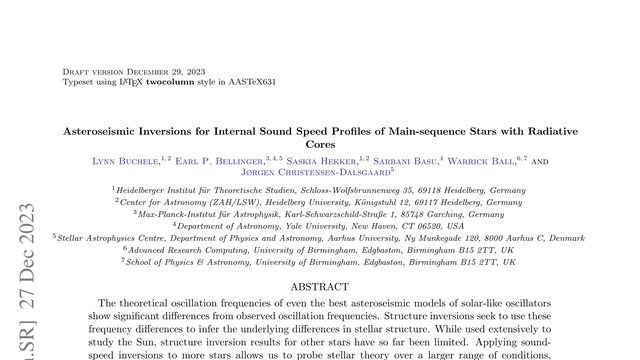
Stars ring like bells, and those faint vibrations let scientists look deep inside them. The surprise is that even our best pictures of stellar interiors can still be wrong at the core.A star’s tiny frequency mismatches can reveal that its model has the wrong core physics. This study turns those mismatches into localized sound-speed measurements inside twelve distant, Sun-like stars.
 3:33