Isometry groups of simply connected unimodular 4-dimensional Lie groups
In depth5:53CCAI
paperi.ai
0:00 / 0:00
Youssef Ayad, Saïd Fahlaoui
What does every symmetry of a curved, four-dimensional Lie group look like? This paper turns that broad geometric question into a finite classification problem across exactly seven groups.
What does every symmetry of a curved, four-dimensional Lie group look like? This paper turns that broad geometric question into a finite classification problem across exactly seven groups. The work describes the full group of isometries of each left invariant Riemannian metric on simply connected unimodular nilpotent or solvable type R Lie groups of dimension four.
That target is specific: the geometry is restricted to left invariant Riemannian metrics and to simply connected unimodular groups in dimension four. The central problem is to determine the full isometry group of each left invariant Riemannian metric on simply connected unimodular nilpotent or solvable type R Lie groups of dimension four.
So the goal is not merely to find some symmetries, but the full isometry group for every metric in this class. There are exactly seven such four-dimensional Lie groups. The two groups Nil three times R and Nil four are nilpotent, while the others are solvable type R Lie groups.
The classification of left invariant Riemannian metrics on these Lie groups is due to Van Thuong. For a connected and simply connected Lie group with a left invariant Riemannian metric, Isom of G and g is the group of all diffeomorphisms whose pullback of g equals g.
This isometry group is itself a Lie group and acts transitively on G. The isotropy subgroup at the identity consists of isometries fixing the identity element. Because G is simply connected, Aut of G is identified with Aut of its Lie algebra, and this group acts on the set of all left invariant Riemannian metrics.
The group G is called type R when, for every x in its Lie algebra, the endomorphism ad x has only real eigenvalues. For a simply connected, unimodular, solvable Lie group of type R, the paper states an additional result for each left invariant Riemannian metric.
A left invariant Riemannian metric is an inner product on the tangent space that varies smoothly across G and makes the left translations isometries. The phrase left invariant therefore records the fact that translating from the left preserves the metric.
An inner product on the Lie algebra defines a left invariant Riemannian metric on G. Thus, classifying left invariant Riemannian metrics on G is equivalent to classifying inner products on its Lie algebra. The paper gives all left invariant Riemannian metrics on the simply connected unimodular nilpotent or solvable type R four-dimensional Lie groups.
The construction uses a bijection between upper triangular matrices with positive diagonal entries and symmetric positive definite matrices. The paper next recalls well known and important results about isometry groups of left invariant Riemannian metrics on Lie groups.
These results recall some well-known and important facts about the isometry groups of left invariant Riemannian metrics on Lie groups. If a diffeomorphism theta pulls a Riemannian metric g back to theta star g, then the isometry group for g is isomorphic to the isometry group for theta star g.
This means changing the metric by a diffeomorphism preserves the isometry group up to isomorphism. Consequently, it is enough to describe the isometry groups of representative metrics from the non-equivalent classes of metrics on the Lie groups.
The classification of metrics therefore reduces the number of isometry problems that must be handled directly. Using result one, the paper gives the isometry groups of the two nilpotent four-dimensional Lie groups. The nilpotent part of the classification is therefore handled as two separate group cases.
For the group Nil three times R, the displayed formula gives its isometry group in this nilpotent case under consideration. This displayed statement identifies the isometry group of Nil three times R as the result for this particular nilpotent group. For the group Nil four, the displayed formula gives its isometry group in this nilpotent case under consideration.
This displayed statement identifies the isometry group of Nil four as the result for this particular nilpotent group. Using result two, the paper gives the isometry groups of its five solvable Lie groups of type R. The solvable part treats the isometry groups of five solvable Lie groups belonging to type R in the classification presented.
For the group Sol four sub m comma n, the displayed formula gives its isometry group in this solvable case. This displayed statement identifies the isometry group of Sol four sub m comma n as the result for this solvable group. For the group Sol three times R, the displayed formula gives its isometry group in this solvable case under consideration.
This displayed statement identifies the isometry group of Sol three times R as the result for this solvable group. For the group Sol four sub zero, the displayed formula gives its isometry group in this solvable case under consideration. This displayed statement identifies the isometry group of Sol four sub zero as the result for this solvable group.
For the group Sol four sub one, the displayed formula gives its isometry group in this solvable case under consideration. This displayed statement identifies the isometry group of Sol four sub one as the result for this solvable group. The key takeaway is a systematic description of the full isometry groups for the relevant nilpotent and solvable four-dimensional Lie groups, reducing the geometry to representative inner products on their Lie algebras.
A derivative work by Paperi · AI-generated script, voice and captions
· pages and figures unaltered
Made with Paperi.
Drop in a research PDF — get a narrated video walkthrough like this one,
with highlights that follow the narration. Free to start.
Sheikh Rubaiat Ul Haque, Martin J. Cross, Sangeeta Rajpurohit, Jonah B. Haber, Christopher J. Ciccarino, Alexandra C. Zimmerman, Isabelle J. Sealey, V. A. Kulichenko, Monique Tie, Huaiyu Hugo Wang, Sharon S. Philip, Choongwon Seo, J. D. Koralek, Luis Balicas, Mykhaylo Ozerov, Dmitry S. Smirnov, Liang Zheng Tan, Felipe H. da Jornada, Tadashi Ogitsu, Matthias C. Hoffmann, Tony F. Heinz, Aaron M. Lindenberg
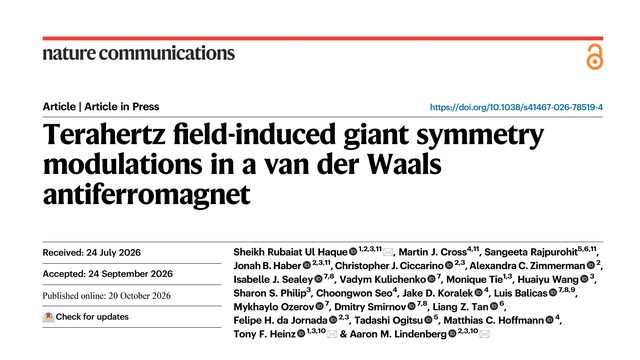
A flash of terahertz light makes a magnetic crystal move as though its hidden internal order has suddenly been rearranged. The striking part is that the crystal’s visible symmetry changes and keeps oscillating long after the flash.What if a burst of terahertz light could make a quantum magnet oscillate so strongly that its symmetry visibly breaks? In MnPS3, that is exactly the behavior these measurements reveal.
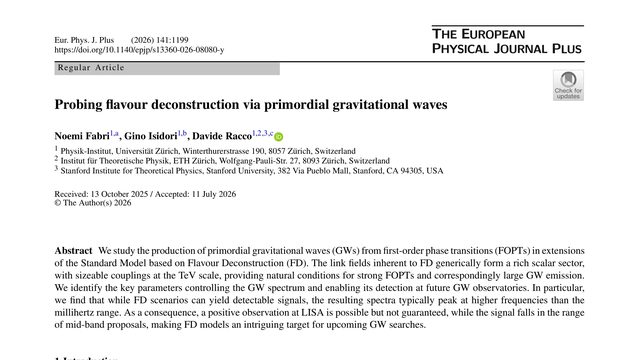
A faint ripple from the early Universe could reveal particles that no collider can reach. But this study finds the signal may be hiding at a higher pitch than the detector many people are counting on.A theory designed to explain the pattern of quark and lepton masses may also leave a signal in ripples from the early Universe. This paper asks whether flavour deconstruction can make gravitational waves loud enough to detect, and where in frequency we should listen.
Michael Mollenhauer, Abdullah Irfan, Xi Cao, Supriya Mandal, Wolfgang Pfaff
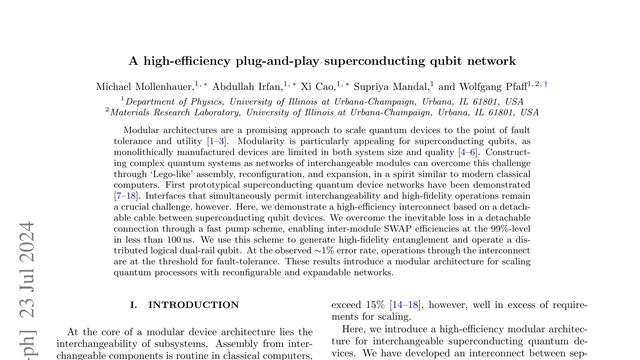
What if a quantum computer did not have to be built as one giant, delicate object? This experiment shows that separate quantum devices can be connected by a cable, unplugged, and still exchange information with about one percent loss.What if scaling a quantum computer looked less like fabricating one enormous chip, and more like plugging together replaceable modules? This paper shows a detachable cable moving quantum information with roughly one-percent loss in under one hundred nanoseconds.
 3:31