Probing flavour deconstruction via primordial gravitational waves
In depth9:08CCAI
paperi.ai
0:00 / 0:00
Noemi Fabri, Gino Isidori, Davide Racco
A theory designed to explain the pattern of quark and lepton masses may also leave a signal in ripples from the early Universe. This paper asks whether flavour deconstruction can make gravitational waves loud enough to detect, and where in frequency we should listen.
We study the production of primordial gravitational waves (GWs) from first-order phase transitions (FOPTs) in extensions of the Standard Model based on Flavour Deconstruction (FD). The link fields inherent to FD generically form a rich scalar sector, with sizeable couplings at the TeV scale, providing natural conditions for strong FOPTs and correspondingly large GW emission. We identify the key parameters controlling the GW spectrum and enabling its detection at future GW observatories. In particular, we find that while FD scenarios can yield detectable signals, the resulting spectra typically peak at higher frequencies than the millihertz range. As a consequence, a positive observation at LISA is possible but not guaranteed, while the signal falls in the range of mid-band proposals, making FD models an intriguing target for upcoming GW searches.
Transcript
A theory designed to explain the pattern of quark and lepton masses may also leave a signal in ripples from the early Universe. This paper asks whether flavour deconstruction can make gravitational waves loud enough to detect—and where in frequency we should listen. The study examines primordial gravitational waves from first-order phase transitions in Standard Model extensions based on Flavour Deconstruction.
In Flavour Deconstruction, link fields form a rich scalar sector with sizeable couplings at the TeV scale, providing natural conditions for strong first-order phase transitions and correspondingly large gravitational-wave emission. The analysis identifies the key parameters controlling the gravitational-wave spectrum and its detectability at future observatories.
The resulting spectra typically peak at higher frequencies than the millihertz range, so LISA detection is possible but not guaranteed, while mid-band proposals can cover the signal. Primordial gravitational waves provide a unique window into the early Universe and can probe high-energy phenomena otherwise inaccessible to laboratory experiments.
Gravitational waves from a cosmological first-order phase transition can carry indirect information about particle content and elementary interactions beyond the Standard Model, at energies beyond those probed directly by colliders. The next decade will bring a new generation of gravitational-wave observatories, including LISA, which is designed to explore the millihertz frequency range where cosmological signals from TeV-scale phase transitions are expected.
That makes gravitational-wave signatures of beyond-the-Standard-Model scenarios with new TeV-scale dynamics especially timely and compelling. The gravitational-wave phenomenology of Flavour Deconstruction has only begun to be explored, and the only dedicated study so far considered the specific PS3 model.
That study discussed a threefold peak structure associated with the three scales of PS3, but this optimistic possibility might not represent a broader class of Flavour Deconstruction models. Because these models span a large and varied parameter space, the analysis revisits the problem in more general terms.
Its goal is to identify the parameters and conditions controlling the first-order phase transition and the resulting gravitational-wave spectra, especially for TeV-scale transitions relevant to LISA. The transition is generated by link fields acquiring a non-trivial vacuum expectation value at a scale called v.
This transition is the last step of a symmetry-breaking chain connecting a completely flavour non-universal gauge group in the ultraviolet to the Standard Model gauge group. The chosen step is an unavoidable expectation of models with a semi-simple ultraviolet embedding and a generic benchmark for models with many broken generators around the TeV scale.
The scalar-potential analysis focuses on a region where a single scalar field, phi, acquires the vacuum expectation value and is significantly lighter than the other scalar degrees of freedom. The other scalar degrees of freedom can then be effectively decoupled at energy scales above v.
Under these hypotheses, tunnelling becomes a one-dimensional problem fully described by the dynamics of phi. The analysis maps the regions of parameter space where the gravitational-wave background generated by the phase transition can be loud enough to detect.
The two parameters are lambda and g four, with lambda defined as the tree-level effective quartic coupling of the lightest singlet field phi controlling the phase transition. After thermal corrections are included in the effective potential, the nucleation temperature can be computed as the temperature at which phi tunnels from the metastable vacuum at the origin to the true vacuum near v.
The numerical calculation of the bounce is difficult, so several numerical packages have been developed for tunnelling calculations. The analysis uses AnyBubble to compute the tunnelling action as a function of temperature. The effective potential is studied perturbatively at one loop, although higher-order effects are likely to have an impact.
Figure 1 shows the expected signal-to-noise ratio at LISA in the g four–lambda plane for v equal to one TeV in the benchmark scenario. A sizeable signal-to-noise ratio requires g four values of order unity and relatively small quartic couplings lambda. In most of the parameter space producing a strong first-order phase transition, lambda is dominated by the one-loop contribution rather than the tree-level term.
Figure two maps the LISA signal-to-noise ratio across the g-four–g-three plane for the symmetry-breaking transition at a scale of one teraelectronvolt. The curves are organized by fixed values of the combination g-three squared plus g-four squared, which controls the coloron mass and strongly influences the thermal potential.
The right panel recasts the same results against the tree-level quartic coupling, showing the gravitational-wave amplitude across this parameter space and marking the matching limits associated with one- and three-teraelectronvolt scales. Figure three shows gravitational-wave spectra from the symmetry-breaking transition, scanning different values of g four and lambda.
Blue, brown, and yellow curves correspond to breaking scales of one, three, and ten to the power of three TeV, alongside projected sensitivities for LISA, LIGO, Virgo, ET, and CE. The plot illustrates how increasing the scale shifts the signal toward higher frequencies, placing the illustrative ten-to-the-power-of-three TeV case in the range of third-generation ground-based detectors.
The U one model can also produce large gravitational-wave energy-density values, but only for very small lambda. Because the Abelian case has a smaller multiplicity, a sufficiently strong first-order phase transition requires delicate and numerically unstable tuning between tree-level and loop corrections to the Higgs potential.
In the non-Abelian model, the nucleation-temperature ratio is almost constant across parameter space, while in the U one case it changes rapidly. In the U one case, large gravitational-wave emission occurs for a nucleation-temperature ratio as low as zero point one, corresponding to large quantum corrections that vary rapidly with the model parameters relative to the tree-level scalar potential.
The considerations make a gravitational-wave signal less likely in the U one case. Because observable signals occur in both Abelian and non-Abelian scenarios, gravitational-wave data alone may not disentangle the underlying theory if a signal is detected.
These models predict a first-order phase transition around the TeV scale, where complementary evidence could come from collider direct searches and precision measurements. Figure five compares the non-Abelian symmetry-breaking pattern with the U(1) model by scanning nucleation temperature against the tree-level quartic coupling and an effective gauge-coupling combination.
The left and central panels show the transition temperature, while the right panel translates the U(1) scan into the gravitational-wave background amplitude. Grey points mark U(1) parameter choices where numerical instabilities prevent the solver from identifying the nucleation range, highlighting why the predicted gravitational-wave signal depends on the assumed symmetry-breaking pattern.
The analysis explores flavour-deconstruction gravitational-wave phenomenology from spontaneous symmetry-breaking steps that naturally occur around the TeV scale. Across two general benchmarks, the key parameters controlling the phase-transition strength are an effective combination of quartic scalar couplings and an effective combination of gauge couplings.
Sizeable gravitational-wave signals arise where loop corrections controlled by gauge couplings compete with tree-level contributions controlled by the quartic coupling in the scalar potential. Matching conditions among gauge couplings are important for TeV-scale transitions because the gauge group after symmetry breaking is the Standard Model one, making the theory highly constrained.
Flavour deconstruction can produce detectable gravitational waves when loop effects compete with tree-level scalar interactions, but its signals often peak above LISA’s millihertz range. That makes mid-band observatories especially important, alongside collider tests around the TeV scale.
A derivative work by Paperi · AI-generated script, voice and captions
· pages and figures unaltered
Made with Paperi.
Drop in a research PDF — get a narrated video walkthrough like this one,
with highlights that follow the narration. Free to start.
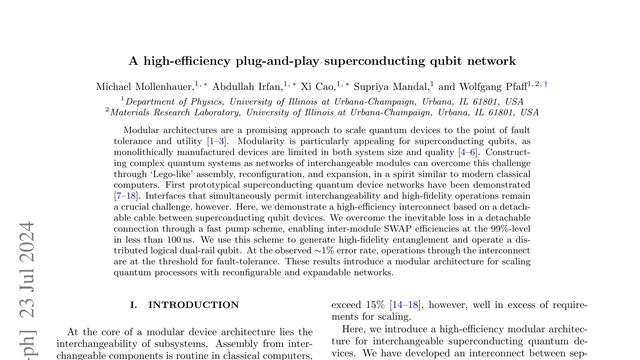
Michael Mollenhauer, Abdullah Irfan, Xi Cao, Supriya Mandal, Wolfgang Pfaff
What if a quantum computer did not have to be built as one giant, delicate object? This experiment shows that separate quantum devices can be connected by a cable, unplugged, and still exchange information with about one percent loss.What if scaling a quantum computer looked less like fabricating one enormous chip, and more like plugging together replaceable modules? This paper shows a detachable cable moving quantum information with roughly one-percent loss in under one hundred nanoseconds.
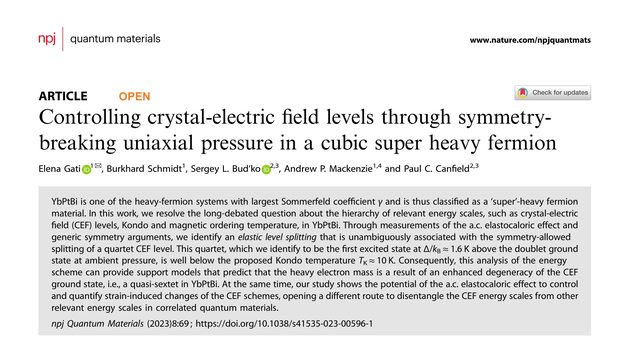
Elena Gati, Burkhard Schmidt, Sergey L. Bud’ko, A. P. Mackenzie, P. C. Canfield
A tiny squeeze can reveal which hidden quantum states are making electrons behave as if they are enormously heavy. In this crystal, that pressure exposes a six-state secret.A tiny squeeze reveals that YbPtBi may effectively behave as though six crystal-field states are available to its electrons. The surprising part is that the key excited quartet sits below the Kondo scale.
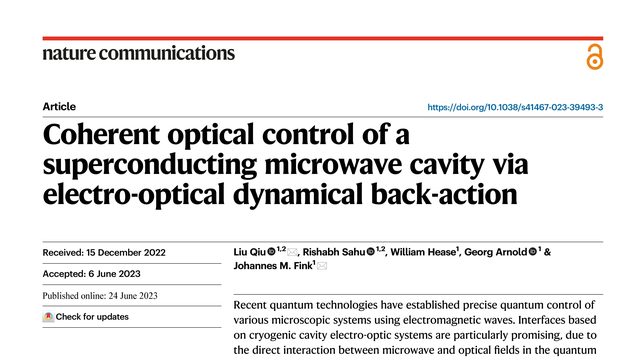
Liu Qiu, Rishabh Sahu, William Hease, Georg Arnold, J. M. Fink
A laser pulse can now steer a superconducting microwave cavity, even though light and microwaves normally barely affect each other. The surprising part is how little unwanted disturbance comes along for the ride.A laser pulse can reshape the behavior of a superconducting microwave cavity, even though optical photons carry far more energy than microwave photons. This experiment shows that the control can remain remarkably coherent at millikelvin temperatures.
 3:33