Terahertz field-induced giant symmetry modulations in a van der Waals antiferromagnet
Overview3:31CCAI
paperi.ai
0:00 / 0:00
Sheikh Rubaiat Ul Haque, Martin J. Cross, Sangeeta Rajpurohit, Jonah B. Haber, Christopher J. Ciccarino, Alexandra C. Zimmerman, Isabelle J. Sealey, V. A. Kulichenko, Monique Tie, Huaiyu Hugo Wang, Sharon S. Philip, Choongwon Seo, J. D. Koralek, Luis Balicas, Mykhaylo Ozerov, Dmitry S. Smirnov, Liang Zheng Tan, Felipe H. da Jornada, Tadashi Ogitsu, Matthias C. Hoffmann, Tony F. Heinz, Aaron M. Lindenberg
A flash of terahertz light makes a magnetic crystal move as though its hidden internal order has suddenly been rearranged. The striking part is that the crystal’s visible symmetry changes and keeps oscillating long after the flash.
Strong-field terahertz (THz) excitations enable dynamic control over electronic, lattice and symmetry degrees of freedom in quantum materials. Here, we uncover pronounced terahertz-induced symmetry modulations and coherent phonon dynamics in the van der Waals antiferromagnet MnPS3, in which inversion symmetry is broken by its antiferromagnetic spin configuration. Our time-resolved second harmonic generation measurements reveal long-lived giant oscillations in the antiferromagnetic phase, with amplitudes comparable to the equilibrium signal, driven by phonons involving percent-level atomic displacements relative to the equilibrium bond lengths. The temporal evolution of the rotational anisotropy patterns indicates a dynamic breaking of mirror symmetry, modulated by two vibrational modes at 1.7 THz and 4.5 THz, with the former corresponding to a hidden mode not observed in equilibrium spectroscopy. These effects arise in part from a field-induced charge rearrangement mechanism that lowers the local crystal symmetry and couples to the phonon modes. We uncover a long-lived field-driven response with a complex THz polarization dependence, consistent with a metastable state of reduced symmetry. Through comparison with simulations, we interpret this response in terms of a potential antiferromagnetic-to-ferrimagnetic transition. Our results establish an effective field-tunable pathway for driving excitations otherwise weak in equilibrium.
Transcript
A flash of terahertz light makes a magnetic crystal move as though its hidden internal order has suddenly been rearranged. The striking part is that the crystal’s visible symmetry changes and keeps oscillating long after the flash. Intense laser pulses let researchers study quantum behavior that cannot be reached by steady changes such as pressure, voltage, strain, or temperature.
Terahertz light is especially useful because strong-field excitation can selectively drive low-energy, collective motions inside materials, making those motions accessible. Those motions could help reveal new behavior in condensed matter and support future light-based technologies, including a wide range of next-generation photonics.
This study examines an antiferromagnet, where the antiferromagnetic spin configuration breaks inversion symmetry, one of the crystal’s usual symmetries in this material. In this picture, strong terahertz excitation dynamically controls the lattice, selectively giving energy to particular atomic vibrations in the material.
The measurements found symmetry changes as large as the material’s ordinary light signal, along with long-lived, coordinated atomic vibrations in its antiferromagnetic state. The proposed cause is a field-driven rearrangement of electric charge that changes the crystal’s underlying symmetry.
The study also found evidence for a field-induced change from antiferromagnetic to ferrimagnetic order. At low temperature, the light signal shows pronounced oscillations whose size is comparable to the material’s equilibrium signal. Above the magnetic ordering temperature, the later-time signal is featureless.
Two especially clear vibrations appear at 1.7 and 4.5 terahertz. The lower-frequency vibration had not been observed in ordinary equilibrium measurements. As temperature rises, the amplitudes of both vibrations decrease and vanish near the magnetic ordering temperature.
The giant coordinated vibration therefore appears only in the antiferromagnetic phase, showing that the magnetic arrangement enables the terahertz field to couple to it. A terahertz pulse briefly drives the material into patterns that no longer match across its mirror line, and that imbalance persists long enough to oscillate.
The oscillations contain the same two characteristic frequencies as the emitted light, linking the lasting symmetry change to atomic vibrations. This field-driven response gives access to vibrations that ordinary linear measurements cannot see.
The appearance of the 1.7-terahertz vibration is also a direct sign that the magnetic moment is being manipulated dynamically. The combined evidence points toward possible new, long-lived magnetic states, supported by the field’s polarization dependence, the newly visible vibration, and matching theory.
For someone outside the laboratory, the promise is a route toward targeted control of phase changes and switching between magnetic states with strong terahertz fields, rather than relying only on permanent changes to the material. A carefully directed electric field can reshape both atomic motion and magnetic order in this material, suggesting a way to switch magnetic states with light rather than permanently changing temperature, pressure, or voltage.
A derivative work by Paperi · AI-generated script, voice and captions
· pages and figures unaltered
Made with Paperi.
Drop in a research PDF — get a narrated video walkthrough like this one,
with highlights that follow the narration. Free to start.
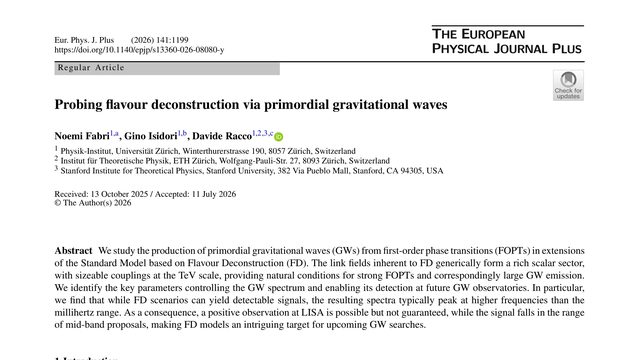
A faint ripple from the early Universe could reveal particles that no collider can reach. But this study finds the signal may be hiding at a higher pitch than the detector many people are counting on.A theory designed to explain the pattern of quark and lepton masses may also leave a signal in ripples from the early Universe. This paper asks whether flavour deconstruction can make gravitational waves loud enough to detect, and where in frequency we should listen.
Michael Mollenhauer, Abdullah Irfan, Xi Cao, Supriya Mandal, Wolfgang Pfaff
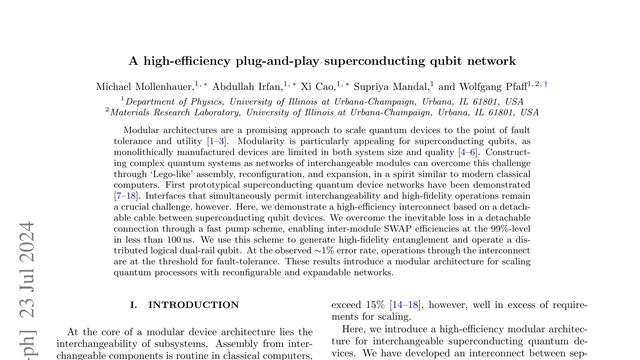
What if a quantum computer did not have to be built as one giant, delicate object? This experiment shows that separate quantum devices can be connected by a cable, unplugged, and still exchange information with about one percent loss.What if scaling a quantum computer looked less like fabricating one enormous chip, and more like plugging together replaceable modules? This paper shows a detachable cable moving quantum information with roughly one-percent loss in under one hundred nanoseconds.
Elena Gati, Burkhard Schmidt, Sergey L. Bud’ko, A. P. Mackenzie, P. C. Canfield
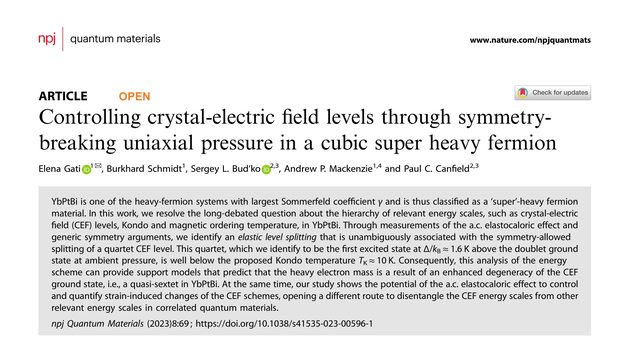
A tiny squeeze can reveal which hidden quantum states are making electrons behave as if they are enormously heavy. In this crystal, that pressure exposes a six-state secret.A tiny squeeze reveals that YbPtBi may effectively behave as though six crystal-field states are available to its electrons. The surprising part is that the key excited quartet sits below the Kondo scale.
 5:19