Renormalization-group improved Schwarzschild black hole: shadow, ringdown, and strong cosmic censorship
In depth14:50CCAI
paperi.ai
0:00 / 0:00
Ahmad Al‐Badawi, Ahmed Faizuddin, İzzet Sakallı
What if a black hole could develop an inner horizon without charge or rotation, and still remain regular at its center? This paper tests that quantum-improved Schwarzschild geometry through shadows, ringdown, thermodynamics, and cosmic censorship.
What if a black hole could develop an inner horizon without charge or rotation—and still remain regular at its center? This paper tests that quantum-improved Schwarzschild geometry through shadows, ringdown, thermodynamics, and cosmic censorship. The renormalization-group approach to quantum gravity produces quantum-corrected black-hole spacetimes that smooth the Schwarzschild singularity at short distances while recovering the classical metric at large radii.
In the original Bonanno-Reuter construction, Newton’s constant becomes a scale-dependent coupling, with the cutoff identified through the background geometry as an inverse distance scale. These asymptotically safe black holes have been studied through shadows and Event Horizon Telescope constraints, quasinormal-mode spectra and time-domain ringdown, regular evaporation endpoints, and Planck-scale thermodynamics.
The closed-form improved Schwarzschild-like metric uses a running coupling that interpolates between the ultraviolet fixed point and the infrared Newtonian regime through a simple rational structure. Its lapse depends on a cutoff scale xi and an interpolation parameter gamma, while the xi approaching zero limit returns the classical Schwarzschild geometry.
For nonzero xi at fixed mass, a second inner zero of the lapse can appear, producing a Reissner–Nordstrom-like two-horizon structure without electric or magnetic charge. The cutoff scale xi fixes the ultraviolet scale, while gamma controls the interpolation between ultraviolet and infrared behavior.
At large radius, the Arnowitt–Deser–Misner mass is exactly M, and quantum corrections enter at inverse radius cubed, one order beyond the Reissner–Nordstrom level. For positive gamma, the small-radius lapse has a de Sitter-core expansion with effective cosmological constant six divided by gamma xi squared.
The curvature invariants remain finite for every positive xi and positive gamma, including a finite Kretschmann scalar across the full positive-radius range. The geometry is regular precisely when xi and gamma are both positive; it becomes singular on the xi equals zero and gamma equals zero boundaries.
The horizon condition produces a quartic equation in the horizon radius, with two positive roots defining outer and inner horizons when xi stays below a critical value. At the critical value, the two roots merge into a double extremal root; above it, the black hole disappears and only a horizonless configuration remains.
As xi or gamma grows, the outer horizon falls and the inner horizon rises, so the horizon separation shrinks toward the merger limit. The outer surface gravity also drops monotonically with xi and gamma, reaching zero at the merger and leaving an extremal, zero-temperature configuration.
Table I lists the inner and outer horizon radii, r minus and r plus, together with their surface gravities, kappa minus and kappa plus, for several values of xi and gamma at mass one. The authors obtain these roots by sign-change bisection of the horizon condition, using step zero point zero zero five and checking at fifty-digit precision.
Across the displayed rows, the outer horizon moves inward and the inner horizon outward as the parameters increase, while outer surface gravity decreases, signaling approach toward horizon merger and an extremal, zero-temperature configuration. The Schwarzschild shadow value is recovered at xi equal to zero, while across the black-hole existence region the model shadow remains within the Event Horizon Telescope one-sigma radius bands for M87 star and Sagittarius A star.
The largest departure from Schwarzschild is about four point three percent at xi equal to zero point five and gamma equal to five point zero, making this a consistency check for the static shadow radius rather than a complete observational constraint. The photon-sphere and quasinormal-mode correspondence is reproduced to better than one percent at multipole number five or greater, connecting the shadow radius with the eikonal quasinormal spectrum.
In the left panel, the photon-sphere surface drops smoothly as xi over M increases, with only a gentler change along gamma. The right panel shows the corresponding shadow-radius surface, including a visibly darker contracted region toward larger xi, while both surfaces flatten near the back-left Schwarzschild corner.
The scalar, electromagnetic, and Dirac perturbation problems are presented together so their spin-dependent potential differences can be compared directly. Each potential forms a single barrier outside the outer horizon, and that barrier controls both the quasinormal spectrum and greybody emission, with height and location depending on spin.
Figure five shows the Dirac potential barrier for spin one-half perturbations. On the left, varying gamma from zero to ten leaves the peak height essentially unchanged while shifting its position inward; on the right, increasing xi from zero to one makes the peak rise and move inward.
In both panels, the barrier vanishes at the outer horizon and peaks near r equal to two point four M, inside the photon sphere but outside the horizon, highlighting why the gamma response of the Dirac quasinormal mode is unusual. Quasinormal modes encode the black hole’s linear response to external perturbations and provide a spectral diagnostic of stability and observational signature.
The semi-analytical WKB method matches expansions near the horizon and at spatial infinity to a Taylor expansion of the effective potential around its peak. Sixth-order WKB is used as the working tool because higher-order gains saturate beyond sixth order, with cross-checks against a thirteenth-order implementation.
A single WKB pipeline computes the fundamental frequencies for scalar, electromagnetic, and Dirac perturbations, while the same quantization condition gives the scalar overtones. Time-domain integration of the scalar master equation supplies a cross-check, and the Gundlach–Price–Pullin scheme reproduces the multipole-two fundamental at the few-per-mil level.
Every entry has a negative imaginary part, so the geometry is physically admissible at the linear level. The negative imaginary part holds across the tables, so the improved Schwarzschild black hole is linearly stable under scalar, electromagnetic, and Dirac perturbations.
At fixed multipole number, increasing xi and gamma raises the real frequency and lowers the magnitude of the imaginary frequency in the scalar and electromagnetic sectors, producing slightly faster and longer-lived modes. The ratio between the real frequency and the shadow-based eikonal estimate stays within one percent for multipole number five, confirming the photon-sphere–quasinormal-mode correspondence.
Table Three reports fundamental scalar quasinormal modes for the improved Schwarzschild black hole at mass one, across angular multipoles one, two, and three, while varying xi and gamma. Each frequency has a negative imaginary part, confirming linear stability; the table also shows that increasing these parameters generally raises the oscillation frequency and reduces the damping magnitude.
These results come from the sixth-order Padé-improved WKB scheme, providing a spectral diagnostic of the black hole’s response. For mass equal to one, xi equal to zero point two, gamma equal to zero point five, and multipole number two, a time-domain ringdown is read at tortoise coordinate twenty after a Gaussian initial pulse.
A Prony fit gives a frequency of zero point four eight four plus or minus zero point zero zero two, with damping zero point zero nine seven plus or minus zero point zero zero three, agreeing with the WKB value to a few parts per mil. Near time one hundred fifty, the signal changes to a power-law tail with slope t to the minus seven, and the frequency and tail agree across the two methods.
The inner horizon exists without charge, spin, or a cosmological-constant source; the two-horizon structure is driven by the renormalization-group improvement of the lapse. Across the tested scalar, electromagnetic, and Dirac multipoles, the spectral-gap ratio is effectively multipole-independent, varying by at most six percent at fixed xi and gamma.
The spectral gap stays below one half throughout the parameter range, so it never reaches the de Sitter Christodoulou bound. The ratio rises toward extremality but reaches only about zero point two five at xi equal to zero point five and gamma equal to five point zero, a factor of two below the bound.
The bound is approached only at the edge of the merger curve, where the photon sphere and outer horizon are no longer well separated and the WKB hierarchy loses validity. At fixed couplings, the solutions form a one-parameter family labeled by the outer-horizon radius, with the mass determined by the positive root of the inversion quadratic.
In the Schwarzschild limit, the heat capacity returns to minus eight pi times the mass squared, and a numerical check reproduces that value to five digits. The Hawking temperature stays below its Schwarzschild value of zero point zero three nine seven nine across the table, with the reduction increasing monotonically in xi and gamma and reaching about thirty-eight percent at xi equal to zero point five and gamma equal to five point zero.
The heat capacity is negative at eleven of twelve points, as in Schwarzschild, so the outer-horizon branch is locally unstable there. The single positive-heat-capacity entry points to a second thermodynamic branch. As xi approaches its critical value, the two horizons merge, the outer surface gravity approaches zero, and the Hawking temperature approaches zero at finite radius and finite mass.
The evaporation endpoint is therefore a cold, finite-mass remnant rather than a curvature singularity, consistent with the finite Kretschmann scalar. The black hole’s response to renormalization-group improvement concentrates in a narrow crescent near the extremal-merger curve.
Across most of the xi–gamma region, the shadow, scalar-barrier peak, spectral-gap ratio, and Hawking temperature remain close to their classical counterparts; only the inner roughly fifteen percent of the critical xi range makes quantum corrections observationally significant.
The contours of these four observables run nearly parallel, indicating that an effective combination of gamma plus three times xi squared captures most of the physical variation. The spectral-gap ratio rises toward the extremal boundary but remains below one half throughout the black-hole existence region, reaching about zero point two five at the most quantum-corrected corner.
Figure six maps four observables across the ξ–γ parameter plane at M equals one, with the dashed black curve marking the extremal merger boundary. The authors show the shadow radius and scalar barrier peak approaching their extremal behavior, while the SCC ratio remains below the de Sitter Christodoulou value of one half throughout the black-hole region.
Hawking temperature fades toward a remnant crescent, highlighting where cooling becomes small and where late-time tails, rather than the spectral gap, govern SCC regularity. At matched perturbation amplitude, the improved Schwarzschild black hole is the least deviant from Schwarzschild among the four families, with a shadow deviation of about zero point nine percent.
At xi equal to zero point five and gamma equal to zero point five, its static shadow differs from the Hayward value by less than zero point four percent and from the Bonanno-Reuter value by less than zero point five percent, so all three coincide within one percent. Separating those geometries requires quasinormal-mode ringdown or thermodynamic information, which split them at the five-to-ten-percent level.
The improved Schwarzschild black hole remains Schwarzschild-like both outside and deep inside, with renormalization-group improvement appearing mainly as a mid-range correction to the lapse. Figure seven plots the Hawking-radiation sparsity parameter against xi over five gamma values, with the Schwarzschild reference at about seventy-three point five.
Every curve rises gradually before increasing sharply near the extremal-merger boundary, and larger gamma shifts that divergence toward smaller xi. The authors use this pattern to show that weakening surface gravity makes the IS-BH increasingly sparse, supporting its interpretation near extremality as a cold, faint, intermittently radiating remnant.
The suppressed emission rate and divergent sparsity make the extremal-merger limit a cold, faint, intermittently radiating remnant rather than an active radiator. Figure eight plots the spectral energy emission rate against frequency for four improved-Schwarzschild configurations and the dashed Schwarzschild reference at mass one.
All curves show a thermal, bell-shaped spectrum: they rise with a Rayleigh–Jeans-like cubic behavior at low frequency and fall exponentially at high frequency. As the parameters approach the extremal-merger boundary, the peak shifts toward lower frequency and lower amplitude, while the geometric prefactor remains the Schwarzschild-like envelope discussed by the authors.
The analysis covers the geometry, perturbation potentials, quasinormal modes, overtones, time-domain ringdown, the inner-horizon spectral-gap ratio, thermodynamics, parameter-plane scans, comparisons with regular black holes, and Hawking-flux sparsity and emission. The results are mutually consistent, and several sit within reach of upcoming observations.
The improved black hole stays remarkably close to Schwarzschild over most of parameter space, while its quantum corrections create a regular core, a cold remnant, and an inner horizon that remains compatible with strong cosmic censorship.
A derivative work by Paperi · AI-generated script, voice and captions
· pages and figures unaltered
Made with Paperi.
Drop in a research PDF — get a narrated video walkthrough like this one,
with highlights that follow the narration. Free to start.
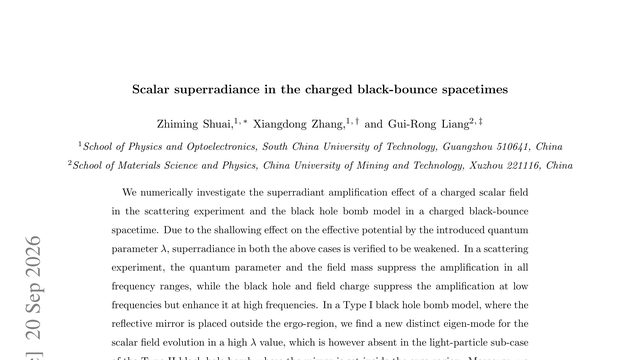
A black hole can act like a cosmic energy booster, making incoming waves leave stronger than they arrived. This study finds that a quantum-scale change to the black hole’s shape turns that booster down.A quantum-regularization parameter makes the black hole geometry smoother, but in these simulations, that smoothness weakens superradiance. Yet the same parameter can also create a new mode in one black hole bomb setup.
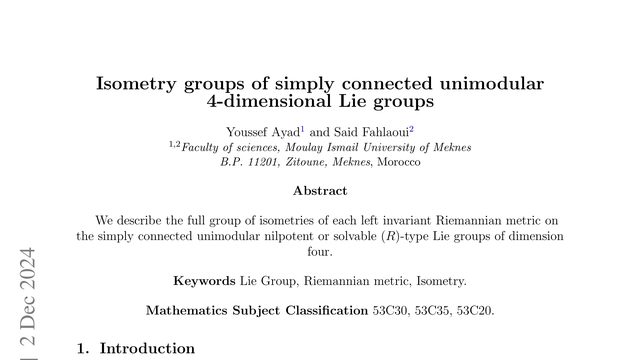
A space can look completely different after you move through it, yet some transformations leave every distance unchanged. This paper maps all such hidden symmetries for a broad family of four-dimensional spaces.What does every symmetry of a curved, four-dimensional Lie group look like? This paper turns that broad geometric question into a finite classification problem across exactly seven groups.
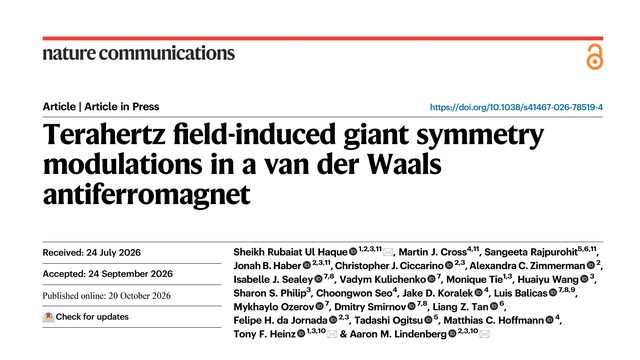
Sheikh Rubaiat Ul Haque, Martin J. Cross, Sangeeta Rajpurohit, Jonah B. Haber, Christopher J. Ciccarino, Alexandra C. Zimmerman, Isabelle J. Sealey, V. A. Kulichenko, Monique Tie, Huaiyu Hugo Wang, Sharon S. Philip, Choongwon Seo, J. D. Koralek, Luis Balicas, Mykhaylo Ozerov, Dmitry S. Smirnov, Liang Zheng Tan, Felipe H. da Jornada, Tadashi Ogitsu, Matthias C. Hoffmann, Tony F. Heinz, Aaron M. Lindenberg
A flash of terahertz light makes a magnetic crystal move as though its hidden internal order has suddenly been rearranged. The striking part is that the crystal’s visible symmetry changes and keeps oscillating long after the flash.What if a burst of terahertz light could make a quantum magnet oscillate so strongly that its symmetry visibly breaks? In MnPS3, that is exactly the behavior these measurements reveal.
 3:52