Tetra-O-methyl-nordihydroguaiaretic acid inhibits energy metabolism and synergistically induces anticancer effects with temozolomide on LN229 glioblastoma tumors implanted in mice while preventing obesity in normal mice that consume high-fat diets
In depth12:51CCAI
paperi.ai
0:00 / 0:00
Kotohiko Kimura, Jong Ho Chun, Yu‐Ling Lin, Yu‐Chuan Liang, Tiffany L. B. Jackson, Ru Chih C. Huang
What if a cancer treatment worked partly by disrupting the tumor’s fuel systems, and the same compound also limited weight gain in mice eating a high-fat diet? This study tests that surprising combination.
Tetra-O-methyl-nordihydroguaiaretic acid (terameprocol; M4N), a global transcription inhibitor, in combination with a second anticancer drug induces strong tumoricidal activity and has the ability to suppress energy metabolism in cultured cancer cells. In this study, we showed that after continuous oral consumption of high-fat (HF) diets containing M4N, the M4N concentration in most of the organs in mice reached ~1 μM (the M4N concentration in intestines and fat pads was as high as 20–40 μM) and treatment with the combination of M4N with temozolomide (TMZ) suppressed glycolysis and the tricarboxylic acid cycle in LN229 human glioblastoma implanted in xenograft mice. Combination treatment of M4N with TMZ also reduced the levels of lactate dehydrogenase A (LDHA), a key enzyme for glycolysis; lactate, a product of LDHA-mediated enzymatic activity; nicotinamide phosphoribosyltransferase, a rate-limiting enzyme for nicotinamide adenine dinucleotide plus hydrogen (NADH)/NAD+ salvage pathway; and NAD+, a redox electron carrier essential for energy metabolism. It was also shown that M4N suppressed oxygen consumption in cultured LN229 cells, indicating that M4N inhibited oxidative phosphorylation. Treatment with M4N and TMZ also decreased the level of hypoxia-inducible factor 1A, a major regulator of LDHA, under hypoxic conditions. The ability of M4N to suppress energy metabolism resulted in induction of the stress-related proteins activating transcription factor 4 and cation transport regulator-like protein 1, and an increase in reactive oxygen species production. In addition, the combination treatment of M4N with TMZ reduced the levels of oncometabolites such as 2-hydroxyglutarate as well as the aforementioned lactate. M4N also induced methylidenesuccinic acid (itaconate), a macrophage-specific metabolite with anti-inflammatory activity, in tumor microenvironments. Meanwhile, the ability of M4N to suppress energy metabolism prevented obesity in mice consuming HF diets, indicating that M4N has
Transcript
What if a cancer treatment worked partly by disrupting the tumor’s fuel systems—and the same compound also limited weight gain in mice eating a high-fat diet? This study tests that surprising combination. Cancer cells utilize energy metabolism differently from normal cells, suggesting that modulating energy metabolism might create physiological environments unfavorable for cancer growth without drastically harming normal tissues.
The paper also connects metabolism with immunity: manipulating immune-cell energy metabolism affects immunity, while cancer-derived metabolites modulate tumor microenvironments and immune-cell activity. Earlier work showed that M4N synergistically induced tumoricidal activity when combined with second anticancer drugs in xenograft mouse models.
That work also showed that M4N suppressed energy metabolism in cultured cancer cells and that combination treatment significantly generated reactive oxygen species, suggesting a link to M4N’s anticancer activity. Here, continuous M4N consumption was evaluated in healthy mice by measuring weight change, while daily M4N and temozolomide combination treatment was studied for its systemic effects on energy metabolism in LN229 glioblastoma tumors implanted in mice.
Female BALB/c nude mice received one times ten to the seventh GFP-labeled LN229 cells under the skin, and mice were randomly divided into four groups when average tumor mass reached two hundred to three hundred cubic millimeters. The groups received one hundred fifty milligrams per kilogram M4N and two point five milligrams per kilogram temozolomide, by daily oral administration.
These treatments made up four groups: M4N alone, temozolomide alone, both drugs together, and a separate control group for comparison. Treatment stopped on day twenty-five for temozolomide alone and the combination, and on day thirty-five for control and M4N alone; tumor measurements were recorded weekly with the Xenogen IVIS Imaging System.
For the diet experiment, mice were split between a high-fat diet and a high-fat diet containing M4N, with the high-fat group serving as control. Each group contained five mice, each mouse had its own cage so food consumption could be tracked individually, and the experiment lasted eight weeks.
Food consumption was calculated from the grams of food given minus the grams left in the cages, with measurements taken three times a week. Mice were weighed once a week at about the same time of day, and organs were collected on the final day. M4N in organs from mice eating the M4N-containing diet was measured using thin layer chromatography and high-performance liquid chromatography–tandem mass spectrometry.
For oxygen consumption, cells were treated with M4N for twenty-four hours, then measured with an oxygen consumption rate assay using a phosphorescent oxygen probe. Mineral oil shielded the medium from oxygen leaks, and fluorescence intensity indicated oxygen consumption.
Student’s t-test was used for statistical analyses, while CompuSyn software assessed synergy between the two drugs. Figure one compares M4N alone with combinations involving TMZ, sorafenib, etoposide, rapamycin, or UCN-01 across tumor-bearing mice and HL-1 heart cells.
In LN229 xenografts, the tumor-growth curves show significant differences from control after day twenty-three, while the survival panels report outcomes for HepG2 and AsPC1 tumors. The heart-cell assay is important as a safety comparison: unlike the tumor models, these combinations did not produce synergistic cell death in HL-1 cells.
Figure two tests whether M4N changes whole-body energy balance in mice eating high-fat diets. In panel A, mice receiving M4N-containing food gained less body weight over the measurement period, with several differences marked as statistically significant, while panel B shows no significant difference in total food intake.
Panel C confirms that after sixteen weeks, M4N was detectable across multiple tissues, including intestines, kidney, brain, and fat, supporting the authors’ interpretation that the compound acts systemically rather than simply reducing eating. To study tumor metabolism in the body, human LN229 glioblastoma cells were implanted in xenograft mice, which received vehicle, M4N, temozolomide, or the M4N and temozolomide combination before tumor metabolites were compared.
Temozolomide alone suppressed lactate and malate to some extent, setting up the comparison with the combination treatment. The M4N and temozolomide combination significantly further suppressed lactate and malate, while M4N and temozolomide markedly suppressed LDHA, a key glycolysis-related enzyme.
These data indicate that the combination suppressed glycolysis by reducing LDHA levels. An oxygen-consumption assay showed that M4N suppressed oxygen consumption in LN229 culture cells, indicating suppressed ATP generation by oxidative phosphorylation.
Figure three maps how M4N plus TMZ reshapes tumor metabolism. The box plots and pathway diagram show reduced lactate, alpha-ketoglutarate, fumarate, and malate in the combination group compared with TMZ alone, alongside stronger suppression of LDHA and oxygen consumption.
Panels B through D extend this mechanism to NAD plus, nicotinamide, FAD, and NAMPT, illustrating interference with the NAD plus salvage pathway and mitochondrial energy production. An MTT assay showed that M4N combination treatment synergistically reduced LN229 cell viability.
Using cobalt chloride to mimic hypoxia, Western blotting showed that cobalt chloride increased HIF1A in a dose-dependent way, while M4N with or without temozolomide reduced HIF1A in its presence. Figure four links M4N’s drug synergy with a mechanism involving HIF1A loss.
In LN229 cells, combining M4N with TMZ reduced viability, and the combination-index points are below one, the caption’s criterion for synergy. Western blots show that M4N, alone or with TMZ, reduced HIF1A under CoCl2-mimicked hypoxia.
In HeLa cells, M4N lowered hypoxia-induced HIF1A protein without a corresponding change in HIF1A messenger RNA, while DFO helped restore the protein, supporting PHD-dependent degradation rather than reduced transcription. Because the combination suppressed energy metabolism in LN229 tumors, the study tested whether it induced severe stress in tumors implanted in mice.
Western blots showed that M4N and temozolomide markedly induced the stress proteins activating transcription factor four and CHAC1 in LN229 tumors. The experiments showed that M4N and temozolomide synergistically induced superoxide, a reactive oxygen species predominantly produced in the mitochondrial electron transport chain of LN229 cells.
Figure five links treatment to cellular stress in two complementary systems. In the tumor samples, Western blots show ATF4 and CHAC1 after twenty-five days of oral M4N, TMZ, or their combination. In cultured LN229 cells, MitoROS measurements across two, four, twenty-four, and forty-eight hours track superoxide, with the combination treatment producing statistically marked changes at some time points.
Together, the figure supports the authors’ interpretation that combined treatment induces severe stress and reactive oxygen species. In xenograft mice with LN229 tumors, M4N significantly changed lactate, two-hydroxyglutarate, and itaconate, metabolites that modulated immunity and inflammation in the tumor microenvironment.
M4N and temozolomide significantly reduced lactate and also significantly reduced two-hydroxyglutarate. Figure six maps how treatment-associated metabolic changes connect to immune regulation in LN229 tumors. The box plots show reduced two-hydroxyglutarate with TMZ plus M4N compared with TMZ alone, while itaconate was significantly induced by M4N in macrophage-related cells.
Because lactate and two-HG can suppress immune-cell function, the authors interpret these shifts as evidence that combination treatment may reshape the tumor microenvironment toward stronger anticancer immunity. M4N prevented obesity in mice consuming high-fat diets, suggesting that M4N affected whole-body energy metabolism when administered systemically.
M4N concentrations in fat tissues reached as high as twenty micromolar after continuous consumption, suggesting that M4N could affect fat metabolism efficiently. The data indicated that M4N could potentially be used as a drug to control obesity.
M4N with temozolomide suppressed conversion from pyruvate to lactate by LDHA and suppressed the tricarboxylic acid cycle in LN229 tumors. The combination reduced NAMPT protein and suppressed nicotinamide adenine dinucleotide plus hydrogen in LN229 tumors, indicating effects on energy metabolism through the NAD plus salvage pathway.
Figure seven is a proposed mechanism for how M4N, especially alongside a second anticancer drug, produces tumoricidal activity. It connects suppression of glycolysis and the TCA cycle with energy-metabolism disruption, ER-stress activation, and increased ROS generation, while also showing changes involving HIF1A, LDHA, NAMPT, and metabolites such as lactate and two-hydroxyglutarate.
The schematic also includes macrophage and inflammation-related pathways, highlighting that M4N’s effects extend beyond cancer-cell metabolism and ultimately converge on cancer-cell death. The proposed mechanism begins with M4N suppressing glycolysis and the tricarboxylic acid cycle by modulating HIF1A, LDHA, and NAMPT.
Reduced energy metabolism activates endoplasmic-reticulum stress, and endoplasmic-reticulum stress increases reactive oxygen species, particularly when a second anticancer drug is combined with M4N. The combination reduces lactate and two-hydroxyglutarate, which the paper states suppress functions of immune cells in the tumor microenvironment; it also induces itaconate production in macrophages.
The paper presents M4N combination treatment with selective anticancer drugs as an approach to possible complete remission of human cancer. It argues that because efficient energy metabolism is crucial for cancer-cell survival, M4N combination treatment should potentially apply to cancers of heterogeneous origin.
Reducing oncometabolites such as lactate and two-hydroxyglutarate is presented as an anticancer effect through immune-related metabolism as well as energy metabolism. In mice carrying LN229 glioblastoma tumors, M4N combined with temozolomide suppressed several energy pathways and altered tumor metabolites, while M4N-containing high-fat diets prevented excess weight gain in normal mice.
A derivative work by Paperi · AI-generated script, voice and captions
· pages and figures unaltered
Made with Paperi.
Drop in a research PDF — get a narrated video walkthrough like this one,
with highlights that follow the narration. Free to start.
Immune cells can help attack a tumor or help it grow. This study suggests that a tiny sugar pattern on their surface helps decide which role they take, and removing it pushes them toward attack.A tiny change in a sugar structure may help push macrophages toward an anti-tumor state. This study traces that switch from bisecting GlcNAc, to Lgals3bp, to NF-kappa B signaling.
Jane Callaghan, Lisa Fellin, Stavroula Mavrou, Joanne H. Alexander, Vasiliki Deligianni-Kouimtzi, Maria Papathanassiou, Judith Sixsmith
For a child living with domestic abuse, a pet may be more than a beloved animal. It may be a source of comfort, safety, and the feeling of being heard, while also becoming part of the danger.For children living with domestic violence and abuse, a pet can be much more than a pet: a family member, a source of comfort, and sometimes part of the control and danger itself.
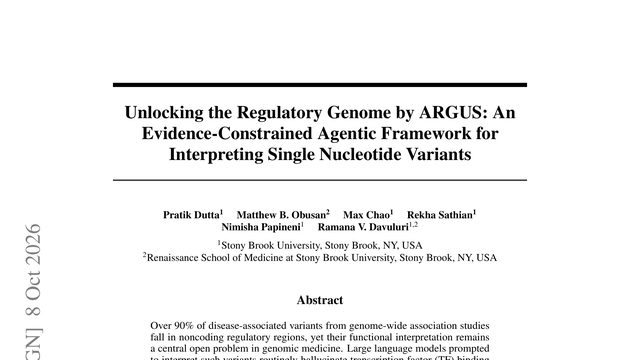
Pratik Dutta, Matthew B. Obusan, Max Chao, Rekha Sathian, Nimisha Papineni, Ramana V. Davuluri
Most disease-linked changes in DNA sit outside genes, where their effects are hard to read. An AI can sound confident about them, and still invent the evidence, so this system is designed to stop and say when the evidence is not enough.What if the safest genomics AI is not the one that always gives an answer, but the one that knows when evidence cannot support a verdict? ARGUS builds that restraint directly into its investigation loop.
 3:18