Immune cells can help attack a tumor or help it grow. This study suggests that a tiny sugar pattern on their surface helps decide which role they take, and removing it pushes them toward attack.
Immune cells can help attack a tumor or help it grow. This study suggests that a tiny sugar pattern on their surface helps decide which role they take—and removing it pushes them toward attack. Macrophages are immune cells being explored for cancer treatment. They can take an anti-tumor state or a pro-tumor state.
The anti-tumor, or M1, state strengthens the immune response against tumors by promoting Th1 responses, presenting antigens, and releasing cytotoxic molecules. The pro-tumor, or M2, state supports tissue repair and facilitates new blood-vessel growth, or angiogenesis, while producing anti-inflammatory cytokines.
Untuned, nonpolarized M0 macrophages remain plastic, allowing them to transition into either the anti-tumor M1 state or the pro-tumor M2 state. Think of them as workers who can be assigned to demolition or construction.
Reprogramming them toward the anti-tumor state is therefore an attractive treatment path. During the change from M0 toward the anti-tumor M1 state, the cells showed decreased levels of bisecting GlcNAc, a sugar pattern. That loss suggested that a deficiency in bisecting GlcNAc may contribute to driving the cells toward the anti-tumor M1 state.
The study then examined which proteins carried the pattern and how those proteins could influence the change. The sugar pattern was lower in anti-tumor macrophages than in uncommitted macrophages, together with lower levels of the enzyme that adds it.
The same decrease appeared in two primary mouse macrophage cell types when they entered the anti-tumor state. When the enzyme that adds the sugar pattern was silenced, the sugar pattern fell and a marker of the anti-tumor state rose. Several anti-tumor signals also increased.
When the enzyme was added instead, it hindered the change toward the anti-tumor state after inflammatory stimulation. The cells’ change involved a major inflammatory signaling pathway. That pathway became more active after either the sugar-adding enzyme was silenced or the cells received inflammatory stimulation.
More of the identified protein, Lgals3bp, increased NF-kappa B activity, while reducing it led to inactivation of that signaling pathway. The study also found that Lgals3bp, with reduced bisecting GlcNAc, showed a stronger binding affinity to its signaling partner, Traf6.
Together, the findings indicate that removing the sugar pattern changes this protein’s interaction with its partner, activates the inflammatory pathway, and drives the anti-tumor state. The study emphasizes that sugar patterns attached to proteins matter in macrophage decision-making.
It points toward a future in which macrophages could be modified through changes to those sugar patterns, rather than treated as fixed cells. The study identifies a self-reinforcing switch: less of this sugar pattern stabilizes a protein, activates an inflammatory signal, and pushes macrophages toward the tumor-fighting state.
That could one day help guide immune-cell treatments.
A derivative work by Paperi · AI-generated script, voice and captions
· pages and figures unaltered
Made with Paperi.
Drop in a research PDF — get a narrated video walkthrough like this one,
with highlights that follow the narration. Free to start.
Jane Callaghan, Lisa Fellin, Stavroula Mavrou, Joanne H. Alexander, Vasiliki Deligianni-Kouimtzi, Maria Papathanassiou, Judith Sixsmith
For a child living with domestic abuse, a pet may be more than a beloved animal. It may be a source of comfort, safety, and the feeling of being heard, while also becoming part of the danger.For children living with domestic violence and abuse, a pet can be much more than a pet: a family member, a source of comfort, and sometimes part of the control and danger itself.
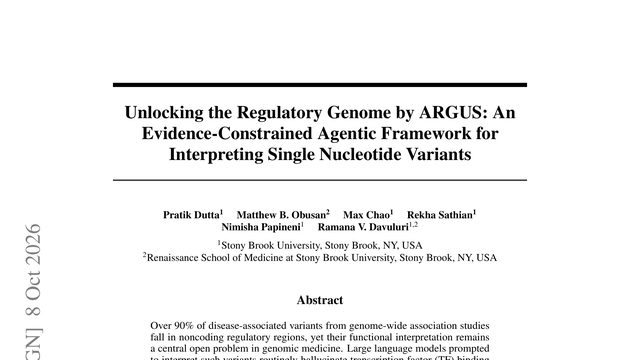
Pratik Dutta, Matthew B. Obusan, Max Chao, Rekha Sathian, Nimisha Papineni, Ramana V. Davuluri
Most disease-linked changes in DNA sit outside genes, where their effects are hard to read. An AI can sound confident about them, and still invent the evidence, so this system is designed to stop and say when the evidence is not enough.What if the safest genomics AI is not the one that always gives an answer, but the one that knows when evidence cannot support a verdict? ARGUS builds that restraint directly into its investigation loop.
Mhd Hussein Murtada, Z. Faidon Brotzakis, Michele Vendruscolo
Proteins are constantly changing shape, but watching every tiny movement can take far longer than the movement itself. This study asks whether a language model can learn those motions and predict what happens under new physical conditions.What if molecular dynamics could be treated like language: structures become tokens, trajectories become sentences, and every generated path comes with an explicit probability? This paper tests that idea across proteins, temperatures, and force-field conditions.
 3:37