Part of the Family: Children’s Experiences with Their Companion Animals in the Context of Domestic Violence and Abuse
In depth10:00CCAI
paperi.ai
0:00 / 0:00
Jane Callaghan, Lisa Fellin, Stavroula Mavrou, Joanne H. Alexander, Vasiliki Deligianni-Kouimtzi, Maria Papathanassiou, Judith Sixsmith
For children living with domestic violence and abuse, a pet can be much more than a pet: a family member, a source of comfort, and sometimes part of the control and danger itself.
Purpose Children who experience Domestic Violence and Abuse (DVA) draw on a range of strategies to manage the complex dynamics of family life. This article explored children’s experiences of their relationships with pets and other animals, considering how children understood these relationships. Methods This qualitative study is based on semi-structured interviews and visual methods-based research with 22 children (aged 9–17), drawn from a larger study on how children cope with DVA. The data were analysed using reflexive thematic analysis. Findings Five themes are discussed: Part of the family explores how children positioned animals as relational beings who occupied an important place in their lives; caring for animals considers the reciprocal caring relationship children described; listening and support details how children interacted with animals to allow themselves to feel more heard and supported; in the theme control and abuse, we consider children’s experiences of perpetrators’ use of companion animals as part of a pattern of abuse and control; and in disruption, uncertainty and loss, we discuss how children feel and relate to their animals when leaving situations of domestic abuse. Conclusions The implications of our analysis are considered in relation to providing support for children impacted by domestic abuse, and the importance of ensuring companion animals are provided for in housing policy and planning for domestic abuse survivors.
Transcript
For children living with domestic violence and abuse, a pet can be much more than a pet: a family member, a source of comfort, and sometimes part of the control and danger itself. Children who experience Domestic Violence and Abuse, or DVA, draw on a range of strategies to manage the complex dynamics of family life.
This article explored children’s experiences of their relationships with pets and other animals, considering how children understood these relationships. This qualitative study is based on semi-structured interviews and visual methods-based research with twenty-two children aged nine to seventeen, drawn from a larger study on how children cope with DVA.
The data were analysed using reflexive thematic analysis. Perpetrators of DVA often direct abusive and controlling behaviours toward companion animals. Domestic abusers abuse pet animals directly and as a tool of control over their human victims.
The literature largely focuses on the co-occurrence of DVA and animal experiences, their potential impact on children, and whether relationships with pets might act as a protective factor. The literature on children, DVA, and companion animals involves only minimal direct input from children and young people.
Some studies include children’s self-reporting of exposure to animal cruelty and relationships with pets, while their experience of DVA and mental health is reported through parental assessment. Qualitative research directly with children on their relationships with pets and experiences of animal abuse in the context of DVA is extremely limited.
This is the gap that the article aims to address. The broader context of child-animal relationships in DVA is less well understood, even though the use of companion animals as tools of coercive control against adult victims has been well established. Child-focused studies have highlighted the impact of witnessing animal cruelty and the potential for positive relationships with pets to mediate the impact of DVA on children’s outcomes.
These studies have rarely spoken directly to children, so their lived experience of relationships with pets in the context of DVA is not well documented. The aim was to explore how children living with DVA understand and experience their relationships with companion animals.
The UNARS, or Understanding Agency and Resistance Strategies, study focused on children’s experiences of coping with and managing DVA. It was a four-nation multimethod study in England, Italy, Spain, and Greece, incorporating individual semi-structured interviews, photo elicitation, and drawings, including family drawings and home maps.
Interviews were conducted within the services where children were recruited, in a quiet interview room or office. The multimethod data generation involved semi-structured interviews, and children were also invited to draw pictures if they wanted to as part of that interview.
Children were invited to take photos that captured their experiences of coping with DVA in their family, and those who participated were invited to a second interview to discuss the photos. Data generation took place in safe places chosen in negotiation with the children themselves and focused on their wellbeing and empowered choices about the stories they told and how they told them.
Researchers completed a reflexive journal immediately after each interview, capturing their emotional responses and reflections, and read these together with each interview transcript as part of the analytic process. Data were analysed using Reflexive Thematic Analysis, informed by a constructionist and feminist theoretical lens.
The interpretation was framed as co-constructed through interaction with the data and with theoretical, analytic, and disciplinary resources. Several researchers coded interviews independently, discussed how they were interpreting and labelling the data, and discussed different interpretations until consensus was reached.
Initial themes were identified, reviewed, further developed, and then refined, defined, and named through discussion and collaboration. Data analysis produced six themes expressing the role of animals in the family in situations of DVA: Part of the Family, Control and abuse, Caring for animals, Comfort and Safety, Listening for support, and Disruption uncertainty and loss.
Dogs and cats are described alongside other family members, each named and imbued with a sense of personhood and relationality. They appear in drawings and talk about home, suggesting importance in children’s place-based meaning making. They are present in photos of important events and celebrations, indicating that they are part of family gatherings.
Dogs and cats are positioned as relational beings, important and meaningful in family life. Caring well for animals is an important source of pride for these children and stands in stark contrast to the abusive relationships and violence that characterise other aspects of family life.
Domestic abuse disrupts family relationships, and perpetrators often directly target the bond between mothers and children by undermining women’s capacity to parent. In contrast, pets offer relationship, closeness, and bonding that allow children to maintain some kind of relational network despite abuse.
Figure three shows a black cat sitting on a bed, alongside George’s account that having the cat in his room helps prevent nightmares. The authors connect this image and quotation to children’s detailed, tactile descriptions of animals, including stroking and spending time with them.
The figure matters because it illustrates how relationships with pets provided comfort, safety, and a deeply personal sense of connection. Figure four shows Anna’s dog in a close-up photograph displayed on a laptop screen. The visual makes the animal’s presence tangible, while the surrounding discussion explains that companion animals can offer children affected by domestic violence dependable, unconditional love and reassurance.
Alongside George’s attention to fur texture and the comfort of stroking animals, the image represents an intimate, tactile connection rather than viewing the dog simply as a pet. Children and young people’s accounts made it clear that they derived considerable comfort and a sense of safety from their relationships with animals.
Children feel that pets and other animals, as relational beings, can hear their experiences, particularly their experiences of DVA. For children, talking to other people about violence and abuse can be very difficult. Animals are safe for children to talk to: they keep secrets, do not disclose things to others, and offer a supportive, listening ear.
Children and young people can often experience animals as supportive and comforting, but there is also a more challenging aspect for children who experience domestic abuse. Research with adult survivors and professionals has suggested that pets are often used as tools of coercion and are directly abused by domestic abuse perpetrators.
The interviews focused on coping with DVA and did not explicitly ask children about direct experiences of violence and abuse, so they do not provide specific examples of animal maltreatment described in previous literature. Nonetheless, the children in the interviews demonstrated an awareness of such threats and violence.
For many child participants, fleeing domestic abuse meant loss and disruption. They left behind friends and belongings, and several also had to leave behind their companion animals. Leaving companion animals was experienced as a core aspect of the losses they experienced.
Tina, aged ten, and her family had to leave very suddenly and fled to a different county overnight. Thinking about pets as part of the family encompasses broader, more complex, and subtle emotional and relational issues in children’s lived experience before and after fleeing DVA.
Children have strong relational bonds with companion animals, who they see as an important source of emotional support, comfort, and safety. This provides evidence to support the speculation that companion animals might play a role in building resilience. Children impacted by domestic abuse may benefit from their relationships with companion animals.
The implications include making children’s experiences visible and signalling concerns that professionals need to consider when children who experience DVA talk about their experiences. This paper is one of the first to work directly with children’s accounts of domestic abuse to understand the role companion animals play for child victim-survivors of domestic abuse.
The data came from a larger study about children’s coping with domestic abuse, and the interviews were not specifically focused on companion animals. That can be a strength because the theme was raised by children themselves rather than by the researchers.
It also meant that opportunities were missed to explore further the meaning of animals in children’s lives and experiences of DVA. A bespoke study focused specifically on this would enable a fuller exploration of children’s perspectives and experiences. The study shows that children’s companion animals can provide emotional support, comfort, safety, and continuity, while separation from them can deepen the losses of fleeing abuse.
Support and housing planning need to account for that bond.
A derivative work by Paperi · AI-generated script, voice and captions
· pages and figures unaltered
Made with Paperi.
Drop in a research PDF — get a narrated video walkthrough like this one,
with highlights that follow the narration. Free to start.
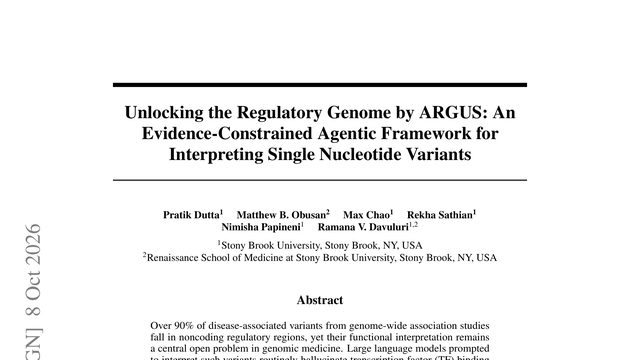
Pratik Dutta, Matthew B. Obusan, Max Chao, Rekha Sathian, Nimisha Papineni, Ramana V. Davuluri
Most disease-linked changes in DNA sit outside genes, where their effects are hard to read. An AI can sound confident about them, and still invent the evidence, so this system is designed to stop and say when the evidence is not enough.What if the safest genomics AI is not the one that always gives an answer, but the one that knows when evidence cannot support a verdict? ARGUS builds that restraint directly into its investigation loop.
Mhd Hussein Murtada, Z. Faidon Brotzakis, Michele Vendruscolo
Proteins are constantly changing shape, but watching every tiny movement can take far longer than the movement itself. This study asks whether a language model can learn those motions and predict what happens under new physical conditions.What if molecular dynamics could be treated like language: structures become tokens, trajectories become sentences, and every generated path comes with an explicit probability? This paper tests that idea across proteins, temperatures, and force-field conditions.
A pesticide can stop a caterpillar from eating, yet the more important warning may appear inside its cells. This study compares both effects instead of treating pest control as a single yes-or-no question.What if an insecticide can stop a crop pest from eating, yet another one leaves the strongest signal of DNA damage? This study compares both effects instead of treating pest control as a single question.
 3:46