Part of the Family: Children’s Experiences with Their Companion Animals in the Context of Domestic Violence and Abuse
Overview3:37CCAI
paperi.ai
0:00 / 0:00
Jane Callaghan, Lisa Fellin, Stavroula Mavrou, Joanne H. Alexander, Vasiliki Deligianni-Kouimtzi, Maria Papathanassiou, Judith Sixsmith
For a child living with domestic abuse, a pet may be more than a beloved animal. It may be a source of comfort, safety, and the feeling of being heard, while also becoming part of the danger.
Purpose Children who experience Domestic Violence and Abuse (DVA) draw on a range of strategies to manage the com plex dynamics of family life. This article explored children’s experiences of their relationships with pets and other animals, considering how children understood these relationships. Methods This qualitative study is based on semi-structured interviews and visual methods-based research with 22 children (aged 9–17), drawn from a larger study on how children cope with DVA. The data were analysed using reflexive thematic analysis. Findings Five themes are discussed: Part of the family explores how children positioned animals as relational beings who occupied an important place in their lives; caring for animals considers the reciprocal caring relationship children described; listening and support details how children interacted with animals to allow themselves to feel more heard and supported; in the theme control and abuse, we consider children’s experiences of perpetrators’ use of companion animals as part of a pattern of abuse and control; and in disruption, uncertainty and loss, we discuss how children feel and relate to their animals when leaving situations of domestic abuse. Conclusions The implications of our analysis are considered in relation to providing support for children impacted by domestic abuse, and the importance of ensuring companion animals are provided for in housing policy and planning for domestic abuse survivors.
Transcript
For a child living with domestic abuse, a pet may be more than a beloved animal. It may be a source of comfort, safety, and the feeling of being heard—while also becoming part of the danger. Children living with domestic violence and abuse draw on different strategies to manage the complicated dynamics of family life.
This study explored children’s experiences of their relationships with pets and other animals, and how children understood those relationships. But there was a missing voice: research on children, domestic abuse, and companion animals included very little direct input from children and young people.
Some studies asked children about animal cruelty or their relationship with a pet, but children’s experience of domestic abuse and their mental health were reported through parents. Direct research with children about their relationships with pets and experiences of animal abuse in domestic abuse was extremely limited, and this study aimed to address that gap.
The children’s accounts were examined by reading and rereading the interviews, while listening to the recordings. Several members of the research team examined some interviews separately, then discussed how they were interpreting and labelling what they found.
Different interpretations were discussed until agreement was reached, and the themes were then reviewed and developed as the analysis progressed. The findings described animals as part of the family and as important beings in children’s lives.
Children described caring for animals and being cared for in return, and they interacted with animals to feel more heard and supported. But the same relationships could also be caught up in abuse and control, and leaving domestic abuse could bring disruption, uncertainty, and loss in children’s relationships with their animals.
For some children, a pet’s steady presence makes home feel safer: stroking its fur, watching it, or simply having it nearby can ease stress and even keep nightmares away. But animals could also be part of the danger: pets may be used to control people and may be directly abused by perpetrators of domestic abuse.
The interviews did not specifically ask about direct experiences of violence against animals, so they did not provide specific examples of animal maltreatment. Even so, the children showed that they were aware of threats and violence toward animals.
The children had strong bonds with their companion animals, whom they saw as important sources of emotional support, comfort, and safety. These findings support the possibility that companion animals may help children build resilience when children are facing the effects of domestic abuse.
They also show how children affected by domestic abuse may benefit from their relationships with companion animals before and after fleeing. The interviews were drawn from a larger study about children coping with domestic abuse, rather than being focused specifically on companion animals.
That meant the theme came from the children themselves, but it also meant that some opportunities were missed to explore more deeply what animals meant in their lives and their experience of domestic abuse. A study focused specifically on this subject could explore children’s perspectives and experiences more fully.
Children described strong bonds with their companion animals before and after leaving abuse. Support for families escaping domestic abuse needs to protect those animals too, because they can be part of a child’s emotional safety.
A derivative work by Paperi · AI-generated script, voice and captions
· pages and figures unaltered
Made with Paperi.
Drop in a research PDF — get a narrated video walkthrough like this one,
with highlights that follow the narration. Free to start.
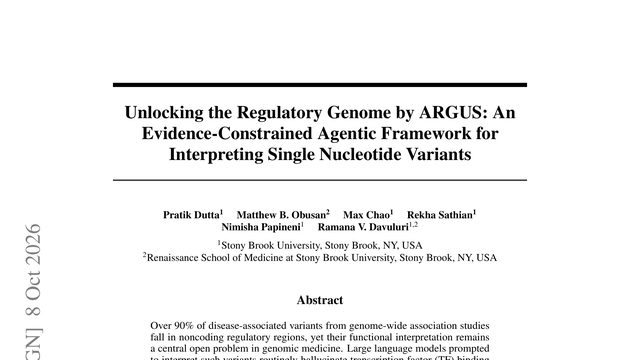
Pratik Dutta, Matthew B. Obusan, Max Chao, Rekha Sathian, Nimisha Papineni, Ramana V. Davuluri
Most disease-linked changes in DNA sit outside genes, where their effects are hard to read. An AI can sound confident about them, and still invent the evidence, so this system is designed to stop and say when the evidence is not enough.What if the safest genomics AI is not the one that always gives an answer, but the one that knows when evidence cannot support a verdict? ARGUS builds that restraint directly into its investigation loop.
Mhd Hussein Murtada, Z. Faidon Brotzakis, Michele Vendruscolo
Proteins are constantly changing shape, but watching every tiny movement can take far longer than the movement itself. This study asks whether a language model can learn those motions and predict what happens under new physical conditions.What if molecular dynamics could be treated like language: structures become tokens, trajectories become sentences, and every generated path comes with an explicit probability? This paper tests that idea across proteins, temperatures, and force-field conditions.
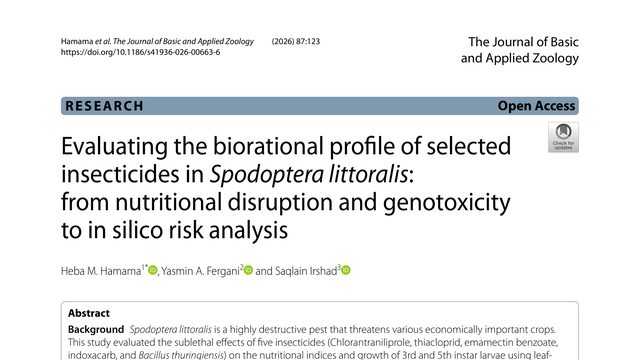
A pesticide can stop a caterpillar from eating, yet the more important warning may appear inside its cells. This study compares both effects instead of treating pest control as a single yes-or-no question.What if an insecticide can stop a crop pest from eating, yet another one leaves the strongest signal of DNA damage? This study compares both effects instead of treating pest control as a single question.
 3:46