Socio-economic impacts of the recent bio-invasion of Callinectus sapidus on small-scale artisanal fishing in southern Italy and Portugal
In depth15:08CCAI
paperi.ai
0:00 / 0:00
Ludovica Nardelli, Vincenzo Fucilli, Hugo Pinto, Jennifer Nicole Elston, Annalisa Carignani, Alessandro Petrontino, Francesco Bozzo, Michel Frem
The same invasive blue crab produces two very different fishing crises. In Apulia, nets and catches take the hit; in the Algarve, the biggest burdens are concentrated in physical harm, working time, costs, and income.
Introduction: The recent and growing bio-invasion of the Callinectes sapidus (known as blue crab) is causing damages in the European aquatic ecosystems, and affecting the livelihoods of the fishermen. In this context, this study explores the socio-economic impacts of this bio-invasion on small-scale artisanal fishermen in the Apulia (southern Italy) and Algarve (southern Portugal) regions, analyzing their perceptions and highlighting the repercussions of this bioinvasion on their livelihoods. Methods: For this purpose, we carried out a field survey with representative small-scale artisanal fishermen based on the “Socio-economic Impact Classification of Alien Taxa” (SEICAT) approach by means of an “Exploratory Factor Analysis” (EFA), and a “Hierarchical Analysis and K-means Cluster Analysis”. Results and discussion: The findings reveal that the two study areas, Apulia and Algarve, exhibit markedly different perceptions of the impact of the blue crab invasion on the well-being and activity of fishermen. In Apulia, the invasion has led to extensive damage to fishing nets, physical harm, a decline in other commercial species, reduced catch quantities, increased working hours, higher costs, and lower incomes. Conversely, in the Algarve, while net damage is less severe, the primary concerns are physical harm, increased working hours, higher costs, and reduced income. Consequently, this research provides an empirical basis for the adoption of management measures and interventions to mitigate the socioeconomic impacts of the blue crab on the fishing community and local economy, thereby contributing to the well-being of both individuals and the marine ecosystem.
Transcript
The same invasive blue crab produces two very different fishing crises. In Apulia, nets and catches take the hit; in the Algarve, the biggest burdens are concentrated in physical harm, working time, costs, and income.
The recent and growing bio-invasion of Callinectes sapidus, known as blue crab, is causing damages in European aquatic ecosystems and affecting fishermen’s livelihoods. The study explores these socio-economic impacts on small-scale artisanal fishermen in Apulia in southern Italy and Algarve in southern Portugal, analyzing their perceptions and repercussions on livelihoods.
Invasive alien species disrupt ecosystems and can alter global biodiversity dynamics. In marine ecosystems, non-indigenous species are organisms introduced beyond their native geographic range, and they can cause loss of indigenous genetic diversity, habitat deterioration, shifts in trophic relationships, and displacement of native species.
These invasions also have adverse socio-economic consequences for fisheries and recreational activities, while management measures to mitigate their impacts have been insufficient. Research has examined invasive species, their economic costs, and their effects on biodiversity, ecosystem services, and human well-being.
The SEICAT methodology classifies alien taxa according to the magnitude of their impacts on human well-being, but previous studies using it focused mainly on terrestrial species. Only one study had examined a marine species with this methodology, classifying blue-crab impacts in Morocco’s Marchica lagoon and finding negative effects on fishing activity.
The study explores the impacts of the recent Callinectes sapidus bio-invasion on fishermen’s well-being and changes in activity size in Apulia and Algarve. The assessment covers catch quality, net and physical damages, interactions with other species, and changes related to fishery areas.
The work proposes a comparative analysis of socio-economic implications in Apulia and Algarve, where studies of this kind in invaded European coastal areas are lacking. The study uses direct interviews based on SEICAT, Exploratory Factor Analysis, and Hierarchical and K-means Cluster Analysis.
Its scope is limited to socio-economic consequences and does not include ecological consequences in the natural environment. Figure two maps the two study regions: Apulia in southern Italy and the Algarve in southern Portugal. Black shading marks the study areas, while red points show blue crab, or C.
sapidus, records along the surveyed coastal and lagoon systems. This geographic view matters because the authors compare socioeconomic impacts of the species across two invaded European coastal settings, including the Lesina lagoon, Ria Formosa lagoon, and Guadiana Estuary. The research was conducted in Lesina lagoon in Apulia and in Faro, Olhao, Moncharapaco, Fuseta, Castro Marim, Vila Real de Santo António, and Monte Gordo in Algarve.
The two selected study areas are conservation areas with active local-community participation in research and biodiversity conservation. SEICAT is a novel standardized system based on human well-being for categorizing alien taxa according to their socio-economic impacts.
The approach assesses impact magnitude, facilitates cross-regional and cross-taxa comparisons, supports predictions of future impacts, and helps prioritize management actions and introduction pathways. The method was selected because it provides transparent and comparable impact measures grounded in clear and explicit definitions.
From October twenty twenty-three to February twenty twenty-four, the survey engaged sixty-six valid small-scale artisanal fishermen at sites bordering Lesina lagoon, Ria Formosa lagoon, and the Guadiana Estuary. A calculation using a ten percent margin of error and a ninety-five percent confidence level produced a sample size of fifty-three, which was increased to sixty-six and divided equally between the study areas.
A rapid appraisal found thirty-three fishermen with at least one contact with the invasive species in Apulia and thirty-six in Algarve. Table one defines the SEICAT scale, a standardized framework for classifying socio-economic impacts of an alien taxon on human activities.
It ranges from massive, coded em-vee, meaning local disappearance irreversible for at least a decade, through major, moderate, and minor impacts, to minimal, coded em-see, where no negative impact is reported. This matters because the scale gives the authors a consistent way to assess impact magnitude and support comparisons across regions and taxa.
The questionnaire had three sections designed to capture SEICAT data. The first section covered fishing areas, professional duration, seasons, boat specifications, fishing gear, and cooperative membership. The second section collected perceptions of income, expenses, net and catch damages, physical injuries, and changes in fishing activity, including fishermen, fishing areas, and catch quantity.
The third section covered age, gender, residence, family composition, education, occupations, and annual family income. Socioeconomic data were analyzed with descriptive statistics using IBM SPSS Statistics software version twenty-nine. Exploratory Factor Analysis identified latent variables and examined the impact of the blue crab on fishermen’s well-being and activities.
Hierarchical Analysis and K-means Cluster Analysis identified clusters of respondents with similar characteristics. The Kaiser-Meyer-Olkin test checked whether the data were suitable for factor analysis, while a p-value less than zero point zero five indicated significant correlations between variables.
The cluster analysis aimed to identify and compare fisherman typologies and determine which groups perceived invasion effects more or less strongly. The KMO value was zero point five five eight for Apulia, suggesting mediocre sampling adequacy, and zero point seven six one for Algarve, indicating good suitability.
In both areas, the p-value was less than zero point zero five, and the Shapiro-Wilk test showed no significant deviations from normality. Table two profiles thirty-three fishermen in each study area, combining socio-economic measures with boat and fishing characteristics.
It reports, for example, mean seniority of forty-two years in Apulia and forty-one in Algarve, while year-round fishing accounts for fifty-eight percent and ninety-seven percent, respectively. The table also records differences in engine power, principal tools, cooperative involvement, age groups, and family size, giving context for comparing the two fishing communities.
The sample was evenly divided: fifty percent fished in Lesina lagoon and fifty percent operated in municipalities within Algarve. Average seniority was similar, at forty-two years in Apulia and forty-one in Algarve, but fishing seasons differed: fifty-eight percent of Apulian fishermen fished year-round, compared with ninety-seven percent in Algarve.
Average boat length was eight meters in Apulia and seven in Algarve, while Algarve boats had higher engine horsepower; cooperative participation was fifty-two percent in Apulia and fifteen percent in Algarve. All respondents were male, average household size was three members, and income distributions differed between the regions.
The two study areas showed markedly different perceptions of the blue-crab invasion’s impact on fishermen’s well-being. In Apulia, all respondents confirmed net damage, and fifty-two percent rated it very significant; ninety-four percent reported increased costs, with thirty-nine percent rating that increase very significant.
Physical damage was reported by eighty-two percent of Apulian respondents, with thirty-three percent describing it as very significant. In Apulia, ninety-seven percent perceived a reduction in other commercial species, ninety-four percent reported increased working hours, and ninety-seven percent noted catch damages.
Sixty-one percent perceived reduced income, with nine percent considering it very significant. In Algarve, equipment damage was reported by sixty-seven percent, increased costs by eighty-eight percent, and physical damage by forty-five percent.
Ninety-one percent of Algarve respondents perceived increased working hours, sixty-seven percent reported catch damage, and fifty-two percent perceived reduced income. Figure five is a radar chart comparing how Apulian and Algarve fishers rate seven effects of the blue-crab invasion, on a scale from insignificant to very significant.
The categories include increased costs, reduced income, catch and net damage, harm to fishers, reduced presence of other species, and increased workload; for example, Apulia’s net-damage score is four point five, while Algarve’s is four point one. The figure matters because it shows that the invasion affects both economic conditions and the practical safety and workload of fishing.
In Apulia, sixty-four percent reported abandonment in some fishing areas, seventy-six percent reported reduction in other areas, and seventy-nine percent reported reshaping fishing activities. In Apulia, forty-five percent of respondents stated that some fishermen had also abandoned the activity, a reported impact on the size of fishing activity.
Moreover, in Apulia, sixty-one percent of respondents reported catching less fish following the invasion, indicating a reduction in reported catch. In Algarve, the corresponding figures were twenty-four percent for abandonment, twenty-seven percent for reduction, fifteen percent for restructuring, fifteen percent for discontinued activity, and thirty percent for catching less fish.
Forty percent of Apulian fishermen sold the crab, compared with ninety-seven percent in Algarve; overall activity impact was categorized as Moderate in Apulia and Minor in Algarve. Figure six is a radar chart comparing how blue-crab invasion affected fishermen’s activity size in Apulia and Algarve, using a one-to-five significance scale across fishing changes, abandonment, reshaping, and reductions in activity or fisher numbers.
Apulia’s reported scores include three point three for FISH, three point zero for REDU1 and REDU3, and two point seven for RNFI, while Algarve’s values range from one point six to three point three. The figure matters because it shows that the invasion was associated with multiple, substantial changes in fishing activity, not just reduced catches.
Figure seven summarizes the blue crab’s overall average impact on fishermen’s wellness and activity in Apulia and Algarve. The chart reports average scores of four for wellness in Apulia and three in Algarve, while activity scores are three and two, respectively.
By bringing these dimensions together, the figure shows that the invasion affected both fishermen’s well-being and the scale or organization of their work, complementing the reported changes in fishing areas, catches, and working demands. Apulia and Algarve exhibit markedly different perceptions of the blue-crab invasion’s impact on fishermen’s well-being.
In Apulia, the invasion affected net damage, physical damage, other commercial species, catch quantity, working hours, costs, and income, with net damage perceived as the most significant impact. In Algarve, perceived net damage was lower, while physical damage, increased working hours, increased costs, and reduced income were the most significant concerns.
Overall, the invasion affected fishing gear, working hours, catch composition, catch quantities, costs, physical harm, and the potential shift toward targeting blue crab as a commercial species. Nearly all fishermen in Algarve, ninety-nine percent of those interviewed, sold the crabs, while only a minority in Apulia recognized their commercial value.
In Apulia there is no established supply chain, the crab is not widely consumed, and fishermen lack appropriate fishing gear, contributing to a more significant perceived impact. The study suggests that reducing the population through commercial exploitation for human consumption may be a comprehensive management control.
Monetary valuation can be challenging and may overlook important dimensions of human well-being. The measured socio-economic impacts were perceived as negative, while ecological impacts on the environment were not studied; the authors therefore state that limiting or containing population expansion requires urgent management actions.
The first preliminary action proposed is early detection and monitoring in non-invaded areas. A holistic approach includes the dissemination of appropriate fishing equipment and practices, together with demonstrations showing how those practices and equipment are used.
Other proposed measures include informative campaigns, training, public and private management programs, acoustic traps, lagoon-gate management, fishing during bans on other species, and alternative gears with larger mesh sizes. Interviewing fishermen presents significant challenges, and the methodology relies on participants’ perceptions, which can vary with the presence or absence of blue crab at interview time.
A detailed analysis of the extent of damage to professional fishing activities remains an area requiring further exploration. Future research should test proposed solutions, evaluate fishermen and market adaptability, and explore circular economy solutions and sustainable alternative fishing methods.
The study also identifies a lack of statistical data on blue-crab abundance and density across the two areas, which is needed to address a limitation of the study. Blue-crab impacts are not uniform: Apulia is classified as having a moderate activity impact, while Algarve is minor, with local fishing practices and markets shaping the difference.
That makes place-specific management essential.
A derivative work by Paperi · AI-generated script, voice and captions
· pages and figures unaltered
Made with Paperi.
Drop in a research PDF — get a narrated video walkthrough like this one,
with highlights that follow the narration. Free to start.
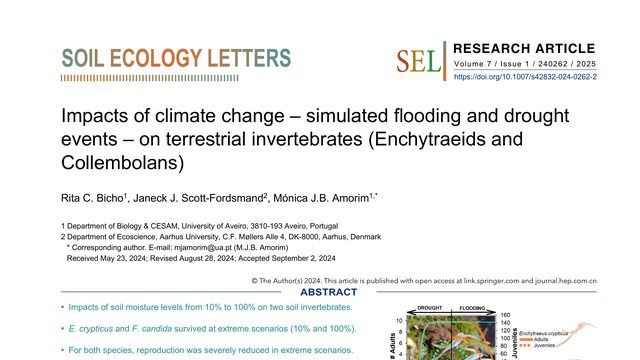
Rita C. Bicho, Janeck James Scott-Fordsmand, Mónica J.B. Amorim
A flood or drought may not kill the tiny animals in soil. The more troubling result is that they can survive while producing far fewer offspring, quietly changing the life of the soil beneath us.What happens when soil swings from severe drought to complete saturation? This study shows that survival can remain surprisingly stable, while reproduction and body size reveal stress much earlier.
Catherine Malboeuf‐Hurtubise, Terra Léger‐Goodes, Catherine M. Herba, Nadia Bélanger, Jonathan Derek Smith, Elizabeth M. Marks
A young person’s fear about climate change may not be a problem to erase. It may be a signal that something important is being threatened, and that the person cares enough to act.What if eco-anxiety is not a problem to erase, but a signal that can be transformed into meaning, connection, and action? This paper argues for facing climate reality while cultivating what it calls radical hope.
The ocean’s nitrogen balance depends on tiny ammonia-eaters, but scientists have found that many of these workers live in places we have barely sampled, and they are not all built for the same jobs.The ocean’s ammonia oxidizers are not distributed evenly, and the best-known habitats may be giving us a misleading view. This study finds a larger, more diverse archaeal world, with much of it still unnamed.
 3:22