Meaning making and fostering radical hope: applying positive psychology to eco-anxiety research in youth
In depth7:54CCAI
paperi.ai
0:00 / 0:00
Catherine Malboeuf‐Hurtubise, Terra Léger‐Goodes, Catherine M. Herba, Nadia Bélanger, Jonathan Derek Smith, Elizabeth M. Marks
What if eco-anxiety is not a problem to erase, but a signal that can be transformed into meaning, connection, and action? This paper argues for facing climate reality while cultivating what it calls radical hope.
The consequences of human activity on climate change are increasingly apparent. For example, they are causing ecological degradation and affecting human and animal health. Rightly so, it is considered as the most important challenge of this century. Researchers in psychology and mental health developed an interest in the direct and indirect effects of climate and ecological change on people’s psychological wellbeing, which is referred to as a concept described as eco-anxiety or eco-distress. It is worth emphasizing that climate issues are taking a larger place in the school curriculum for youth in elementary, middle and high schools. Youth are thus increasingly aware of the major threat and understandably report legitimate concerns and worries. For some youth, eco-anxiety leads to greater involvement and activism, as can be seen by the international movement set out and led by youth activist Greta Thunberg. However, eco-anxiety can also lead to feelings of hopelessness and disengagement. Despite contributing the least to the climate and ecological crises, youth will be most affected by the impacts, and will carry the burden of the climate crisis throughout their lives. Researchers, educators and mental health professionals must therefore find ways to foster youth psychosocial wellbeing and resilience alongside ensuring that their voices are heard. To this end, it is vital that young people feel able to openly discuss climate change and associated issues alongside the distressing thoughts and feelings they engender. This can be supported by using various psychological approaches to develop effective interventions. Researchers and clinicians in child mental health could gain from drawing from research in positive psychology to develop such interventions. In this review and commentary, we will outline how eco-anxiety and child psychological wellbeing can be framed within a positive psychology framework, including the relevance of self-determined motivation. Insights from interventions based on positive psychology including exercises to foster hope, forgiveness and meaning making will also be discussed. We will highlight how such interventions can be adapted as powerful tools to foster child wellbeing and cope with their eco-anxiety.
Transcript
What if eco-anxiety is not a problem to erase, but a signal that can be transformed into meaning, connection, and action? This paper argues for facing climate reality while cultivating what it calls radical hope. The consequences of human activity on climate change are increasingly apparent, causing ecological degradation and affecting human and animal health.
Climate issues are taking a larger place in the school curriculum for youth in elementary, middle and high schools, so youth are increasingly aware of the major threat and report legitimate concerns and worries. For some youth, eco-anxiety leads to greater involvement and activism, but it can also lead to feelings of hopelessness and disengagement.
The review proposes positive psychology, including self-determined motivation and exercises to foster hope, forgiveness and meaning making, as tools to foster child wellbeing and cope with eco-anxiety. Eco-anxiety refers to the emotional, cognitive and physical changes an individual experiences when realizing the impacts of human action on the climate and the environment.
Eco-anxiety can also encompass how the climate crisis intersects with social inequality and global injustice. It can involve anger, sadness, guilt, hopelessness and despair, along with distressing thoughts about realistic, negative future outcomes and a feeling of urgency to act.
Psychological, or eudaimonic, wellbeing differs from subjective wellbeing, also called happiness, because it encompasses a broader range of emotions and the importance of living a meaningful, self-realized and fully functional life. Its predictors include satisfaction of basic psychological needs: self-determination or autonomy, affiliation, and competence, as well as morality, altruism, compassion and gratitude.
Moral outrage, anger and related feelings of injustice are valid reactions to the climate crisis and can fuel citizens, including youth, to take action. Because youth shoulder climate change caused by past generations, the science of forgiveness may be useful when developing clinical interventions exploring forgiveness of past generations.
The science of eco-anxiety would gain from incorporating positive psychology more explicitly when considering wellbeing, resilience and psychosocial adaptation. Self-determined motivation is relevant because it encompasses an essential condition for youth wellbeing.
Acting in a self-determined, or autonomous, manner has been linked to optimal psychosocial adaptation. Hope can be conceptualized as a dynamic cognitive-emotional concept: a positive emotional state associated with confidence in the ability to achieve goals and determination to pursue them.
False hope is grounded in denial or disillusion of reality, or in a biased confidence in the ability to achieve goals. False hope can involve believing that technological fixes will solve everything or that conditions cannot be as bad as the scientific consensus demonstrates.
Children may use false hope to cope by downplaying climate threats and losses, and overly optimistic or simple messages about progress do not appear to benefit the individual. Children should not be pushed out of denial before they have tools for emotional regulation, awareness of values, intention and action, and self-care.
Radical hope is rooted in traumas within individuals and communities, including cultural or historical injustice, and aims to help people and communities transform, heal old wounds and move toward greater psychological wellbeing. It speaks to collective memory of the past and to collective and individual changes serving societal health and self-determination.
Radical hope involves turning toward painful realities and devastation without giving up, holding that a better future is possible and remaining determined to work toward it. Related terms include realistic hope, active hope and constructive hope, which emphasize seeing the reality of crises alongside active movement toward a better future.
Ojala’s model suggests three coping approaches used by children: problem-focused, emotion-focused and meaning-focused techniques. Problem-focused coping acts individually or collectively to solve an issue, but it can over-emphasize personal responsibility and lead to guilt or burn-out.
Ojala found that problem-focused coping was correlated with more negative affect and lower life satisfaction. Emotion-focused coping can provide momentary relief when children distance themselves from the climate threat, but climate realities remain increasingly obvious through media, school and direct observations.
Meaning-focused coping is suggested to be more adaptive in the long term because it acknowledges reality, including the complexity of issues that go beyond the personal. It recognizes engagement, energy and inspiration that can come from wishing to act in response to the climate crisis, enabling youth to reframe eco-anxiety in a more helpful and constructive way.
Meaning-focused coping includes identifying important values, hopes, beliefs and self-identities, which may help youth reappraise the situation as having potential for growth and community engagement. This aligns with eudaimonia, which emphasizes self-actualization and the search for meaning in life, a sense of meaning associated with psychological wellbeing.
Philosophy for children, or P4C, promotes critical thinking, caring, creative reasoning and inquiry in schools, making it an intervention that can promote meaning making. Although P4C was not initially developed to affect children’s mental health, it has been shown to improve children’s mental health.
By fostering resiliency and self-determined motivation, P4C could promote engagement about the climate crisis and perhaps reduce distressing levels of eco-anxiety for some children. Photovoice is another promising intervention focused on meaning making that could be implemented with children.
It uses picture taking to encourage individual expression and autonomy support, then brings participants together for spoken expression, collective dialogue and discussion of community issues. Its overarching goal is to make sense collectively of a given issue, and with youth it has been used to foster engagement, citizen participation, critical thinking, moral judgement and social identity.
Art exhibits organized around youth’s pictures can also allow young participants to be heard by politicians and policy makers. The article’s purpose is to articulate how positive psychology can inform research on eco-anxiety and youth. Self-determined motivation, awe and hope establish theoretical bases for interventions targeting eco-anxiety in children, hope and civic engagement.
Interventions using philosophy for children and the arts show promise in this regard. Eco-anxiety is not pathological; the point is not to make it go away but to make sure it is not destructive in children and to help them see meaning in it.
Any cure for eco-anxiety in children lies in changing the cultural approach to caring for the planet, not in young people themselves. The central message is that youth eco-anxiety should not simply be eliminated: positive psychology can help young people make meaning, sustain wellbeing, and engage with climate action while adults address the systems causing the crisis.
A derivative work by Paperi · AI-generated script, voice and captions
· pages and figures unaltered
Made with Paperi.
Drop in a research PDF — get a narrated video walkthrough like this one,
with highlights that follow the narration. Free to start.
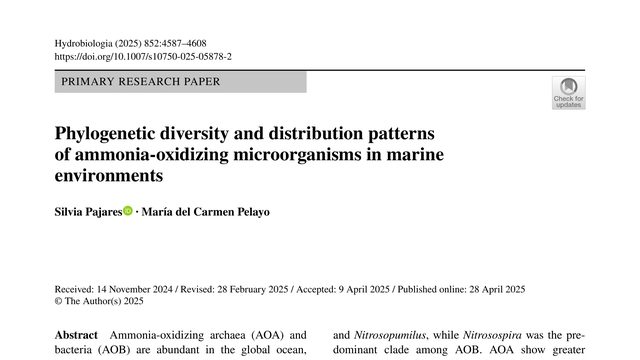
The ocean’s nitrogen balance depends on tiny ammonia-eaters, but scientists have found that many of these workers live in places we have barely sampled, and they are not all built for the same jobs.The ocean’s ammonia oxidizers are not distributed evenly, and the best-known habitats may be giving us a misleading view. This study finds a larger, more diverse archaeal world, with much of it still unnamed.
Pierre Foucault, Sébastien Halary, Charlotte Duval, Midoli Goto, Benjamin Marie, Sahima Hamlaoui, Ludwig E. Jardillier, Dominique Lamy, Émilie Lance, Emmanuelle Raimbault, Fayçal Allouti, Marc Troussellier, Cécile Bernard, Julie Leloup, Sébastien Duperron
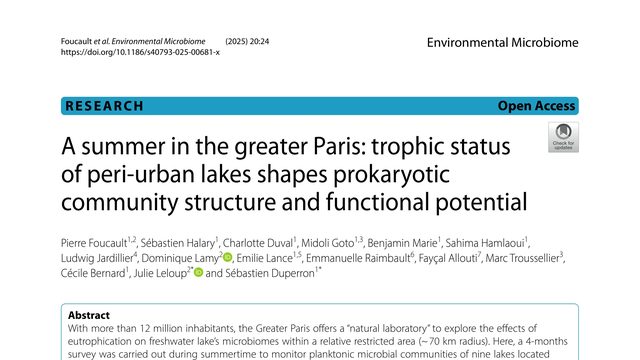
A lake can look calm while its invisible life is changing dramatically underneath. Around Paris, the amount of nutrient pollution helped determine not only which microbes lived in each lake, but what those microbes could do.Two lakes can sit near the same city, share similar shapes and depths, and still host radically different microbial worlds. In this study, the strongest dividing line was how nutrient-rich those lakes had become.
Pierluigi Carbonara, Giulia Prato, Simone Niedermüller, Sébastien Alfonso, Cosmidano Neglia, Marilena Donnaloia, Giuseppe Lembo, María Teresa Spedicato
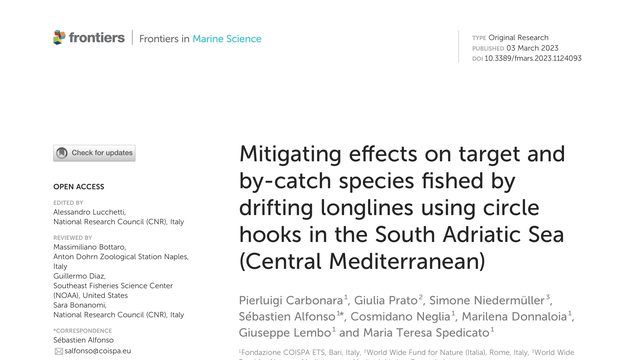
What if a small change to a fishing hook could help sharks survive, without reducing the fishers’ catch? In the South Adriatic, researchers found a striking difference in the condition of blue sharks brought aboard.What if changing the shape of a fishing hook could leave swordfish catches unchanged, but send more blue sharks back in healthy condition? This study tests that idea in the South Adriatic Sea.
 3:30