Phylogenetic diversity and distribution patterns of ammonia-oxidizing microorganisms in marine environments
Overview3:30CCAI
paperi.ai
0:00 / 0:00
Silvia Pajares, María del Carmen Pelayo
The ocean’s nitrogen balance depends on tiny ammonia-eaters, but scientists have found that many of these workers live in places we have barely sampled, and they are not all built for the same jobs.
The ocean’s nitrogen balance depends on tiny ammonia-eaters—but scientists have found that many of these workers live in places we have barely sampled, and they are not all built for the same jobs. Ammonia-oxidizing archaea and bacteria are abundant in the global ocean, playing a crucial role in marine nitrogen cycling through nitrification.
But understanding of their distribution patterns in marine habitats remains limited, despite extensive studies using a gene involved in ammonia processing. The complicated interaction of ocean conditions creates diverse ecological niches for marine ammonia-oxidizing communities.
It is like trying to understand a city by studying only the neighborhoods that are easiest to reach: the missing places can change the whole picture. Their diversity and distribution matter because they help regulate marine nitrogen cycling and may respond to environmental changes.
The study brought together thousands of genetic sequences from marine sites to compare ammonia-oxidizing communities across different environments. The sequences were sorted by settings such as water, sediment, organisms, ocean ridges, estuaries, coasts, the open ocean, deep sea, and heated vents.
The map reveals a broad worldwide spread, with studies clustering along coasts and in parts of the Pacific, while vast ocean regions remain sparsely represented. The marine archaeal group contained twenty-five distinct branches, and fifty-two percent of its sequences could not be assigned to known lineages.
Among the recognized branches, the most abundant were Ca. Nitrosopelagicus, Nitrosoarchaeum, and Nitrosopumilus. The different branches did not occupy the same environments. Some were mainly found in sediment, others in the water column, and one was especially common in sponges.
Several other branches had a mixed distribution across environments. The greatest variety of these archaeal sequences was found in sediments, followed by the water column, organisms, and ocean ridges. Sediments shared some branches with water, ocean ridges, and organisms, but ocean ridges and organisms shared only a small number with each other.
Environment, habitat, and climate zone significantly influenced the distribution of the bacterial group. But the low explanatory values indicate that additional factors also contribute to where these bacteria occur. Most sequences came from estuarine sediments and coastal waters, while organisms, ocean ridges, the open ocean, and the deep sea remain largely unsampled.
The archaeal group showed higher diversity than the bacterial group, with many unclassified sequences that may represent additional branches. The archaeal group occurred widely across marine habitats and was especially associated with nutrient-poor and extreme environments such as low-oxygen zones and the deep sea.
By contrast, the bacterial group was more prevalent in nutrient-rich estuarine and coastal sediments. These different habitats likely reflect differences in oxygen use, ammonia uptake, and the ways the two groups obtain energy. The ocean contains two broad groups of ammonia-eaters with different habitats: one spreads through nutrient-poor and low-oxygen places, while the other is concentrated near nutrient-rich coasts.
That map is still incomplete.
A derivative work by Paperi · AI-generated script, voice and captions
· pages and figures unaltered
Made with Paperi.
Drop in a research PDF — get a narrated video walkthrough like this one,
with highlights that follow the narration. Free to start.
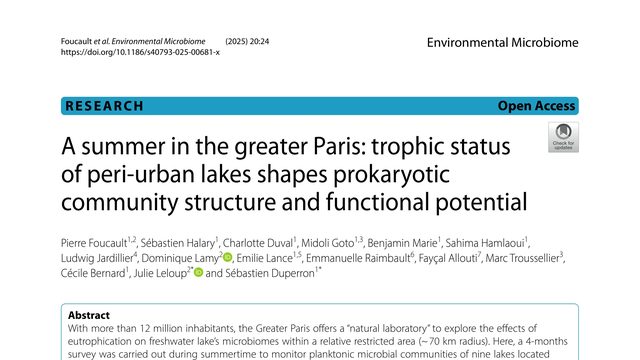
Pierre Foucault, Sébastien Halary, Charlotte Duval, Midoli Goto, Benjamin Marie, Sahima Hamlaoui, Ludwig E. Jardillier, Dominique Lamy, Émilie Lance, Emmanuelle Raimbault, Fayçal Allouti, Marc Troussellier, Cécile Bernard, Julie Leloup, Sébastien Duperron
A lake can look calm while its invisible life is changing dramatically underneath. Around Paris, the amount of nutrient pollution helped determine not only which microbes lived in each lake, but what those microbes could do.Two lakes can sit near the same city, share similar shapes and depths, and still host radically different microbial worlds. In this study, the strongest dividing line was how nutrient-rich those lakes had become.
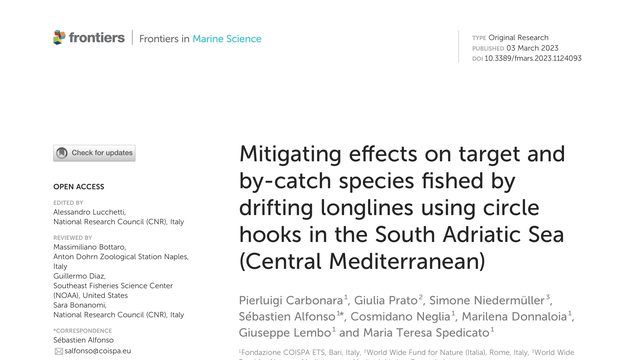
Pierluigi Carbonara, Giulia Prato, Simone Niedermüller, Sébastien Alfonso, Cosmidano Neglia, Marilena Donnaloia, Giuseppe Lembo, María Teresa Spedicato
What if a small change to a fishing hook could help sharks survive, without reducing the fishers’ catch? In the South Adriatic, researchers found a striking difference in the condition of blue sharks brought aboard.What if changing the shape of a fishing hook could leave swordfish catches unchanged, but send more blue sharks back in healthy condition? This study tests that idea in the South Adriatic Sea.
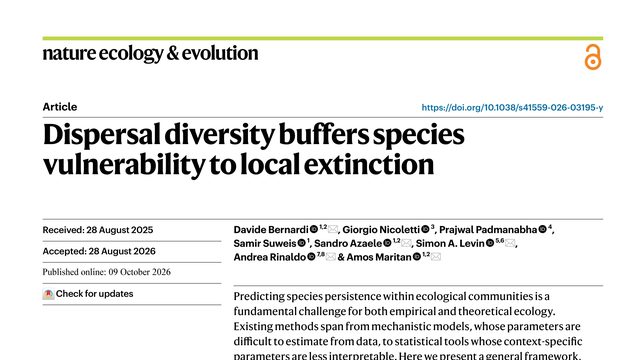
Davide Bernardi, Giorgio Nicoletti, Prajwal Padmanabha, Samir Suweis, Sandro Azaele, Simon A. Levin, Andrea Rinaldo, Amos Maritan
A species can look safe simply because it is numerous, but that headcount can miss the real danger. Its chances may depend on how differently its members move through space, and on the other species around them.A species can be rare without being especially vulnerable. This study argues that extinction risk depends not just on how much abundance a species has, but on how its dispersal strategy fits into the entire community.
 4:30