Impacts of climate change–simulated flooding and drought events–on terrestrial invertebrates (Enchytraeids and Collembolans)
In depth8:30CCAI
paperi.ai
0:00 / 0:00
Rita C. Bicho, Janeck James Scott-Fordsmand, Mónica J.B. Amorim
What happens when soil swings from severe drought to complete saturation? This study shows that survival can remain surprisingly stable, while reproduction and body size reveal stress much earlier.
What happens when soil swings from severe drought to complete saturation? This study shows that survival can remain surprisingly stable, while reproduction and body size reveal stress much earlier. Knowledge on impacts of climate change on soil invertebrate communities is scarce.
At the same time, temperature increases and arid regions occur alongside extreme precipitation events and flooding. The aim of the present study was to investigate the impacts of drought and flooding in soil invertebrates, using Enchytraeus crypticus and Folsomia candida to assess survival, reproduction, and size.
Across the tested moisture conditions, both species had high tolerance for drought and flooding, but reproduction decreased at moisture of thirty percent or less and above seventy percent. In drought, adult size decreased for both species from moisture of thirty percent or less, while evidence of adaptive phenotypic plasticity was highest for Folsomia candida.
Enchytraeids and collembolans are abundant worldwide and are essential for soil ecosystem services, including decomposition of organic matter and nutrient cycling. Enchytraeids mostly live in the first five to ten centimeters of soil and have functions similar to earthworms, including soil bioturbation, making them excellent bioindicators of soil quality.
Collembolans are particularly important because of grazing activity on fungi, with benefits to plants. Earlier studies were limited: laboratory work on reproduction and growth generally covered only twenty-five to seventy-five percent of soil water holding capacity, leaving a knowledge gap for extreme moisture regimes.
The main aim was to investigate the innate stress tolerance range across a wide soil moisture range, from ten to one hundred percent moisture, representing drought and flooding scenarios. The study selected Enchytraeus crypticus and Folsomia candida as standard soil model species because they are extensively used in ecotoxicological assays and represent different ecological functions within the soil mesofauna.
Enchytraeus crypticus and Folsomia candida were exposed in LUFA 2.2 soil for twenty-one and twenty-eight days, respectively, to assess survival, reproduction, and size. The study covered ten, twenty, thirty, forty, fifty, sixty, seventy, eighty, ninety, and one hundred percent of soil water holding capacity to assess tolerance ranges from flooding to drought.
For each soil moisture regime, water was homogeneously mixed into the soil, the soil was split into test vessels, and the vessels were covered with parafilm to avoid water evaporation. Soil was equilibrated for one day before the test started, and water was replenished weekly to maintain the corresponding starting soil moisture regime.
For the Enchytraeus test, ten organisms were placed in each test container with twenty grams of moist soil and a food supply of twenty-four plus or minus one milligrams of autoclaved, ground rolled oats. Exposure lasted twenty-one days at twenty degrees Celsius with a sixteen to eight hour photoperiod, and food and water were replenished weekly.
Four replicates were used per treatment, and endpoints included survival, reproduction, and adult size, measured through adults, juveniles, and adult length. At the end, organisms were fixed, sieved through three meshes, counted using a stereo microscope, and photographed for adult length analysis with ImageJ.
One-way analysis of variance followed by Dunnett’s comparison post-hoc test, with p less than or equal to zero point zero five, assessed differences between controls and treatments. Effect Concentrations were estimated with a logistic two-parameter regression model using the Toxicity Relationship Analysis Program, or TRAP version one point three.
Because the dose-response was overall bell-shaped, the increased-response section was inverted to fit the model, including drought data from ten to fifty percent moisture. Figure one maps survival, reproduction, and adult or juvenile size against soil moisture for Enchytraeus crypticus and Folsomia candida.
Survival changes mainly at extreme drought or flooding, while reproduction peaks around intermediate moisture and declines toward either extreme; adult size is particularly reduced under drought, beginning at or below thirty percent moisture. The fitted curves and error bars show why moisture conditions are critical when interpreting standardized soil-toxicity tests.
For Enchytraeus crypticus, survival was affected only at the extreme levels of ten and one hundred percent moisture, with LC ninety values of sixteen percent for drought and ninety-nine percent for flooding. Reproduction showed an optimum between fifty and seventy percent moisture, and decreased outside that range, below fifty percent and above seventy percent.
For Folsomia candida, survival was not impacted except at extreme drought conditions of ten percent moisture or less. Reproduction performed best around fifty percent moisture and decreased outside that level, with an EC fifty of seventy-eight percent under flooding and thirty-nine percent moisture under drought.
Size was mostly impacted by drought, with smaller adults from thirty percent moisture or less and an EC fifty of eighteen point five percent. Table one reports effect concentrations for survival, reproduction, and adult size under flooding and drought in LUFA two point two soil.
For example, Enchytraeus crypticus under drought has survival EC fifty of sixteen, with a ninety-five percent confidence interval from twelve to nineteen, while its reproduction EC fifty is thirty-three, from thirty-one to thirty-five. Folsomia candida shows a flooding reproduction EC fifty of seventy-eight, from seventy-six to eighty, and the fitted log-two-parameter models include slope and intercept values.
For Enchytraeus crypticus, survival was affected only at the extremes of drought at ten percent moisture and flooding at one hundred percent moisture, while reproduction had a narrower average-performance range between fifty and seventy percent moisture. The recommended soil moisture in the standard guideline is between forty and sixty percent of water holding capacity, within the adequate conditions observed in this study.
Despite the large impact of extreme events, both species showed remarkable tolerance for drought and flooding levels. Enchytraeus crypticus and Folsomia candida showed drought survival thresholds up to ten and twenty percent moisture, respectively, while the flooding survival threshold was much higher for Folsomia candida.
Drought strongly affected the size of Folsomia candida adults, but flooding did not, and larger animals have higher survival than smaller animals. Enchytraeus crypticus and Folsomia candida showed high tolerance for drought and flooding, with survival thresholds between ten and ninety percent for Enchytraeus crypticus and ten and one hundred percent moisture for Folsomia candida.
For both species, reproduction was more affected, decreasing roughly outside moisture levels of thirty percent or less and above seventy percent. Size was mainly impacted under drought conditions, specifically through a decrease in body size during the drought treatment conditions tested.
These morphological adaptations support evidence of adaptive phenotypic plasticity for both species, but the evidence was highest for Folsomia candida. A redistribution of soil invertebrate species can be expected under present and future climate change scenarios, with new and more tolerant species prevailing in different habitats.
These extreme events can change the abundance and diversity of soil invertebrate communities, and at this level and frequency they will force a structural change. Both species tolerated remarkably wide moisture extremes, but reproduction declined outside the middle range and drought reduced body size.
That difference could reshape soil communities and the ecosystem services they support.
A derivative work by Paperi · AI-generated script, voice and captions
· pages and figures unaltered
Made with Paperi.
Drop in a research PDF — get a narrated video walkthrough like this one,
with highlights that follow the narration. Free to start.
Catherine Malboeuf‐Hurtubise, Terra Léger‐Goodes, Catherine M. Herba, Nadia Bélanger, Jonathan Derek Smith, Elizabeth M. Marks
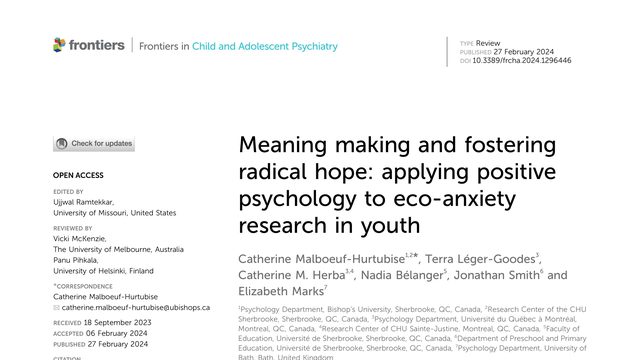
A young person’s fear about climate change may not be a problem to erase. It may be a signal that something important is being threatened, and that the person cares enough to act.What if eco-anxiety is not a problem to erase, but a signal that can be transformed into meaning, connection, and action? This paper argues for facing climate reality while cultivating what it calls radical hope.
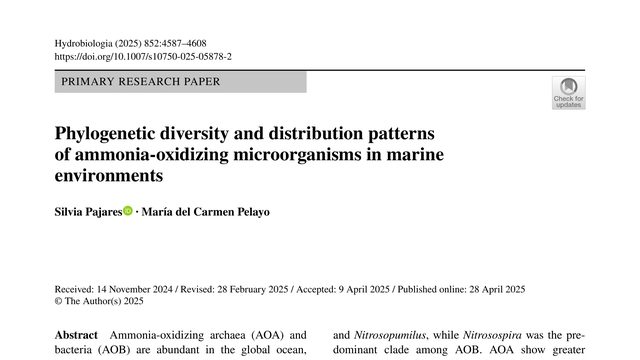
The ocean’s nitrogen balance depends on tiny ammonia-eaters, but scientists have found that many of these workers live in places we have barely sampled, and they are not all built for the same jobs.The ocean’s ammonia oxidizers are not distributed evenly, and the best-known habitats may be giving us a misleading view. This study finds a larger, more diverse archaeal world, with much of it still unnamed.
Pierre Foucault, Sébastien Halary, Charlotte Duval, Midoli Goto, Benjamin Marie, Sahima Hamlaoui, Ludwig E. Jardillier, Dominique Lamy, Émilie Lance, Emmanuelle Raimbault, Fayçal Allouti, Marc Troussellier, Cécile Bernard, Julie Leloup, Sébastien Duperron
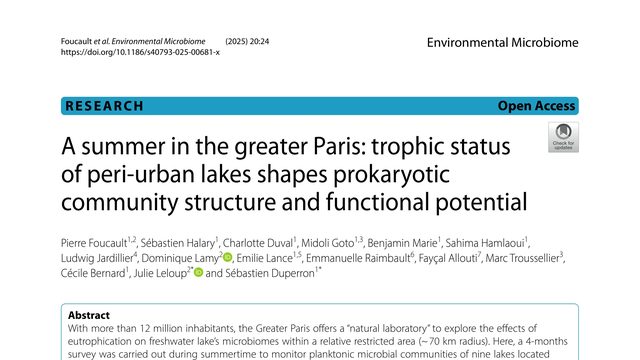
A lake can look calm while its invisible life is changing dramatically underneath. Around Paris, the amount of nutrient pollution helped determine not only which microbes lived in each lake, but what those microbes could do.Two lakes can sit near the same city, share similar shapes and depths, and still host radically different microbial worlds. In this study, the strongest dividing line was how nutrient-rich those lakes had become.
 4:01