Meaning making and fostering radical hope: applying positive psychology to eco-anxiety research in youth
Overview4:01CCAI
paperi.ai
0:00 / 0:00
Catherine Malboeuf‐Hurtubise, Terra Léger‐Goodes, Catherine M. Herba, Nadia Bélanger, Jonathan Derek Smith, Elizabeth M. Marks
A young person’s fear about climate change may not be a problem to erase. It may be a signal that something important is being threatened, and that the person cares enough to act.
The consequences of human activity on climate change are increasingly apparent. For example, they are causing ecological degradation and affecting human and animal health. Rightly so, it is considered as the most important challenge of this century. Researchers in psychology and mental health developed an interest in the direct and indirect effects of climate and ecological change on people’s psychological wellbeing, which is referred to as a concept described as eco-anxiety or eco-distress. It is worth emphasizing that climate issues are taking a larger place in the school curriculum for youth in elementary, middle and high schools. Youth are thus increasingly aware of the major threat and understandably report legitimate concerns and worries. For some youth, eco-anxiety leads to greater involvement and activism, as can be seen by the international movement set out and led by youth activist Greta Thunberg. However, eco-anxiety can also lead to feelings of hopelessness and disengagement. Despite contributing the least to the climate and ecological crises, youth will be most affected by the impacts, and will carry the burden of the climate crisis throughout their lives. Researchers, educators and mental health professionals must therefore find ways to foster youth psychosocial wellbeing and resilience alongside ensuring that their voices are heard. To this end, it is vital that young people feel able to openly discuss climate change and associated issues alongside the distressing thoughts and feelings they engender. This can be supported by using various psychological approaches to develop effective interventions. Researchers and clinicians in child mental health could gain from drawing from research in positive psychology to develop such interventions. In this review and commentary, we will outline how eco-anxiety and child psychological wellbeing can be framed within a positive psychology framework, including the relevance of self-determined motivation. Insights from interventions based on positive psychology including exercises to foster hope, forgiveness and meaning making will also be discussed. We will highlight how such interventions can be adapted as powerful tools to foster child wellbeing and cope with their eco-anxiety.
Transcript
A young person’s fear about climate change may not be a problem to erase. It may be a signal that something important is being threatened—and that the person cares enough to act. The consequences of human activity on climate change are increasingly apparent.
They are causing ecological degradation and affecting human and animal health. Climate change is also increasingly affecting the daily life of people who had been largely spared from such events. But the distress is not only about damaged environments.
The failures of people in power to act appropriately contribute substantially to environmental distress, even more than awareness of the decline of natural environments. Eco-anxiety refers to the emotional, cognitive and physical changes an individual experiences when realizing the impacts of human action on the climate and the environment.
It can also encompass how the climate crisis intersects with social inequality and global injustice. It can involve anger, sadness, guilt, hopelessness and despair, along with distressing thoughts about realistic negative futures and a feeling of urgency to act.
Here is the paper’s central shift: when considering wellbeing, resilience and adjustment, research on eco-anxiety would gain from drawing more explicitly on work about what helps people function well. Self-determined motivation matters because it is an essential condition for young people’s wellbeing, and acting autonomously has been linked to optimal psychosocial adaptation.
For young people, acting from their own values and choices has previously been linked to better adjustment. Radical hope requires considering new and possibly radical conceptions of the future. It acknowledges the severity of overwhelming, uncertain and potentially catastrophic climate impacts.
Radical hope embraces uncertainty: although one cannot know where one’s actions will lead, one remains committed to working towards a more sustainable and just world aligned with one’s values. This kind of hope can also involve significant adults taking a validating and empathic posture toward children.
One example is a school approach that promotes critical thinking, caring, creative reasoning and inquiry, helping children make meaning. Although it was not initially developed to affect children’s mental health, it has been shown to improve children’s mental health. By fostering greater resilience and motivation that comes from within, it could also promote greater engagement with the climate crisis and perhaps reduce distressing levels of eco-anxiety for some children.
The paper’s purpose was to explain how work on wellbeing can inform research on eco-anxiety and youth. Ideas about motivation, awe and hope can support interventions that explore eco-anxiety, foster hope and encourage civic engagement. Interventions using discussion in schools and the arts show promise.
Eco-anxiety is not pathological; the point is not to make it go away but to make sure it is not destructive in children. Any cure for eco-anxiety in children lies in changing our cultural approach to caring for the planet, not in young people themselves. Supporting children with this distress is an opportunity to reimagine what supportive emotional and environmental education should entail.
That includes seeing our values and learning how to respond to difficult emotions, rather than trying to avoid them or make them go away. It also means adults hearing and heeding young people, not dismissing or ignoring them.
Supporting young people in developing motivation from within can foster wellbeing and help them be heard by those in power. The paper argues that support should help young people understand and use eco-anxiety, not simply suppress it. That means listening to them, making room for difficult feelings, and changing how adults care for the planet.
A derivative work by Paperi · AI-generated script, voice and captions
· pages and figures unaltered
Made with Paperi.
Drop in a research PDF — get a narrated video walkthrough like this one,
with highlights that follow the narration. Free to start.
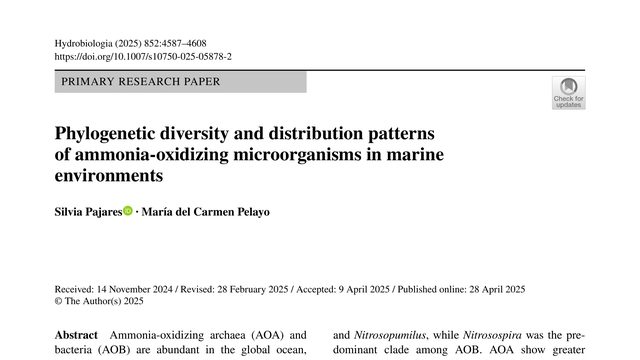
The ocean’s nitrogen balance depends on tiny ammonia-eaters, but scientists have found that many of these workers live in places we have barely sampled, and they are not all built for the same jobs.The ocean’s ammonia oxidizers are not distributed evenly, and the best-known habitats may be giving us a misleading view. This study finds a larger, more diverse archaeal world, with much of it still unnamed.
Pierre Foucault, Sébastien Halary, Charlotte Duval, Midoli Goto, Benjamin Marie, Sahima Hamlaoui, Ludwig E. Jardillier, Dominique Lamy, Émilie Lance, Emmanuelle Raimbault, Fayçal Allouti, Marc Troussellier, Cécile Bernard, Julie Leloup, Sébastien Duperron
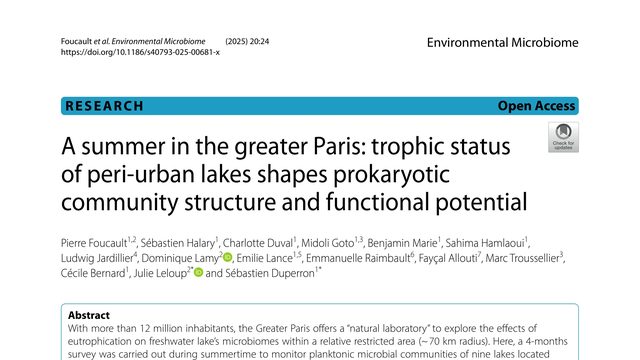
A lake can look calm while its invisible life is changing dramatically underneath. Around Paris, the amount of nutrient pollution helped determine not only which microbes lived in each lake, but what those microbes could do.Two lakes can sit near the same city, share similar shapes and depths, and still host radically different microbial worlds. In this study, the strongest dividing line was how nutrient-rich those lakes had become.
Pierluigi Carbonara, Giulia Prato, Simone Niedermüller, Sébastien Alfonso, Cosmidano Neglia, Marilena Donnaloia, Giuseppe Lembo, María Teresa Spedicato
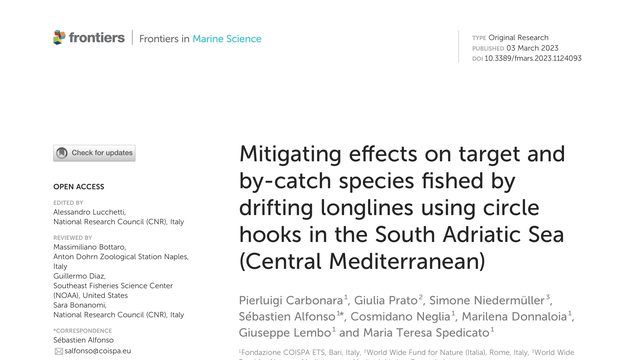
What if a small change to a fishing hook could help sharks survive, without reducing the fishers’ catch? In the South Adriatic, researchers found a striking difference in the condition of blue sharks brought aboard.What if changing the shape of a fishing hook could leave swordfish catches unchanged, but send more blue sharks back in healthy condition? This study tests that idea in the South Adriatic Sea.
 3:30