Impacts of climate change–simulated flooding and drought events–on terrestrial invertebrates (Enchytraeids and Collembolans)
Overview3:22CCAI
paperi.ai
0:00 / 0:00
Rita C. Bicho, Janeck James Scott-Fordsmand, Mónica J.B. Amorim
A flood or drought may not kill the tiny animals in soil. The more troubling result is that they can survive while producing far fewer offspring, quietly changing the life of the soil beneath us.
A flood or drought may not kill the tiny animals in soil. The more troubling result is that they can survive while producing far fewer offspring, quietly changing the life of the soil beneath us. Knowledge on impacts of climate change on soil invertebrate communities is scarce.
At the same time, some regions face expanding arid conditions while others face extreme precipitation and flooding. The study investigated drought and flooding in soil invertebrates by examining survival, reproduction, and size across a very wide range of soil moisture.
The study used two standard soil animals because they are widely used in testing and represent different ecological functions within the soil community. They were exposed to soil ranging from drought conditions to flooding conditions, and the study assessed survival, reproduction, and size.
For the first soil animal, survival was affected only at the most extreme dry and wet conditions. Most of the time, it stayed alive. But reproduction worked best in the middle range of moisture and decreased below that range or above it.
Survival and reproduction were telling different stories. For the second soil animal, survival was not affected except under the most extreme drought conditions. Again, staying alive was not the same as thriving. Reproduction worked best around the middle moisture level and decreased on either side.
Drought also produced smaller adults. Survival stayed fairly steady across most soil moisture levels, but reproduction and adult size suffered when the soil became too dry or too wet. The clearest message is that these tiny soil animals need a middle range of moisture—not simply as much water as possible.
Despite the strong effects of extreme events, both species showed remarkable tolerance for drought and flooding. The second species tolerated flooding better than the first. Drought strongly reduced the size of adults, while flooding did not. Larger animals had higher survival than smaller ones, linking body size with the ability to endure dry conditions.
The changes in size and reproduction suggest a trade-off: a survival strategy can impose costs on other traits. During drought, the animals changed while surviving and shifted toward a new condition that supported survival. The study found evidence that both species can change their traits as moisture changes; under drought, surviving individuals shifted toward a new optimum that guaranteed their survival.
Longer studies with recovery phases are needed to determine whether this plasticity reflects adaptation, remains durable, or can be maintained or passed through generations. The overall finding is that both species tolerated drought and flooding, but reproduction was more affected than survival, and body size mainly decreased under drought.
As extreme drought and flooding become more common, more tolerant soil animals may replace less tolerant ones in different habitats. That redistribution could change soil communities, farming, and human health. Extreme wet and dry conditions affected reproduction before survival, and the animals changed their bodies while enduring drought.
That could reshape which soil communities support farming and human well-being.
A derivative work by Paperi · AI-generated script, voice and captions
· pages and figures unaltered
Made with Paperi.
Drop in a research PDF — get a narrated video walkthrough like this one,
with highlights that follow the narration. Free to start.
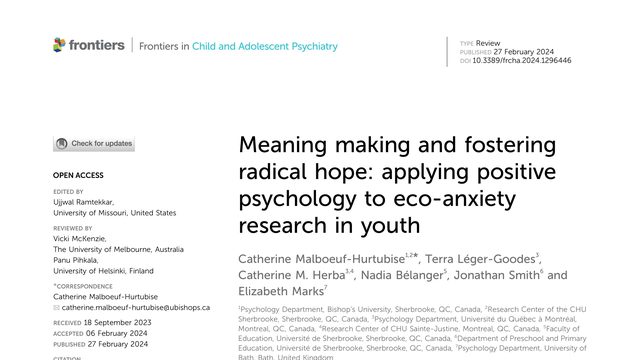
Catherine Malboeuf‐Hurtubise, Terra Léger‐Goodes, Catherine M. Herba, Nadia Bélanger, Jonathan Derek Smith, Elizabeth M. Marks
A young person’s fear about climate change may not be a problem to erase. It may be a signal that something important is being threatened, and that the person cares enough to act.What if eco-anxiety is not a problem to erase, but a signal that can be transformed into meaning, connection, and action? This paper argues for facing climate reality while cultivating what it calls radical hope.
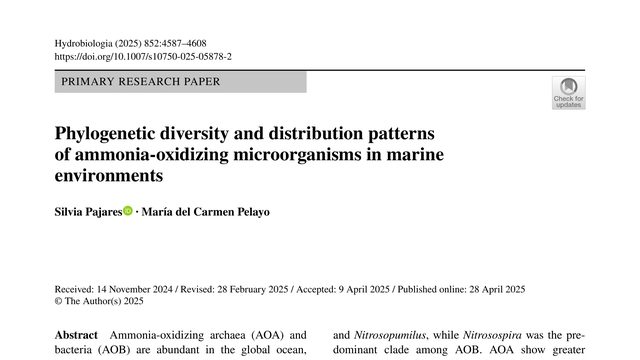
The ocean’s nitrogen balance depends on tiny ammonia-eaters, but scientists have found that many of these workers live in places we have barely sampled, and they are not all built for the same jobs.The ocean’s ammonia oxidizers are not distributed evenly, and the best-known habitats may be giving us a misleading view. This study finds a larger, more diverse archaeal world, with much of it still unnamed.
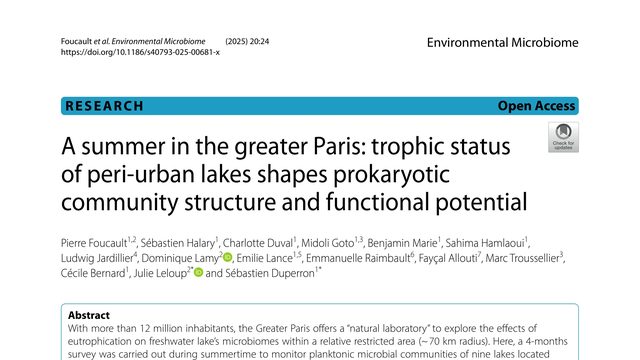
Pierre Foucault, Sébastien Halary, Charlotte Duval, Midoli Goto, Benjamin Marie, Sahima Hamlaoui, Ludwig E. Jardillier, Dominique Lamy, Émilie Lance, Emmanuelle Raimbault, Fayçal Allouti, Marc Troussellier, Cécile Bernard, Julie Leloup, Sébastien Duperron
A lake can look calm while its invisible life is changing dramatically underneath. Around Paris, the amount of nutrient pollution helped determine not only which microbes lived in each lake, but what those microbes could do.Two lakes can sit near the same city, share similar shapes and depths, and still host radically different microbial worlds. In this study, the strongest dividing line was how nutrient-rich those lakes had become.
 4:01