Public Service Decline and Support for the Populist Right: Evidence from England’s National Health Service
Overview3:59CCAI
paperi.ai
0:00 / 0:00
Z. Dickson, SARA BINZER HOBOLT, Catherine E. De Vries, Simone Cremaschi
A local doctor’s surgery closes, and years later, people affected by that closure are more likely to support the populist right. The surprising link is not just healthcare; it is trust in the state.
The rise of populist right parties is well studied, but relatively little attention has been given to how public service performance influences voter support. Given that public services are often the primary means through which citizens interact with the state, we argue that declining public services can create grievances that increase the appeal of populist right parties. Focusing on England’s National Health Service, we combine administrative data on local health facility closures with panel data on public preferences and voting intentions. Using a staggered difference-in-differences design, we find that closures reduce satisfaction with public services and increase support for populist right parties. These effects are moderated by migrant registrations at local health practices, highlighting the interaction between public service performance and immigration concerns in fueling populist right support. Our findings underscore the role of public service decline as a driver of support for populist parties, especially in areas undergoing demographic change.
Transcript
A local doctor’s surgery closes—and years later, people affected by that closure are more likely to support the populist right. The surprising link is not just healthcare; it is trust in the state. The argument begins with a bargain people expect from government: citizens pay taxes and obey the law, while government delivers public goods such as safety, roads, education, and healthcare.
Here, the study argues that direct experience with declining public services creates grievances with the political establishment and increases the appeal of populist right parties. The study follows the universe of GP practice closures in England between 2013 and 2023, using administrative data from the NHS.
It then examines patients’ experiences, finding that closures reduce satisfaction and produce more negative patient reports about the experience of making appointments. Finally, it examines political choices, using large-scale annual panel datasets to show that direct exposure to a closure increases support for the populist right.
The study first looks at patient reports, asking whether closures bring lower satisfaction and more negative experiences when people try to make appointments. It then examines whether direct exposure to a closure increases support for the populist right.
When a local doctor’s practice closes, nearby residents may lose a familiar route to care. These closures are spread across England, with especially dense clusters around major urban areas, showing this is a widespread access problem rather than an isolated event.
The patient results point in the same direction: people forced to switch practices after a closure, or people whose practice absorbs patients from a closing practice, report declining satisfaction with the service. Those results are consistent with the idea that closures generate grievances among affected patients.
The voting results suggest that closure of GP practices increases support for the populist right among affected voters. The effect is nearly immediate and persists across both data sources, lasting for at least four to five years. It is relatively small, but it is consistent across the two independent samples.
Here is the surprise: the effect is much greater in areas with higher immigration and more new migrant registrations at local practices than in areas where immigration is lower. The results suggest that the populist right has been successful in framing public-service decline as the result of increased competition from migrants.
This relationship appears only for the populist right, not the other party families examined. The broader conclusion is that public-service decline can drive grievances and, in turn, support for the populist right. When the state falls short of its obligations, voters may respond to anti-establishment arguments about a political elite disconnected from ordinary people.
Those effects become stronger when service problems are combined with concerns about competition with immigrants, making voters more likely to punish established parties by supporting the populist right. Across different analyses and sources of data, the study finds consistent causal evidence that exposure to declining public services fuels support for the populist right.
The effects are relatively small, but they persist over time and matter in elections, where changing one’s vote can be difficult. For patients, that means exposure to declining public services can shape political choice by fueling support for the populist right. The study finds that declining public services can push voters toward the populist right, especially where immigration concerns are stronger.
Keeping everyday services working may therefore matter for politics as well as health.
A derivative work by Paperi · AI-generated script, voice and captions
· pages and figures unaltered
Made with Paperi.
Drop in a research PDF — get a narrated video walkthrough like this one,
with highlights that follow the narration. Free to start.
Homer can feel like a locked room: important, famous, and very far away. In one Greek classroom, students found a key in an unexpected place, not another lecture, but modern songs.What if the best way to make Homer feel contemporary is not to simplify the epics, but to let students remake them through songs they already understand? This project turns classical reception into a creative, digital classroom experience.
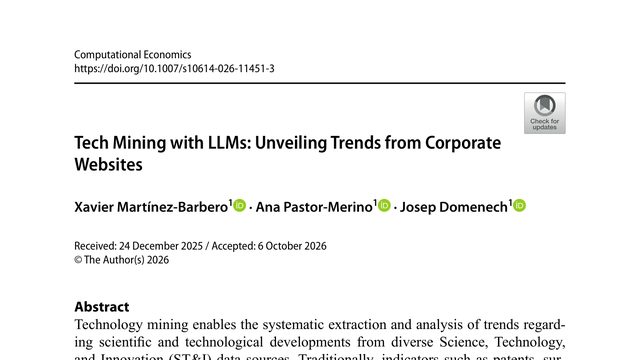
Xavier Martínez-Barbero, Ana Pastor-Merino, Josep Domènech
A company's website may reveal where its technology is heading, but only if someone can separate real signals from polished marketing. This study turns those public pages into a moving map of industrial change.What if company websites could act as a live radar for technological change? This study uses large language models to turn corporate web language into a measurable picture of manufacturing’s shifting technology landscape.
Domestic violence is not only a private crisis. This study finds that it can be widespread, hidden by silence, and tied to beliefs that make harmful behavior seem ordinary.In this study, nearly two-thirds of the participating women were classified as experiencing severe violence. The mixed-methods design also shows how social norms can keep that violence unspoken.
 4:11