Domestic violence is not only a private crisis. This study finds that it can be widespread, hidden by silence, and tied to beliefs that make harmful behavior seem ordinary.
Background Violence against women is one of the most widespread, persistent and detrimental violations of human rights in today’s world, which has not been reported in most cases due to impunity, silence, stigma and shame, even in the age of social communication. Domestic violence against women harms individuals, families, and society. The objective of this study was to investigate the prevalence and experiences of domestic violence against women in Semnan. Methods This study was conducted as mixed research (cross-sectional descriptive and phenomenological qualitative methods) to investigate domestic violence against women, and some related factors (quantitative) and experiences of such violence (qualitative) simultaneously in Semnan. In quantitative study, cluster sampling was conducted based on the areas covered by health centers from married women living in Semnan since March 2021 to March 2022 using Domestic Violence Questionnaire. Then, the obtained data were analyzed by descriptive and inferential statistics. In qualitative study by phenomenological approach and purposive sampling until data saturation, 9 women were selected who had referred to the counseling units of Semnan health centers due to domestic violence, since March 2021 to March 2022 and in-depth and semi-structured interviews were conducted. The conducted interviews were analyzed using Colaizzi’s 7-step method. Results In qualitative study, seven themes were found including “Facilitators”, “Role failure”, “Repressors”, “Efforts to preserve the family”, “Inappropriate solving of family conflicts”, “Consequences”, and “Inefficient supportive systems”. In quantitative study, the variables of age, age difference and number of years of marriage had a positive and significant relationship, and the variable of the number of children had a negative and significant relationship with the total score and all fields of the questionnaire (p < 0.05). Also, increasing the level of female education and income both independently showed a significant relationship with increasing the score of violence. Conclusions Some of the variables of violence against women are known and the need for prevention and plans to take action before their occurrence is well felt. Also, supportive mechanisms with objective and taboo-breaking results should be implemented to minimize harm to women, and their children and families seriously.
Transcript
Domestic violence is not only a private crisis. This study finds that it can be widespread, hidden by silence, and tied to beliefs that make harmful behavior seem ordinary. Violence against women is one of the most widespread, persistent, and harmful violations of human rights in today’s world.
It is often not reported because of silence, shame, stigma, and the belief that nothing will happen to the abuser. Domestic violence against women harms individuals, families, and society. The study set out to investigate both how common it was and what women experienced in Semnan.
The scale reaches far beyond one household. It is estimated that thirty-five percent of women, almost one out of every three women aged fifteen to forty-nine, experience physical or sexual violence by a spouse or another sexual partner during their lifetime.
Different forms of family violence are often connected. Like a harmful pattern passed through a family, abuse can persist from children who witness it into their adult relationships and later into how older family members are treated. The study combined two kinds of evidence: one measured how much violence women reported and what factors were related to it, while the other focused on women’s own experiences of that violence in Semnan.
The information was collected with consent, kept anonymous and confidential, and participation was voluntary, so participants could withdraw from the study at any time. The women’s accounts gathered around seven connected themes: what helped violence happen, failures in expected roles, forces that kept women from speaking, efforts to preserve the family, poor ways of handling conflict, the consequences, and ineffective support systems.
Together, these themes cover factors that may shape violence, pressures surrounding family roles and preservation, ways of handling conflict, consequences, and the shortcomings of support systems. The reported violence was not concentrated only at the mild end: the largest group had experienced severe violence, while smaller groups had experienced moderate or low violence.
That pattern matters because it describes violence as a serious burden across the group, not as a rare event affecting only a few isolated households. Women’s experiences of domestic violence are presented as part of a wider family system: anger and conflict sit alongside pressure to preserve the family, failures in expected roles, harmful responses, consequences, and weak support.
This matters because violence is not portrayed as one isolated act, but as something sustained by several surrounding forces. Patriarchal beliefs rooted in social tradition and family upbringing scored highest in relation to domestic violence. The study also found that treating men’s anger and harassment as normal can discourage women from expressing what is happening.
The results contained a difficult surprise: higher education and income among women were linked with higher violence scores. That does not mean education or income causes violence; it means violence was found across women with different ages, education levels, and social positions, and most cases were not reported.
The study says that some factors linked with violence are already known, so prevention can act before violence occurs rather than waiting for the damage to deepen. It calls for breaking the taboo around domestic violence and taking counseling and divorce seriously as possible ways to reduce harm to women, children, and families.
The study points to a cycle supported by cultural beliefs, silence, family pressures, and weak support. Recognizing those forces matters because prevention and real help can reduce harm to women, children, and families.
A derivative work by Paperi · AI-generated script, voice and captions
· pages and figures unaltered
Made with Paperi.
Drop in a research PDF — get a narrated video walkthrough like this one,
with highlights that follow the narration. Free to start.
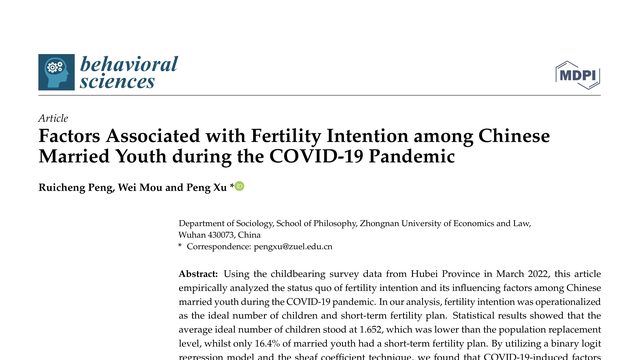
Why would married young people want fewer children even when governments encourage larger families? This study points to an unexpected answer: pandemic-related worries may matter more than money or job security.During the COVID-19 pandemic, having more money or a stable job did not necessarily mean stronger fertility intentions. The most stable influence came from pandemic-related changes in marriage and delayed pregnancy preparation after vaccination.
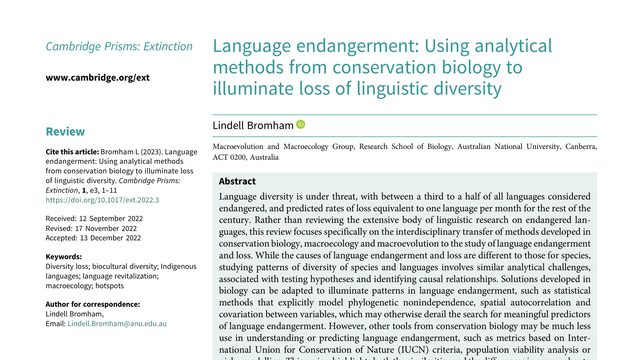
A language can disappear even while its community grows. This paper asks what the science of disappearing species can teach us about protecting the words, stories, and knowledge carried by human languages.What if methods designed to predict species extinction could help explain disappearing languages—but only after being carefully redesigned? This review shows where the analogy is powerful, and where it breaks down.
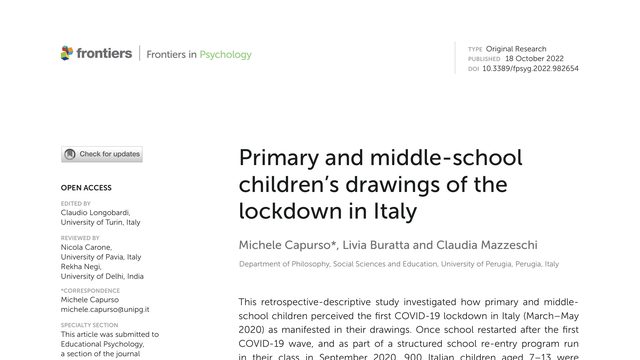
When children were asked to draw their lockdown lives, many did not draw the outside world at all. And among older children, the child in the picture was often missing—or had no face.What happens when children are asked to draw lockdown from memory? These pictures often show cheerful, colorful moments—but older children frequently leave their own faces, or even themselves, out of the scene.
 5:00
5:00