Singing Homer : Modern Greek songs, digital literacy, and the experiential reception of the epics in secondary education
In depth8:23CCAI
paperi.ai
0:00 / 0:00
Βασίλειος Ι. Τσιότρας
What if the best way to make Homer feel contemporary is not to simplify the epics, but to let students remake them through songs they already understand? This project turns classical reception into a creative, digital classroom experience.
This article reports on Singing Homer, a two-year cultural project (2021–2023) in a Greek lower-secondary school that engaged students with the Iliad and the Odyssey through modern Greek songs. The project addressed persistent challenges in teaching Homer – linguistic difficulty, cultural distance, and questions of curricular relevance – by introducing music as a medium of reception and reinterpretation, through which students connected modern musical narratives with Homeric figures and themes. Students researched songs, transcribed lyrics, juxtaposed them with epic passages, and produced digital presentations and videos. Their artefacts, together with questionnaire responses, show how music mediated Homeric figures and motifs, encouraging affective engagement, critical comparison, and collaborative creativity. Findings indicate three main outcomes. First, music provided an emotional gateway: students consistently reported joy, pride, and surprise, which sustained motivation and opened interpretive depth. Second, participants articulated clear rationales for the modern value of Ancient Greek texts, linking Homer to cultural roots, ethical reflection, and adolescent identity. Third, the integration of digital tools and public presentation fostered twenty-first-century competences, including creativity, collaboration, communication, and digital literacy. The study theorises experiential reception as a pedagogical approach where students actively reinterpret classical texts through culturally familiar media. It offers a transferable model for re-energising Homer in today’s classrooms, demonstrating that epic can function simultaneously as cultural heritage and as a living pedagogical resource.
Transcript
What if the best way to make Homer feel contemporary is not to simplify the epics, but to let students remake them through songs they already understand? This project turns classical reception into a creative, digital classroom experience.
Homer has traditionally occupied a central place in classical and literary education, both in Greece and internationally. Yet for many students today, epic poetry appears linguistically demanding and culturally remote, a challenge repeatedly noted in both Greek and international pedagogy.
The Homeric moment is never a recovery of an original, timeless Homer but always a historically situated act of interpretation, refracted through successive layers of translation, ideology, and cultural mediation. For modern learners, Homer’s meaning often reaches them at a distance, filtered through these mediations, which makes the question of meaningful engagement especially pressing.
Reception studies provide a productive perspective because classical texts acquire meaning as they are continually reshaped by later audiences. Experiential reception is an approach in which students actively reinterpret Homer through affective, creative, and participatory practices.
Those practices include researching modern songs inspired by Homeric themes, comparing their lyrics with passages from the epics, and producing collaborative digital presentations and videos. Experiential reception bridges reception studies and pedagogy while foregrounding modern song as a distinctive vehicle of Homeric reception.
The study proposes a transferable model for integrating epic literature with music to enhance engagement, critical reflection, and digital literacies. Its sequence moves from the theoretical framework to methods and materials, analyses of Iliad and Odyssey themes, survey findings, and discussion of implications for classical reception pedagogy and secondary education.
The project was implemented as a cultural programme in a Greek lower-secondary school from 2021 to 2023 and was explicitly aligned with national curriculum aims. Those aims were to foreground the enduring relevance of ancient Greek culture, investigate the impact of the epics on modern music, and develop critical digital literacy through student-produced media.
Selected Homeric passages from the Iliad and the Odyssey were coordinated with thematic units of the Ancient Greek syllabus, ensuring continuity with formal instruction. Students developed critical interpretation, intertextual comparison, and multimodal literacy by moving between textual analysis, musical listening, and visual representation.
The workflow was a structured sequence of inquiry-based tasks: web search, corpus curation, thematic coding, transcription, and audiovisual production. Students conducted guided digital searches, selected songs using thematic relevance, interpretive potential, and clarity of lyrics, and identified recurring motifs such as exile, desire, honour, and return.
Transcription and close reading enabled detailed textual analysis, while audiovisual production translated interpretive insights into compositions combining text, sound, and image. Each thematic axis guided a recurring sequence: close reading of a Homeric episode, identification of analogous motifs in modern lyrics, and articulation of the correspondences through discussion and digital production.
The teaching plan and process comprised weekly ninety-minute sessions, with approximately twenty-four sessions per year. Each cycle followed a stable but flexible sequence. Table one maps the project across two cycles: the Iliad in 2021–2022 and the Odyssey in 2022–2023, with the same cohort of forty-nine students participating in both.
Students collected more than one hundred songs overall and analysed approximately forty in depth, producing eight videos and multiple presentations, with public school events in both years. The table matters because it makes the study’s materials, outputs, and single-cohort case-study scope transparent.
The qualitative case-study design combined thematic analysis of lyrics and student artefacts with descriptive survey data, while frequencies illustrated trends in engagement and perceived relevance. Thematic analysis examined motifs of rage, fidelity, exile, and return through musical techniques such as melody, rhythm, harmony, and instrumentation.
The analysis also considered how text, music, and image were orchestrated multimodally as part of its thematic examination of musical expression. It also examined moments of ethical reasoning in student commentary, including how interpretive judgements intertwined with aesthetic appreciation and cultural understanding.
Student engagement was sustained through a combination of social, aesthetic, and technological factors. Collaboration with peers and the teacher was by far the strongest driver, at seventy-five point seven percent, highlighting teamwork, shared responsibility, and the supportive role of the instructor.
The musical corpus followed at fifty-four point one percent because students found the art songs engaging when they reframed Homer through modern sounds. Thirty-five point one percent underlined ICT, while twenty-nine point seven percent valued autonomy in choosing songs and shaping the direction of their work.
The most widely acknowledged benefit was connecting antiquity with the present, at eighty-four point two percent, confirming the project’s central aim of showing Homer’s relevance today. Students described this connection as a clearer understanding of Greek cultural heritage and an appreciation of continuity in values and the Greek language.
More than half highlighted renewal of school routine at fifty-five point three percent, improved collaboration and peer relations at fifty-two point six percent, and development of digital and research skills at fifty-two point six percent. A smaller group, thirteen point two percent, referred to gains in self-confidence, particularly through presenting their work in public.
Looking down the count column, the distribution ranges from thirty-two students for linking antiquity with the present to five for self-confidence—a gap of twenty-seven responses. The middle rows form a close pair, with twenty students each for critical digital and research skills and peer relations or collaboration.
As a single-site case study with forty-nine participants and without systematic pre- and post-testing, the scope for generalisation is inevitably restricted. Even so, triangulation of artefacts, classroom observations, and questionnaire data provides robust evidence for the mechanisms at work: music-mediated reception heightened engagement, fostered collaboration, and deepened reflection.
Future research could use comparative designs, pre- and post-measures of attitudes towards Ancient Greek, and cross-curricular applications linking literature, history, and music. Three key findings stand out. Music opened an emotional gateway: students consistently reported joy, pride, and surprise, emotions that sustained engagement and deepened interpretation.
Learners articulated clear rationales for the modern relevance of ancient texts, presenting Homer as a resource for identity, values, and cultural continuity. Digital tools and authentic public presentation transformed classical reception into a twenty-first-century competence practice, reinforcing creativity, collaboration, critical thinking, and communication.
Modern Greek songs gave students an emotional and culturally familiar route into Homer, while collaborative digital work supported interpretation, creativity, and communication. The case suggests a promising model, though its single-school design limits generalisation.
A derivative work by Paperi · AI-generated script, voice and captions
· pages and figures unaltered
Made with Paperi.
Drop in a research PDF — get a narrated video walkthrough like this one,
with highlights that follow the narration. Free to start.
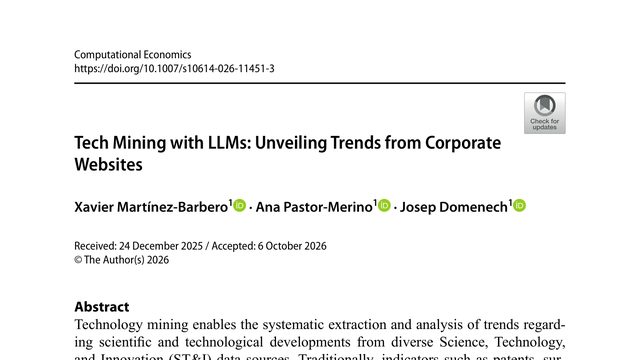
Xavier Martínez-Barbero, Ana Pastor-Merino, Josep Domènech
A company's website may reveal where its technology is heading, but only if someone can separate real signals from polished marketing. This study turns those public pages into a moving map of industrial change.What if company websites could act as a live radar for technological change? This study uses large language models to turn corporate web language into a measurable picture of manufacturing’s shifting technology landscape.
Domestic violence is not only a private crisis. This study finds that it can be widespread, hidden by silence, and tied to beliefs that make harmful behavior seem ordinary.In this study, nearly two-thirds of the participating women were classified as experiencing severe violence. The mixed-methods design also shows how social norms can keep that violence unspoken.
Why would married young people want fewer children even when governments encourage larger families? This study points to an unexpected answer: pandemic-related worries may matter more than money or job security.During the COVID-19 pandemic, having more money or a stable job did not necessarily mean stronger fertility intentions. The most stable influence came from pandemic-related changes in marriage and delayed pregnancy preparation after vaccination.
 4:09