In this study, nearly two-thirds of the participating women were classified as experiencing severe violence. The mixed-methods design also shows how social norms can keep that violence unspoken.
Background Violence against women is one of the most widespread, persistent and detrimental violations of human rights in today’s world, which has not been reported in most cases due to impunity, silence, stigma and shame, even in the age of social communication. Domestic violence against women harms individuals, families, and society. The objective of this study was to investigate the prevalence and experiences of domestic violence against women in Semnan. Methods This study was conducted as mixed research (cross-sectional descriptive and phenomenological qualitative methods) to investigate domestic violence against women, and some related factors (quantitative) and experiences of such violence (qualitative) simultaneously in Semnan. In quantitative study, cluster sampling was conducted based on the areas covered by health centers from married women living in Semnan since March 2021 to March 2022 using Domestic Violence Questionnaire. Then, the obtained data were analyzed by descriptive and inferential statistics. In qualitative study by phenomenological approach and purposive sampling until data saturation, 9 women were selected who had referred to the counseling units of Semnan health centers due to domestic violence, since March 2021 to March 2022 and in-depth and semi-structured interviews were conducted. The conducted interviews were analyzed using Colaizzi’s 7-step method. Results In qualitative study, seven themes were found including “Facilitators”, “Role failure”, “Repressors”, “Efforts to preserve the family”, “Inappropriate solving of family conflicts”, “Consequences”, and “Inefficient supportive systems”. In quantitative study, the variables of age, age difference and number of years of marriage had a positive and significant relationship, and the variable of the number of children had a negative and significant relationship with the total score and all fields of the questionnaire (p < 0.05). Also, increasing the level of female education and income both independently showed a significant relationship with increasing the score of violence. Conclusions Some of the variables of violence against women are known and the need for prevention and plans to take action before their occurrence is well felt. Also, supportive mechanisms with objective and taboo-breaking results should be implemented to minimize harm to women, and their children and families seriously.
Transcript
In this study, nearly two-thirds of the participating women were classified as experiencing severe violence. The mixed-methods design also shows how social norms can keep that violence unspoken. Violence against women by husbands, including physical, sexual, and psychological violence, is presented as both a public-health problem and a violation of women’s human rights.
The block estimates that thirty-five percent of women, and almost one out of every three women aged fifteen to forty-nine, experience physical or sexual violence by a spouse or non-spouse sexual violence during their lifetime. The violence described includes physical, sexual, and psychological actions, as well as control, threats, aggression, abuse, and rape.
The study combines cross-sectional and phenomenology studies to investigate the amount of domestic violence and related factors quantitatively, alongside women’s experiences of that violence qualitatively. The research received ethics approval, obtained informed written consent, and assured participants that their information would remain anonymous and confidential.
Participation was voluntary, and participants could withdraw from the study at any time. The cross-sectional study ran from February two thousand twenty-one to March two thousand twenty-two and used cluster sampling among married women in areas served by three healthcare centers in Semnan city.
Participants were included when they were married and agreed to written and verbal informed consent about the ethical considerations. The questionnaire was completed either on paper or online. The qualitative analysis produced themes including facilitators, role failure, repressors, efforts to preserve the family, inappropriate solving of family conflicts, consequences, and inefficient supportive systems.
Together, these themes organize both factors connected with violence and the ways women respond to it and experience its consequences. Figure one maps the experiences of domestic violence in women to seven surrounding themes: facilitators, role failure, repressors, efforts to preserve the family, inappropriate solving of family conflicts, consequences, and inefficient supportive systems.
The authors use this thematic structure to show that domestic violence is connected not only to harmful outcomes, but also to family roles, conflict responses, attempts to preserve family relationships, and the support available to women. The quantitative sample included three hundred seventy-six married women living in Semnan city.
The participants’ mean age was thirty-eight point fifty-two years, with a standard deviation of ten point thirty-eight years; ages ranged from eighteen to seventy-three. Years of marriage ranged from one to forty, and the number of children ranged from none to seven.
Table three describes the sociodemographic profile of the three hundred seventy-six married women in the study. Their mean age was thirty-eight point five two years, with an average marriage duration of eight point two zero years and two point five four children; the table also reports education and occupations for participants and their husbands.
This context matters because the authors later examine how these characteristics relate to questionnaire scores and reported violence levels. The frequency distribution divided participants into low, moderate, and severe violence groups.
Eighty-nine participants, or twenty-three point seven percent, experienced low violence, while fifty-nine, or fifteen point seven percent, experienced moderate violence. The largest group was the severe-violence category, with two hundred twenty-eight participants, or sixty point six percent.
Table four reports correlations between demographic variables and questionnaire domains, including psychological, economical, physical, and sexual violence, as well as patriarchy beliefs and tradition and family upbringing. Across the total score, age, age difference, and years of marriage show positive correlations, while number of children shows a negative correlation; the education-difference correlation is small and not statistically significant, with an r of zero point zero three and a p-value of zero point five.
This matters because it maps how demographic characteristics relate to reported domestic violence and its associated beliefs. Age, age difference, and years of marriage had positive and significant relationships with the total score and all questionnaire fields.
The number of children had a negative and significant relationship with the total score and all questionnaire fields. The difference in education level showed no significant relationship with the total score or any questionnaire field, while patriarchal beliefs had the highest average score among the fields.
Table five presents the final regression model for predicting violence. Two variables remained: women’s education, with an unstandardized coefficient of three point three eight six, a standardized coefficient of zero point two three seven, and a p-value of zero point zero zero one; and women’s income, with corresponding values of three point four three nine, zero point two three five, and zero point zero zero one.
The authors interpret both as significant independent relationships with violence scores. Patriarchal beliefs, rooted in social and family tradition and culture, had the highest score in relation to domestic violence in this study.
Qualitatively, the normalcy of men’s anger and harassment in society acted as a repressor of women expressing violence. Quantitatively, increases in women’s education and income level were predictors of increased violence. Women across a wide range of ages, education levels, and social positions faced the problem, and most cases were not reported.
The study identifies variables of violence against women and emphasizes the need for policymaking and social pathology in society. It calls for operational plans that act before violence occurs. The block also recommends breaking the taboo of domestic violence and promoting divorce as a viable solution after counseling, aiming to minimize harm to women, children, and families.
Domestic violence against women is described as an important issue in Iranian society, while women resist showing and expressing it. That resistance made sampling a long-term process in both the qualitative and quantitative studies. The interview location and women’s fear that their husbands would discover their participation were additional research challenges.
The researchers attempted to minimize those challenges by respecting ethical considerations, but personal and professional experiences and the reviewed literature may have influenced the results. The study connects domestic violence with patriarchal beliefs, silence around men’s anger, and barriers to disclosure, while also showing why prevention, support, and careful ethical research matter.
A derivative work by Paperi · AI-generated script, voice and captions
· pages and figures unaltered
Made with Paperi.
Drop in a research PDF — get a narrated video walkthrough like this one,
with highlights that follow the narration. Free to start.
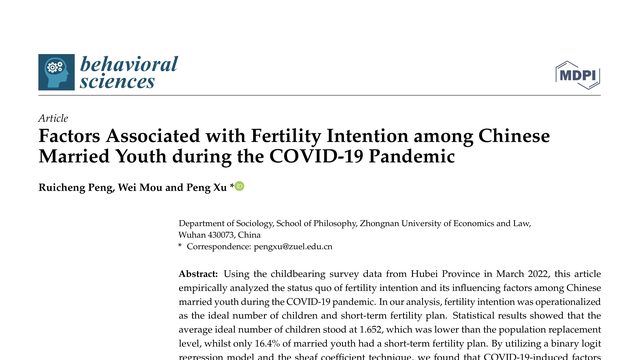
Why would married young people want fewer children even when governments encourage larger families? This study points to an unexpected answer: pandemic-related worries may matter more than money or job security.During the COVID-19 pandemic, having more money or a stable job did not necessarily mean stronger fertility intentions. The most stable influence came from pandemic-related changes in marriage and delayed pregnancy preparation after vaccination.
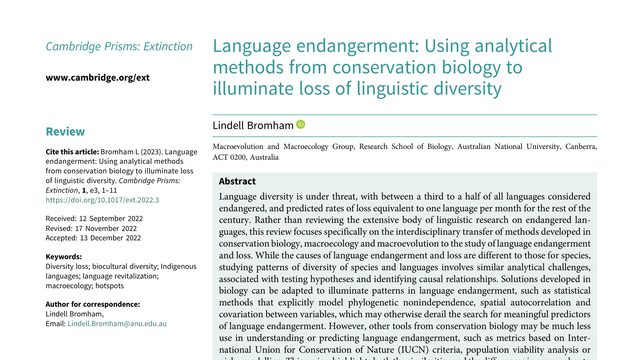
A language can disappear even while its community grows. This paper asks what the science of disappearing species can teach us about protecting the words, stories, and knowledge carried by human languages.What if methods designed to predict species extinction could help explain disappearing languages—but only after being carefully redesigned? This review shows where the analogy is powerful, and where it breaks down.
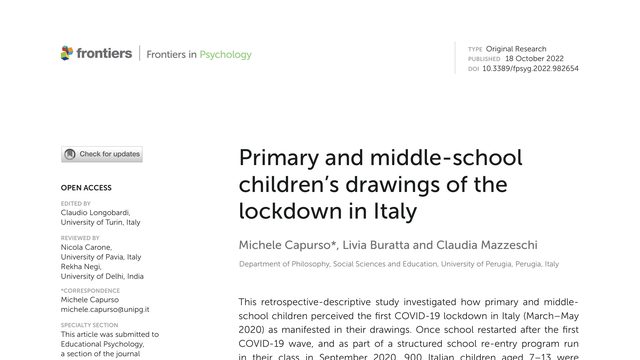
When children were asked to draw their lockdown lives, many did not draw the outside world at all. And among older children, the child in the picture was often missing—or had no face.What happens when children are asked to draw lockdown from memory? These pictures often show cheerful, colorful moments—but older children frequently leave their own faces, or even themselves, out of the scene.
 5:00
5:00