Effect of injectable platelet rich fibrin augmented with vitamin c compared to injectable platelet rich fibrin alone on healing of necrotic mature single rooted teeth with chronic periapical periodontitis following regenerative endodontic therapy (a randomized controlled trial)
Overview3:44CCAI
paperi.ai
0:00 / 0:00
Wesam Osama Hassan, Ahmed S. ElSheshtawy, Manal Mohamed Abdelbaki, Geraldine Ahmed
When a tooth is badly infected, the goal is not only to clean it, it is to help the damaged area heal. This study tested whether adding vitamin C would make that healing better, and the answer was unexpectedly even-handed.
Objectives To assess the healing potential, postoperative pain and clinical normalcy associated with injectable platelet-rich fibrin combined with Vitamin C in regenerative endodontic procedure using cone-beam computed tomography and two-dimensional radiograph. Methods Twenty-eight healthy patients with mature permanent single-rooted teeth diagnosed with pulp necrosis and chronic apical periodontitis were randomly allocated into two groups (n = 14). Regenerative endodontic treatment was performed using injectable platelet-rich fibrin combined with Vitamin C (intervention group) and injectable platelet-rich fibrin alone (control group). Periapical healing was assessed using CBCT and periapical radiographs over 12 months. Postoperative pain and clinical normalcy were also evaluated. Results Both groups showed significant lesion reduction at 12 months (P = 0.001), with no significant between-group differences in postoperative lesion size (P = 0.981) or reduction magnitude (P = 0.497). CBCT-PAI scores improved in both groups without significant intergroup differences at baseline or follow-up. Two-dimensional radiographs showed a baseline difference (P = 0.007) but no postoperative differences; both groups demonstrated significant longitudinal reduction (P < 0.001). Postoperative pain scores were comparable between groups at all time points (P > 0.05), with a significant temporal decrease observed only in the intervention group (P = 0.001). All teeth remained asymptomatic during follow-up.
Transcript
When a tooth is badly infected, the goal is not only to clean it—it is to help the damaged area heal. This study tested whether adding vitamin C would make that healing better, and the answer was unexpectedly even-handed. An infection inside a tooth can spread to the area around its root, often after decay or an injury.
That condition is commonly treated by removing the inner tissue and sealing the tooth. But removing that tissue may leave the treated tooth less structurally durable, making it more prone to fracture and reinfection. The passage points to the inner tissue as important for keeping a tooth healthy over time.
That concern leads to a different idea: treatment can try to support healing inside the tooth. The study tested injectable platelet-rich fibrin combined with vitamin C as a scaffold in regenerative treatment. The study also looked at healing in two kinds of dental images, along with pain after treatment and the tooth’s clinical condition.
The comparison was designed so people were assigned by chance to one of two treatment groups, and both the patients and the people assessing them were kept unaware of the assignment. Everyone gave written consent before taking part, and treatment and follow-up took place in an outpatient clinic from April twenty twenty-three through January twenty twenty-five.
The main question was whether the damaged area around the root looked smaller after treatment, comparing images taken before treatment with images taken twelve months later. The study also assessed healing with another image-based score, ordinary two-dimensional dental images, the tooth’s clinical condition, and pain after treatment.
A dark area near the tooth’s root becomes progressively smaller on repeat X-rays, shrinking from two point eight eight square millimetres before treatment to zero point nine seven at six months. That visible change is consistent with the bone healing around the root.
Here is the first important result: the damaged area became significantly smaller over time in both treatment groups. The size of the improvement was large in both groups, indicating substantial improvement over time regardless of which treatment was used.
The clinical picture was also reassuring. During follow-up, none of the cases in either group showed pain when the tooth was tapped, swelling, or a draining passage. Clinical success was achieved in all cases in both groups. But the result needs a boundary around it.
The relatively modest number of participants may have made it harder to detect small differences between the treatments. And although the follow-up was long enough to assess early healing trends, it may not show whether healing remains stable over much longer periods.
The overall finding is that both the blood-based material alone and the same material supplemented with vitamin C were associated with favorable clinical and image-based outcomes in these damaged mature teeth. No statistically significant difference appeared between the groups for healing around the root, clinical outcomes, or pain after treatment.
Both approaches had favorable clinical outcomes, and no adverse events were observed during follow-up. For someone facing this kind of tooth problem, that means both options showed encouraging short-term results, but vitamin C did not clearly add an advantage.
Both treatments were linked with healing and no troubling symptoms during follow-up, but adding vitamin C did not produce a detectable advantage. For patients, the encouraging part is that both approaches showed favorable short-term results, while longer-term benefit remains uncertain.
A derivative work by Paperi · AI-generated script, voice and captions
· pages and figures unaltered
Made with Paperi.
Drop in a research PDF — get a narrated video walkthrough like this one,
with highlights that follow the narration. Free to start.
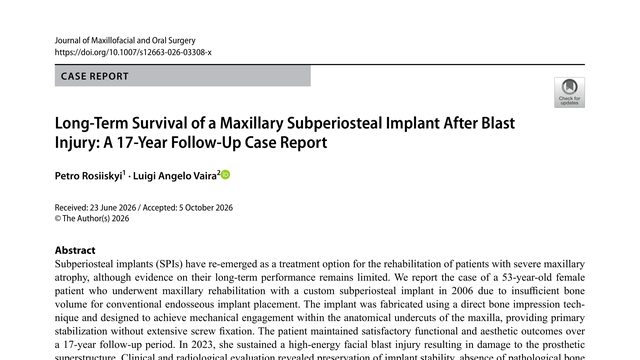
A dental implant stayed stable for seventeen years, and then endured a high-energy blast. The visible replacement was damaged, but the structure supporting it remained usable.A dental implant endured seventeen years in a severely atrophic upper jaw, and then a high-energy blast injury. The remarkable part is what the implant did not do: it did not become mobile or lose its functional stability.
Bruna Machado Fernandes, Anelise Fernandes Montagner, Sarah Arangurem Karam, Françoise Hélène van de Sande, Marcos Britto Corrêa
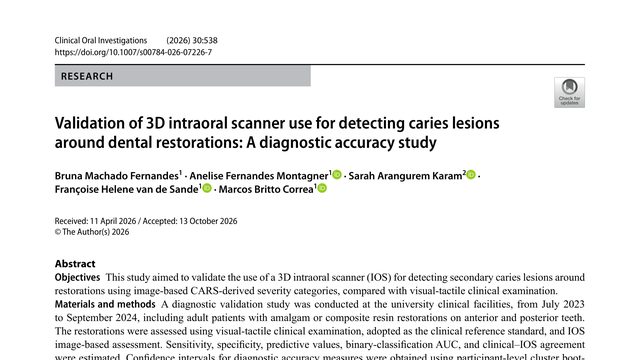
A filling can look perfectly ordinary while decay is forming at its edge. This study asks whether a three-dimensional dental scan can help find that hidden trouble, without replacing the dentist’s judgment.A dental scanner can produce a remarkably convincing three-dimensional picture, but can that picture actually detect decay around an old filling? This study finds a useful answer: sometimes, but especially as a complement, not a replacement.
Viktor Martian, Christoph Sasse, Ralf Bürgers, Andrea Schubert, Oskar Bunz
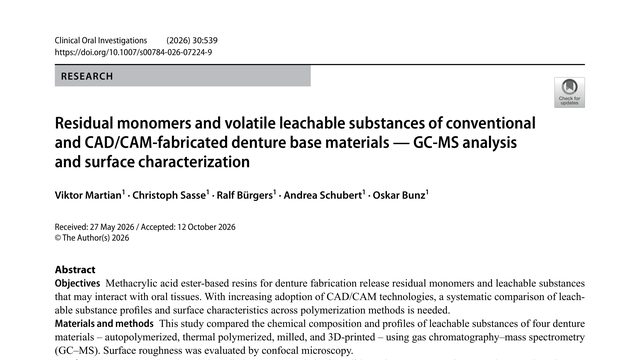
A denture can contain leftover building blocks from its manufacture. But in this study, the material with the most detectable residue did not release more of one key substance than plain control liquid.A denture resin can contain residual monomer without releasing more methyl methacrylate than a negative control. And the 3D-printed material may look chemically different for reasons a single screening method cannot fully reveal.
 2:35