Long-Term Survival of a Maxillary Subperiosteal Implant After Blast Injury: A 17-Year Follow-Up Case Report
Overview2:35CCAI
paperi.ai
0:00 / 0:00
Petro Rosiiskyi, Luigi Angelo Vaira
A dental implant stayed stable for seventeen years, and then endured a high-energy blast. The visible replacement was damaged, but the structure supporting it remained usable.
Subperiosteal implants (SPIs) have re-emerged as a treatment option for the rehabilitation of patients with severe maxillary atrophy, although evidence on their long-term performance remains limited. We report the case of a 53-year-old female patient who underwent maxillary rehabilitation with a custom subperiosteal implant in 2006 due to insufficient bone volume for conventional endosseous implant placement. The implant was fabricated using a direct bone impression technique and designed to achieve mechanical engagement within the anatomical undercuts of the maxilla, providing primary stabilization without extensive screw fixation. The patient maintained satisfactory functional and aesthetic outcomes over a 17-year follow-up period. In 2023, she sustained a high-energy facial blast injury resulting in damage to the prosthetic superstructure. Clinical and radiological evaluation revealed preservation of implant stability, absence of pathological bone resorption, and only a localized intrusion of the implant framework of approximately 2 mm in the anterior region. No implant mobility or functional impairment was observed. The patient was successfully rehabilitated with a new prosthetic restoration without the need for additional surgical intervention. This case highlights the potential long-term stability of subperiosteal implants and provides a rare clinical observation of their behavior under extreme traumatic conditions. Further studies are needed to better understand the biomechanical performance of these systems.
Transcript
A dental implant stayed stable for seventeen years—and then endured a high-energy blast. The visible replacement was damaged, but the structure supporting it remained usable. Severe loss of upper-jaw bone can make conventional implants impossible because there is not enough bone to hold them.
In such cases, a subperiosteal implant may offer an alternative, allowing a dental replacement without extensive bone grafting procedures. Newer computer-guided design and modern manufacturing have improved the precision and repeatability of these supporting frameworks.
But long-term clinical information remains limited, especially about how these implants behave under extreme mechanical stress or traumatic events. That gap is illustrated by a rare case: an upper-jaw implant maintained its structure and function through seventeen years and a high-energy blast injury.
Like a carefully fitted shelf, the framework was shaped from the jaw’s surface and used natural undercuts for mechanical grip and initial stability, rather than relying on extensive screw fixation. It was placed fourteen days later and adapted stably without extensive screw fixation.
The blast fractured and removed the front ceramic part of the dental replacement. There was inflammation in the surrounding soft tissue, but no implant movement and no pain during normal use. The images trace the visible gap from damaged front teeth and exposed supports, through healing, to a complete replacement that restores the patient’s smile.
Imaging showed that the supporting framework was preserved, with no harmful loss of surrounding bone. Only the front part had moved inward by about two millimeters; the back extensions remained stable. The damaged dental replacement could be replaced quickly using the existing supporting parts, avoiding additional surgery.
That may benefit patients with severe jawbone loss, because the damaged visible replacement could be restored using existing implant abutments, without another operation. The evidence is limited because it comes from one case and lacks three-dimensional imaging and mechanical analysis.
Larger studies are needed to clarify how these implants behave over time and how different ways of securing them affect that behavior. This case suggests that an implant resting on severely reduced jawbone can remain stable through years of use and extreme trauma. For some patients, that could mean restoring function without another major operation.
A derivative work by Paperi · AI-generated script, voice and captions
· pages and figures unaltered
Made with Paperi.
Drop in a research PDF — get a narrated video walkthrough like this one,
with highlights that follow the narration. Free to start.
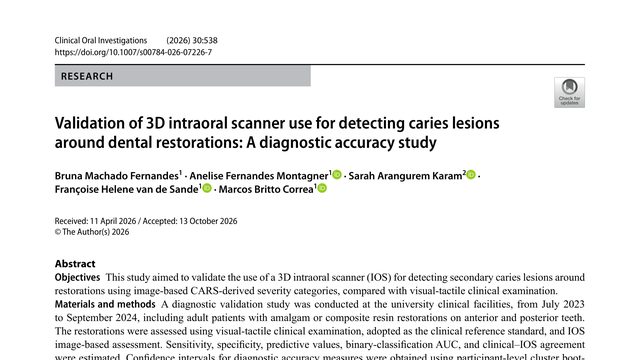
Bruna Machado Fernandes, Anelise Fernandes Montagner, Sarah Arangurem Karam, Françoise Hélène van de Sande, Marcos Britto Corrêa
A filling can look perfectly ordinary while decay is forming at its edge. This study asks whether a three-dimensional dental scan can help find that hidden trouble, without replacing the dentist’s judgment.A dental scanner can produce a remarkably convincing three-dimensional picture, but can that picture actually detect decay around an old filling? This study finds a useful answer: sometimes, but especially as a complement, not a replacement.
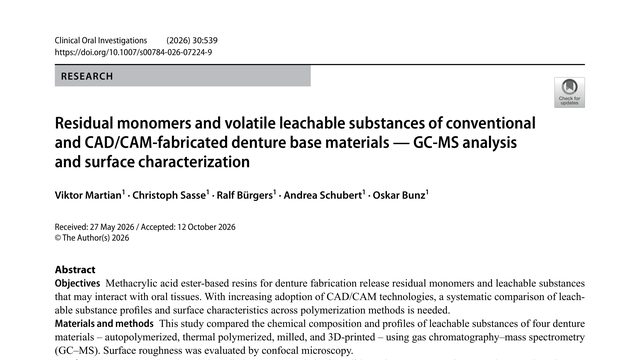
Viktor Martian, Christoph Sasse, Ralf Bürgers, Andrea Schubert, Oskar Bunz
A denture can contain leftover building blocks from its manufacture. But in this study, the material with the most detectable residue did not release more of one key substance than plain control liquid.A denture resin can contain residual monomer without releasing more methyl methacrylate than a negative control. And the 3D-printed material may look chemically different for reasons a single screening method cannot fully reveal.
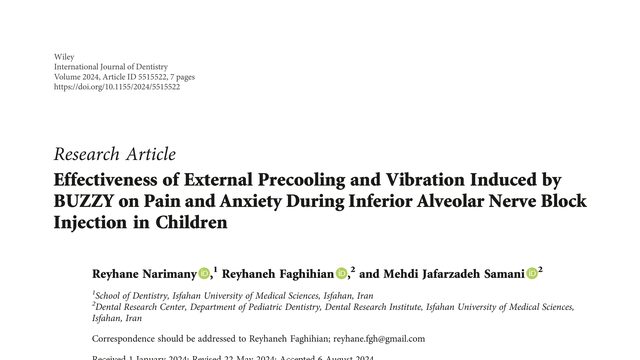
Reyhane Narimany, Reyhaneh Faghihian, Mehdi Jafarzadeh Samani
A small device combines cooling and vibration to make a dental injection less frightening for children. But when it was tested, the reassuring sensation did not clearly reduce either pain or anxiety.A device combining cold and vibration sounds like a simple way to make dental injections easier for children. But in this randomized trial, BUZZY did not significantly reduce pain or anxiety during the injection.
 3:27