Structural and Evolutionary Analysis of Non-specific Lipid Transfer Proteins (nsLTPs) in Cereus (Cactaceae)
Overview3:22CCAI
paperi.ai
0:00 / 0:00
Maria Izadora Oliveira Cardoso, João Alfredo Teodoro, Tales Alexandre Costa-Silva, Danilo Trabuco Amaral
A cactus survives harsh heat and drought with proteins that may act like tiny gates: their main structure stays stable, while the entrances subtly change what can pass through.
The genus Cereus (Cactaceae), widely distributed across arid and semi-arid environments of South America, exhibits adaptive capacity that is partly associated with proteins involved in lipid metabolism and stress responses, such as nonspecific lipid transfer proteins (nsLTPs). Although well-characterized in model plants, the structural diversity and func tional roles of these proteins in cacti remain largely unexplored. In this study, we characterized the nsLTP repertoire of Cereus by integrating transcriptomic data, phylogenetic analyses, structural modeling, and ligand-binding site mapping. Structural comparisons revealed conservation of the typical nsLTP fold, with variations mainly localized to loop regions surrounding the binding cavity, suggesting functional plasticity without compromising scaffold stability. Phylogenetic analyses revealed frequent duplication and loss events, as well as species-specific paralogs. Several lineage-specific copies exhibited distinctive loop architectures and pocket geometries relative to their closest orthologs, suggesting rapid structural diversification following duplication. This pattern is consistent with functional fine-tuning after gene duplication. Positive selection analyses identified nine codons with significant evidence of episodic diversifying selection (p < 0.05), some of which mapped near predicted functional regions, supporting the hypothesis that selective pressures have shaped key interaction interfaces. Together, these results provide the first integrated characterization of nsLTPs in Cereus, supporting a gate-modulation hypothesis in which structural variation concentrated at tunnel entrances may contribute to functional diversification while preserving the conserved nsLTP fold (four-helix scaffold). Rather than asserting adaptation directly, our findings provide a structural basis and testable predictions for how nsLTP diversification may influence lipid trafficking processes relevant to cuticle/membrane function under abiotic stress.
Transcript
A cactus survives harsh heat and drought with proteins that may act like tiny gates: their main structure stays stable, while the entrances subtly change what can pass through. Cereus has a broad evolutionary history, but the diversification and structural variation of gene families linked to stress-related processes remain poorly understood.
These proteins have recognized roles in lipid binding, transport, and stress responses in other plant lineages, yet they have not been investigated in this cactus genus. The central question is whether sequence variation gathers around the predicted lipid-binding cavities while the overall structural scaffold remains conserved.
The proteins keep the typical overall fold, while most variation sits in loop regions surrounding the internal binding cavity. It is like a house whose frame stays firm while the shape of a doorway changes. The pattern suggests functional flexibility without compromising the stable scaffold.
The evolutionary picture also shows frequent duplication and loss, along with copies found only in particular species. The alignment shows eight conserved cysteines characteristic of plant lipid-transfer proteins. In contrast, residues between the cysteines display greater variability, particularly in loop segments and solvent-exposed surfaces.
All the proteins retain the characteristic water-repelling tunnel found in plant lipid-transfer proteins. But predicted binding energies vary with both the lipid and the local shape of the pocket, indicating that the cavities are not energetically equivalent across the protein variants.
Copies from different Cereus species are extensively intermingled in the evolutionary tree rather than forming separate species-specific groups. That pattern indicates that much of the family’s diversification predates the spread of the living Cereus species, with many duplicated copies retained across descendant lineages.
Other groups contain multiple copies from the same species, revealing more recent duplications added to this older pattern. Evidence of episodic positive selection appeared at eighteen sites, and nine reached the stated significance threshold. The pressure was not spread evenly across the whole gene; it appeared locally in particular branches or lineages.
These results identify candidate sites associated with sequence diversification, rather than definitive targets of adaptive evolution, and their functional consequences remain unknown. The results should therefore be treated as hypotheses about evolutionary diversification, not direct evidence of ecological adaptation or physiological specialization.
The observed sequence diversification occurred through multiple independent events after lineages separated, rather than through selection acting across all copies. The candidate sites provide a rational starting point for future biochemical and functional studies, because their biological significance cannot be determined from sequence analysis alone.
The Cereus proteins keep a sturdy shared framework but vary around their internal passageways. That points to possible differences in lipid handling, while leaving the real effects to future experiments.
A derivative work by Paperi · AI-generated script, voice and captions
· pages and figures unaltered
Made with Paperi.
Drop in a research PDF — get a narrated video walkthrough like this one,
with highlights that follow the narration. Free to start.
Marcio Viana Ramos, Rayanne Farias da Silva, Cristina P. S. Carvalho, Arlete Aparecida Soares, José Francisco C. Gonçalves, Patrícia M. S. Carvalho, Pedro A. V. R. Júnior, Joao Maria Matos-Neto, Cléverson D.T. Freitas
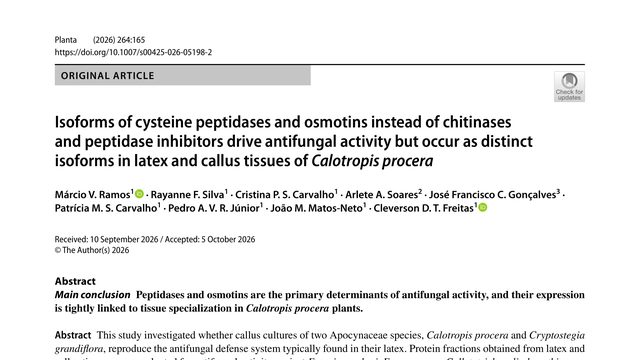
A plant's wound-sealing liquid can fight fungi, but when researchers grew plant tissue outside that liquid, the defense survived in one species and vanished in another. The surprise was not just which proteins worked, but where their versions came from.What if a plant tissue that lacks latex can still make a powerful antifungal mixture, but uses different molecular versions of the same defense proteins? That is the puzzle this study tests.
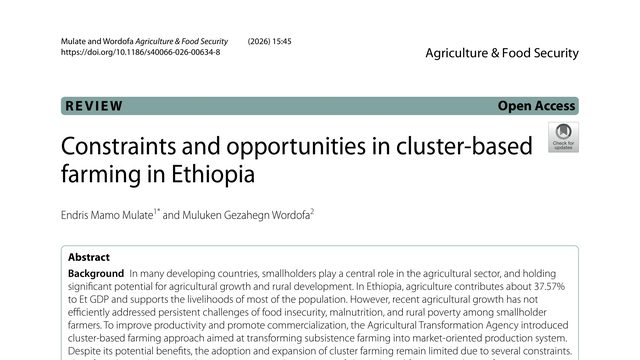
What if neighboring farmers could gain more power simply by farming side by side? In Ethiopia, bringing small plots together promises better harvests and stronger markets, but cooperation itself may be the hardest crop to grow.What if the route from subsistence farming to commercial agriculture is not a bigger farm, but neighboring smallholders working together? In Ethiopia, cluster farming promises gains across five dimensions, but the same review finds serious barriers to making it work.
E. W. Slessarev, H. R. Goertzen, Rebecca A. Lybrand, Karis J. McFarlane, Jennifer Pett‐Ridge, Noah W. Sokol, D. G. Zaharescu, K. Georgiou
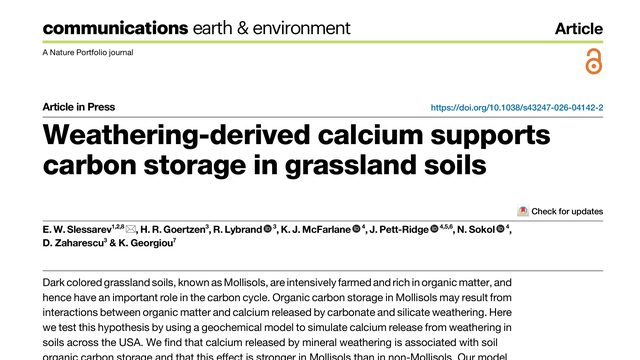
Some of the world’s best farmland may hold onto carbon not just because of its grasses, but because minerals slowly release calcium into the soil. Farming may have dramatically changed that hidden support system.What if part of the carbon stored in America’s richest grassland soils depends on something as ordinary as calcium? This study links mineral weathering, agriculture, and soil carbon across the entire conterminous United States.
 3:31