Constraints and opportunities in cluster-based farming in Ethiopia
In depth7:00CCAI
paperi.ai
0:00 / 0:00
Endris Mamo Mulate, Muluken Gezahegn Wordofa
What if the route from subsistence farming to commercial agriculture is not a bigger farm, but neighboring smallholders working together? In Ethiopia, cluster farming promises gains across five dimensions, but the same review finds serious barriers to making it work.
Background In many developing countries, smallholders play a central role in the agricultural sector, and holding significant potential for agricultural growth and rural development. In Ethiopia, agriculture contributes about 37.57% to Et GDP and supports the livelihoods of most of the population. However, recent agricultural growth has not efficiently addressed persistent challenges of food insecurity, malnutrition, and rural poverty among smallholder farmers. To improve productivity and promote commercialization, the Agricultural Transformation Agency introduced cluster-based farming approach aimed at transforming subsistence farming into market-oriented production system. Despite its potential benefits, the adoption and expansion of cluster farming remain limited due to several constraints. Therefore, this study reviews the opportunities and constraints of cluster-based farming in Ethiopia from social, economic, ecological/environmental, institutional, and political perspectives. Methods This study employed a systematic literature review methodology. Relevant studies were identified through digital libraries, web sources, Ethiopian public university repositories, ATA government website and other academic databases. A keyword-based search strategy was used to identify relevant publications mainly covering the period from 2015 to 2026. Based on relevance to study objective, a total of 23 empirical studies were selected and analyzed. Results The findings indicate that cluster-based farming in Ethiopia provides several opportunities across multiple dimensions. Social opportunities include enhanced farmer-to-farmer interaction, knowledge sharing, and collaboration. Economic opportunities involve improved productivity, economies of scale, better market access, and increased bargaining power. Ecological opportunities include improved natural resource management and the potential adoption of climate-smart agricultural practices. Institutional opportunities arise from stronger partnerships and coordination among farmers, government agencies, and development organizations, while political support through national agricultural development strategies further promotes cluster initiatives. However, several constraints also affect the implementation of cluster-based farming. These include farmers’ resistance to collective approaches, limited economies of scale among smallholders, unfavorable agro-ecological conditions, weak institutional coordination, and political instability. Conclusions Cluster-based farming has the potential to transform smallholder agriculture in Ethiopia by improving productivity, commercialization, and rural livelihoods. However, its success depends on addressing key social, economic, ecological, institutional, and political constraints.
Transcript
What if the route from subsistence farming to commercial agriculture is not a bigger farm, but neighboring smallholders working together? In Ethiopia, cluster farming promises gains across five dimensions—but the same review finds serious barriers to making it work. In many developing countries, smallholders play a central role in the agricultural sector and hold significant potential for agricultural growth and rural development.
In Ethiopia, agriculture contributes about thirty-seven point fifty-seven percent to GDP and supports the livelihoods of most of the population. However, recent agricultural growth has not efficiently addressed persistent challenges of food insecurity, malnutrition, and rural poverty among smallholder farmers.
To improve productivity and promote commercialization, the Agricultural Transformation Agency introduced cluster-based farming, aimed at transforming subsistence farming into a market-oriented production system. Cluster farming is a farming approach in which farmers with adjacent farmland voluntarily collaborate to grow the same commodity by pooling a portion of their farmland.
In this approach, farmers are expected to implement best agronomic practices such as recommended fertilizers, improved seed varieties, pesticides, herbicides, proper tillage, harvesting, and threshing techniques. Previous studies have examined productivity improvement, commercialization, and farmer welfare outcomes, but the literature on cluster-based farming in Ethiopia remains fragmented.
The literature remains fragmented and often focuses on specific commodities, geographic areas, or single aspects such as productivity, commercialization, or adoption. As a result, it provides limited comprehensive understanding of the broader opportunities and constraints associated with cluster-based farming from multiple perspectives.
This study therefore provides a systematic synthesis of empirical research and examines cluster-based farming from social, economic, ecological, institutional, and political perspectives. The review is organized around two research questions: why cluster farming is needed in Ethiopia, and what constraints and opportunities it presents across social, economic, ecological, institutional, and political perspectives.
The search was restricted to documents published in English between twenty fifteen and twenty twenty-six, except for foundational concepts and theories of cluster farming practices. After initial results were retrieved, duplicate records were removed, and titles, abstracts, and full texts were screened against clearly defined inclusion and exclusion criteria.
Included studies directly addressed the research questions, were published in peer-reviewed journals, conference proceedings, or institutional repositories, and had a clear research design and findings. After screening and removing irrelevant records, one hundred twenty-nine studies were examined.
After identification, eligibility, and screening, a total of twenty-three papers were included for further analysis and discussion. The identification column shows records coming from four source categories, with database screening contributing forty-nine and web sources fifty-six.
In the eligibility branch, sixty-eight full-text articles were assessed, while the excluded full texts are broken down into twenty-six irrelevant articles, three non-English articles, and sixteen with no full text available. Cluster-based farming fosters farmer-to-farmer knowledge exchange and social collaboration, improving the adoption of better practices and reducing isolation.
Cluster-based farming creates a social relationship between smallholder farmers, allowing them to learn from each other and share skills. This interaction increases awareness of agricultural mechanization, such as tractors and combine harvesters, for productivity and quality improvement.
It also enables farmers to group together to purchase large production machines, which would be difficult to acquire individually. Cluster-based farming helps farmers within the cluster obtain the latest technologies, achieve economies of scale by sharing risks, share costs related to training, and increase crop productivity.
Smallholder farmers can achieve economies of scale and bargaining power to negotiate for better market conditions and prices by marketing their produce collectively. External agencies, universities, the Ministry of Agriculture, and agricultural research institutes provide assistance and knowledge transfer to members via the farmer group rather than through individual farmers.
Cluster-based farming enables smallholder farmers to pool their resources and collaborate with the Ministry of Agriculture on soil conservation, water conservation, and agroforestry conservation. Cluster farming also provides a platform for adopting Climate-Smart Agriculture practices, including soil and water conservation, improved seeds, organic manure, and integrated weed management.
These practices can improve resilience to climate shocks, stabilize productivity, and reduce environmental degradation. The review finds opportunities across social, economic, ecological, institutional, and political dimensions. Socially, cluster farming promotes farmer-to-farmer interaction, knowledge sharing, and collective learning, helping farmers adopt improved agricultural practices and technologies.
Economically, it allows farmers to achieve economies of scale, improve bargaining power, reduce transaction costs, and enhance access to credit, inputs, and output markets. Institutionally, the cluster approach strengthens partnerships and coordination among farmers, government institutions, research organizations, and other stakeholders.
Despite these opportunities, the review identifies constraints that may affect the effectiveness and sustainability of cluster-based farming in Ethiopia. Social challenges include farmers’ resistance to collective approaches and limited trust among participants.
Economic limitations include lack of access to credit, high input costs, and weak rural financial systems. Ecological risks relate to climate change, land scarcity, and environmental degradation, while institutional challenges include weak coordination and limited implementation capacity.
Cluster-based farming offers social, economic, ecological, institutional, and political opportunities in Ethiopia, but its effectiveness and sustainability depend on overcoming resistance, financial limits, environmental risks, weak coordination, and political challenges.
A derivative work by Paperi · AI-generated script, voice and captions
· pages and figures unaltered
Made with Paperi.
Drop in a research PDF — get a narrated video walkthrough like this one,
with highlights that follow the narration. Free to start.
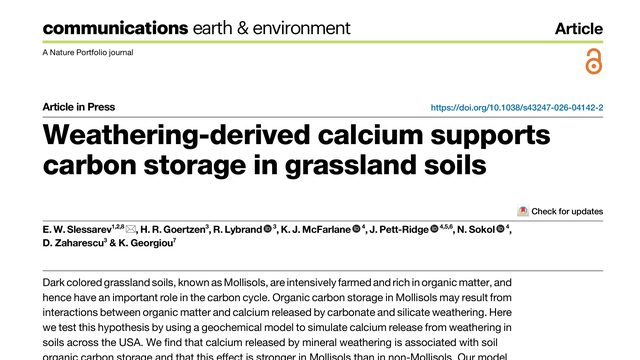
E. W. Slessarev, H. R. Goertzen, Rebecca A. Lybrand, Karis J. McFarlane, Jennifer Pett‐Ridge, Noah W. Sokol, D. G. Zaharescu, K. Georgiou
Some of the world’s best farmland may hold onto carbon not just because of its grasses, but because minerals slowly release calcium into the soil. Farming may have dramatically changed that hidden support system.What if part of the carbon stored in America’s richest grassland soils depends on something as ordinary as calcium? This study links mineral weathering, agriculture, and soil carbon across the entire conterminous United States.
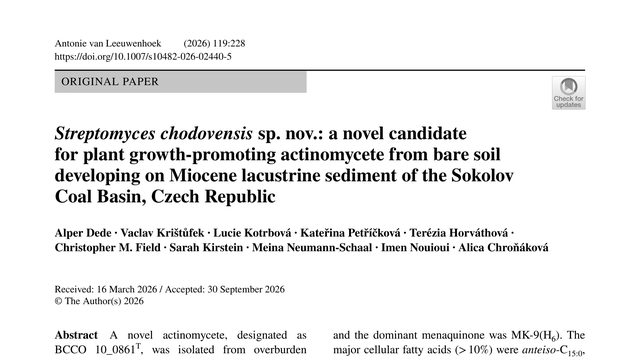
Alper Dede, Václav Krištůfek, Lucie Kotrbová, Kateřina Petřı́čková, Terézia Horváthová, Christopher M. Field, Sarah Kirstein, Meina Neumann‐Schaal, Imen Nouioui, A. Chroňáková
A place stripped bare by coal mining has yielded a bacterium that may help plants grow. It is not just another soil microbe: its traits suggest a possible ally for rebuilding damaged land.A bare soil patch left by coal mining has yielded a candidate for a completely new Streptomyces species, with unusual chemistry and thousands of predicted plant-growth-promoting genes.
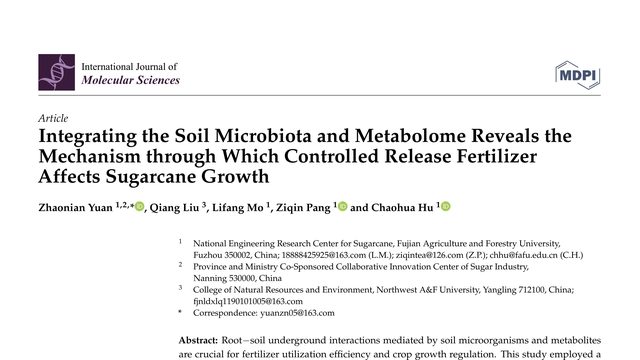
Zhaonian Yuan, Qiang Liu, Lifang Mo, Ziqin Pang, Chaohua Hu
More fertilizer does not necessarily mean more sugar. This study found that sugarcane did best when nutrients arrived at the right pace, apparently by changing the living community and chemical signals around its roots.A controlled-release fertilizer did more than feed sugarcane. At one application rate, it was linked to higher sugar yield while reshaping the root-zone microbes and metabolites surrounding the plant.
 4:39