Factors Associated with Fertility Intention among Chinese Married Youth during the COVID-19 Pandemic
Curious5:00CCAI
paperi.ai
0:00 / 0:00
Ruicheng Peng, Wei Mou, Peng Xu
Why would married young people want fewer children even when governments encourage larger families? This study points to an unexpected answer: pandemic-related worries may matter more than money or job security.
Using the childbearing survey data from Hubei Province in March 2022, this article empirically analyzed the status quo of fertility intention and its influencing factors among Chinese married youth during the COVID-19 pandemic. In our analysis, fertility intention was operationalized as the ideal number of children and short-term fertility plan. Statistical results showed that the average ideal number of children stood at 1.652, which was lower than the population replacement level, whilst only 16.4% of married youth had a short-term fertility plan. By utilizing a binary logit regression model and the sheaf coefficient technique, we found that COVID-19-induced factors (i.e., change in the marital relationship during the epidemic, delayed pregnancy preparation due to vaccination) had a more stable effect on fertility intention, especially on short-term fertility planning. Parenting perception characteristics exerted a great impact on the ideal number of children but a relatively small impact on short-term fertility planning. Meanwhile, married youth with stable jobs and a high family income did not necessarily show stronger fertility intentions than those with fewer socioeconomic resources. In addition, the findings also reveal that the relative importance of fertility-influencing factors could vary at different fertile stages, which have valuable implications for population policy in Chinese contexts.
Transcript
Why would married young people want fewer children even when governments encourage larger families? This study points to an unexpected answer: pandemic-related worries may matter more than money or job security. China has entered a period of extremely low fertility, and fertility anxiety is spreading, especially among people under thirty-five.
Policies encouraging more births have not produced the expected population growth, and some young people experience fear about having children. The COVID-19 pandemic added pressure to an already difficult decision. Staying home increased family economic pressure and conflict between work and family, while vaccination raised concerns about possible effects during pregnancy.
At the same time, the wider economic downturn and worsening employment environment added more uncertainty to household decisions about having children. Earlier research had identified many possible influences on fertility, including economic circumstances, views about parenting, and pandemic-related experiences.
But it had not clearly shown which group of factors mattered most. The decision could differ depending on where a couple stood in the process of having children. In one Shanghai survey, plans for a second or third child were reported by approximately sixteen and nine percent, respectively.
So the study treated fertility intention as something that could differ by stage, rather than as one single decision. The central question was whether economic circumstances, views about parenting, and pandemic-related factors influenced fertility intentions among married young people in China.
The study also asked which type of factor mattered more. To examine those questions, the study used a childbearing survey from Hubei Province, designed to investigate fertility intentions and the factors connected with them during the three-child policy. People of childbearing age were selected in Yichang, and the survey covered the entire Yichang area.
The study looked at two different signs of fertility intention: the number of children people ideally wanted, and whether they had a short-term plan to have a child. The average ideal number was 1.652, but only 16.4 percent had a short-term plan.
The early comparisons pointed to several differences. People reporting worse marital relationships or worries about vaccination side effects tended to have lower fertility intentions, while people with higher education, stable jobs, and higher family incomes were more likely to have a short-term plan.
Views about parenting mattered too: people who believed that more children could benefit children’s development tended to report stronger fertility intentions, although expectations about children’s education did not follow a simple pattern. The deeper analysis found that views about parenting did not affect every fertility decision in the same way.
People who believed that having more children benefits children’s development had a 199.5 percent higher chance of wanting at least two children. Those views were also connected with a 35.4 percent higher chance of planning a second child.
Among childless families, expecting a child to earn a master’s degree was linked with a 61.5 percent higher chance of planning a first child. But among families that already had two children, parenting perceptions had a very weak influence on fertility intention.
What shapes people’s immediate plans to have a child is quite different from what shapes their ideal family size. The study compared the relative effects of the three broad groups within the same model, so their importance could be judged on the same basis.
For fertility plans, COVID-19-induced factors were very important and explained approximately 70 percent of the variation attributed to the three groups. There is an important limit to the conclusion. Because the information was collected at one point in time, the study cannot clearly infer that any factor caused a change in fertility intention.
The survey also did not strictly follow random sampling, so its findings may not fully represent married young people more broadly. Some measurements from the questionnaire were not rigorous, which may affect the precision of the results. The study also acknowledged that its survey was not strictly random, which limited how representative the findings could be and pointed to the need for a larger sample to reduce selection bias.
Among the factors examined, pandemic-related strain—especially changes in marital relationships and worries about vaccination—was especially important for short-term plans. But these findings show links, not proof that one factor caused another.
A derivative work by Paperi · AI-generated script, voice and captions
· pages and figures unaltered
Made with Paperi.
Drop in a research PDF — get a narrated video walkthrough like this one,
with highlights that follow the narration. Free to start.
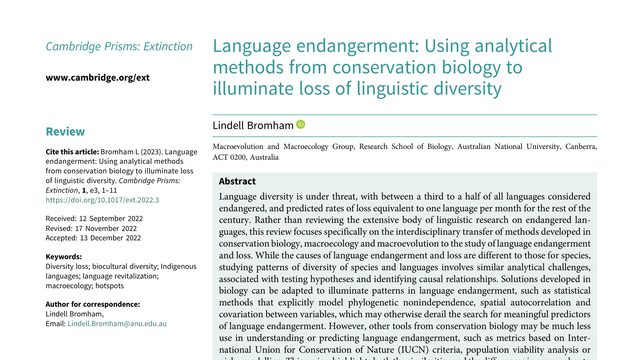
A language can disappear even while its community grows. This paper asks what the science of disappearing species can teach us about protecting the words, stories, and knowledge carried by human languages.What if methods designed to predict species extinction could help explain disappearing languages—but only after being carefully redesigned? This review shows where the analogy is powerful, and where it breaks down.
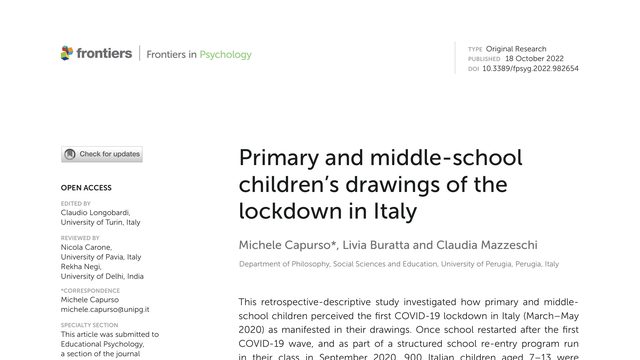
When children were asked to draw their lockdown lives, many did not draw the outside world at all. And among older children, the child in the picture was often missing—or had no face.What happens when children are asked to draw lockdown from memory? These pictures often show cheerful, colorful moments—but older children frequently leave their own faces, or even themselves, out of the scene.
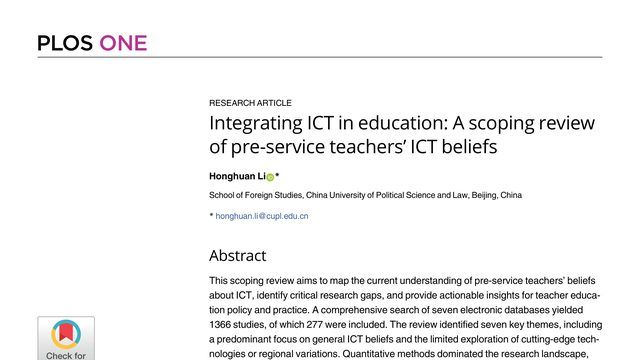
A classroom can be filled with modern technology and still teach in the old way. This review finds that what future teachers believe about technology may shape whether it actually changes learning.Future teachers’ beliefs about technology can shape whether ICT reaches the classroom effectively. Yet this review finds a research landscape concentrated on general ICT attitudes, with limited attention to newer technologies and regional differences.
 4:02
4:02