Repeated unilateral handgrip contractions alter functional connectivity and improve contralateral limb response times
Overview3:38CCAI
paperi.ai
0:00 / 0:00
Justin W. Andrushko, Jacob M. Levenstein, Catharina Zich, Evan Edmond, Jon Campbell, William T. Clarke, Uzay E. Emir, Jonathan P. Farthing, Charlotte Jane Stagg
What if tiring out one hand could make the other hand respond faster? This study found that repeated squeezing with the right hand was followed by better performance in the left.
In humans, motor learning is underpinned by changes in sensorimotor network functional connectivity (FC). Unilateral contractions increase FC in the ipsilateral primary motor cortex (M1) and supplementary motor area (SMA); areas involved in motor planning and execution of the contralateral hand. Therefore, unilateral contractions are a promising approach to augment motor performance in the contralateral hand. In a within-participant, randomized, cross-over design, 15 right-handed adults had two magnetic resonance imaging (MRI) sessions, where functional-MRI and MR-Spectroscopic Imaging were acquired before and after repeated right-hand contractions at either 5% or 50% maximum voluntary contraction (MVC). Before and after scanning, response times (RTs) were determined in both hands. Nine minutes of 50% MVC contractions resulted in decreased handgrip force in the contracting hand, and decreased RTs and increased handgrip force in the contralateral hand. This improved motor performance in the contralateral hand was supported by significant neural changes: increased FC between SMA-SMA and increased FC between right M1 and right Orbitofrontal Cortex. At a neurochemical level, the degree of GABA decline in left M1, left and right SMA correlated with subsequent behavioural improvements in the left-hand. These results support the use of repeated handgrip contractions as a potential modality for improving motor performance in the contralateral hand.
Transcript
What if tiring out one hand could make the other hand respond faster? This study found that repeated squeezing with the right hand was followed by better performance in the left. Grasping objects and safely handling everyday tasks depend on motor skill, although able-bodied people may take these abilities for granted.
Many people lose these abilities after injury, so restoring movement matters for stroke survivors and for healthy people such as athletes seeking better performance. The unanswered question is how to improve behaviour most effectively, including restoring movement after neurological injury and maximizing performance in healthy people.
The study tested whether repeated handgrip contractions with one hand, followed by faster responses and stronger gripping in the opposite hand, were related to stronger links between matching movement areas on the two sides of the brain. The researchers also tested whether those changes were connected with more of a brain chemical involved in activity, or less of a chemical brake on brain activity, in those movement areas.
Like warming up one side of a machine before switching to the other, repeated right-hand contractions may prepare the movement system for the left hand, whose responses and grip force improved afterward. After repeated contractions with the right hand, left-hand response times and gripping force improved.
The change was accompanied by altered communication between movement areas and chemical changes in those areas. The right-hand task was used to test whether the left hand would improve. The left hand increased its gripping force after the task in both conditions.
There was no observable difference in right-hand gripping force between conditions or across time. The clearest strength change therefore appeared in the opposite, left hand. A sustained, demanding grip made people’s force control deteriorate, while the easier grip did not.
Afterward, response times also changed differently between the two hands, suggesting that the strain affected both performance and how the hands responded. After the stronger contractions, communication between the two brain areas involved in planning movement increased.
The reported increase was specifically between matching planning areas on the two sides. The broader analysis found that the pattern depended on which brain area, condition, and time point were being compared, rather than showing one uniform change everywhere.
The study found no overall significant effect or interaction when it compared the chemical measurements across brain areas, sides, and time points. But people whose left-hand responses improved more also showed larger decreases in the brain’s inhibitory chemical in the left movement area and in movement-planning areas on both sides.
Overall, repeated stronger contractions with the right hand improved behaviour in the opposite hand and were accompanied by stronger communication between matching movement-planning areas. Communication also increased between two other measured brain areas. The results suggest that repeated contractions with one hand can enhance later motor performance in the other hand.
This approach may eventually help prepare the movement system during rehabilitation for neurological or orthopedic conditions. The result suggests that a simple exercise with one limb may temporarily prepare the opposite limb by changing communication and braking signals in the brain.
That could eventually help rehabilitation after injury, though more work is needed.
A derivative work by Paperi · AI-generated script, voice and captions
· pages and figures unaltered
Made with Paperi.
Drop in a research PDF — get a narrated video walkthrough like this one,
with highlights that follow the narration. Free to start.
Saurabh Thapliyal, Parvathi Sushama Gopinath, Dominique A. Glauser
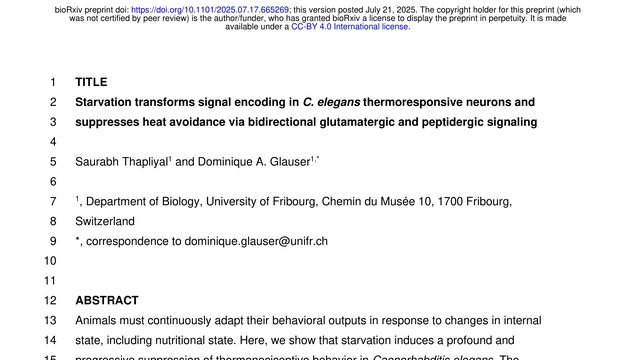
What if hunger could turn down an animal’s heat alarm, not just making the warning quieter, but changing the alarm’s pattern so escape is no longer the default?When a worm gets hungry, it does not simply turn down its heat alarm. Starvation changes the alarm’s neural code, and flips several signals from promoting escape to suppressing it.
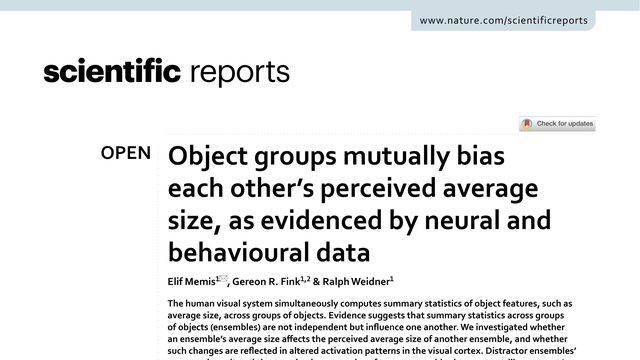
When you look at a group of objects, your brain can estimate their average size almost instantly. But that estimate is not fixed: another group nearby can quietly make the first group look larger or smaller.Your visual system can average a whole crowd of objects almost instantly, but those averages are not independent. Put a larger crowd beside one group, and the other group can look smaller.
Enrique Vázquez-Mendoza, Carol Alejandra Olmos-Pastoresa, Donají Chi-Castañeda, María Leonor López‐Meraz, Luis Beltrán‐Parrazal, Consuelo Morgado‐Valle
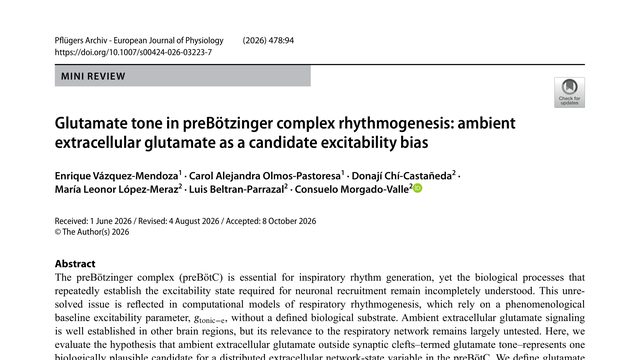
Breathing depends on a tiny brain network that repeatedly gathers enough strength to trigger each inhale. This paper asks whether the chemical background around those cells helps decide when that gathering can begin.What if the brain’s breathing rhythm is influenced not only by synapses firing, but by a quiet background of glutamate between them? This paper proposes that this “glutamate tone” could bias neurons toward the next breath, without generating the burst itself.
 5:03