Object groups mutually bias each other’s perceived average size, as evidenced by neural and behavioural data
Overview3:15CCAI
paperi.ai
0:00 / 0:00
Elif Memis, Gereon R. Fink, Ralph Weidner
When you look at a group of objects, your brain can estimate their average size almost instantly. But that estimate is not fixed: another group nearby can quietly make the first group look larger or smaller.
The human visual system simultaneously computes summary statistics of object features, such as average size, across groups of objects. Evidence suggests that summary statistics across groups of objects (ensembles) are not independent but influence one another. We investigated whether an ensemble’s average size affects the perceived average size of another ensemble, and whether such changes are reflected in altered activation patterns in the visual cortex. Distractor ensembles’ average sizes altered the perceived average size of target ensembles in a contrast-like manner: Large distractor ensembles decreased the target ensembles’ perceived average sizes; conversely, smaller distractor ensembles increased target ensembles’ perceived average sizes. These contrast effects were reflected in more activated voxels in retinotopic regions when target ensembles were perceived as larger. Distractor ensembles’ voxel counts were similarly modulated by target ensembles’ average size, suggesting their perceived average size was also altered. Additionally, individual differences in the magnitude of the ensemble-size contrast effect covaried with activation in higher-level regions, including the left intraparietal sulcus (IPS) and middle temporal gyrus (MTG). Together, these findings suggest that ensemble summary statistics are contrasted, resulting in changes in perceived size and altered retinotopic activation pattern, with involvement of a network including left IPS and left MTG.
Transcript
When you look at a group of objects, your brain can estimate their average size almost instantly. But that estimate is not fixed: another group nearby can quietly make the first group look larger or smaller. The human visual system simultaneously computes summary statistics of object features, such as average size, across groups of objects.
It can take in the overall impression of a group rather than every object one by one. Think of two people comparing piles of apples at a market. A pile can seem small or large partly because of the pile beside it. The same kind of comparison can happen between groups of objects in vision.
The study investigated whether the perceived average size of one group influences the perceived average size of another group, and whether this contrast effect alters processing in early visual regions. Participants saw two colour-defined groups and reported the perceived average size of the target group.
The target and distractor groups appeared in different parts of the visual field, allowing their signals to be separated. The perceived average size of the target group was systematically changed by the size of the surrounding distractor group, even though that distractor group was irrelevant to the task.
The average size of the distractor group influenced the perceived average size of the target group. People judged an average-sized group of objects differently depending on the surrounding group: a smaller target was judged smaller beside larger objects, while a larger target was judged smaller beside smaller objects.
This contrast appeared consistently across participants. The behavioural results obtained during the imaging session replicated the earlier findings: the perceived average size of the target group was modulated by the size of the distractor group. Participants perceived the average size as larger when the distractor group was small than when the distractor group was large.
Neural populations in early visual areas represented differences in perceived average size. Together with the behavioural evidence of contrast-like modulation, this links the change in perception to changes in early visual activity.
The average size of two groups of objects exerted a mutual influence, with each group acting as context for the other. A target group looked larger beside a smaller distractor group and smaller beside a larger one. The pattern resembled classic size-contrast effects, but it occurred at the level of whole groups rather than just individual objects.
The statistical features of simultaneously presented object groups were not computed independently, but were shaped by size-contrast mechanisms. The distractor group changed the perceived average size of the target group.
A similar pattern appeared in regions representing objects that participants were explicitly instructed to ignore. Each group served as a reference for the other, regardless of task relevance. The brain treats neighboring groups as mutual reference points, even when one group is irrelevant to the task.
This helps explain why what we see depends not only on objects themselves, but also on the surrounding scene.
A derivative work by Paperi · AI-generated script, voice and captions
· pages and figures unaltered
Made with Paperi.
Drop in a research PDF — get a narrated video walkthrough like this one,
with highlights that follow the narration. Free to start.
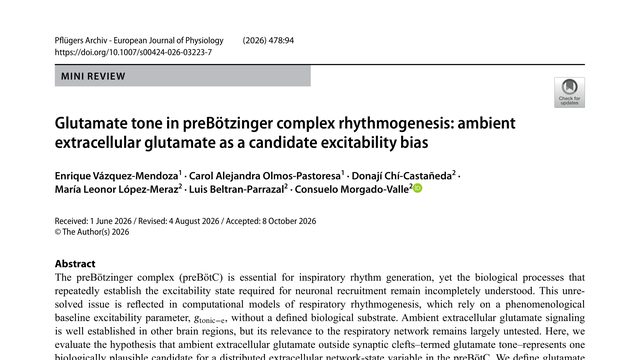
Enrique Vázquez-Mendoza, Carol Alejandra Olmos-Pastoresa, Donají Chi-Castañeda, María Leonor López‐Meraz, Luis Beltrán‐Parrazal, Consuelo Morgado‐Valle
Breathing depends on a tiny brain network that repeatedly gathers enough strength to trigger each inhale. This paper asks whether the chemical background around those cells helps decide when that gathering can begin.What if the brain’s breathing rhythm is influenced not only by synapses firing, but by a quiet background of glutamate between them? This paper proposes that this “glutamate tone” could bias neurons toward the next breath, without generating the burst itself.
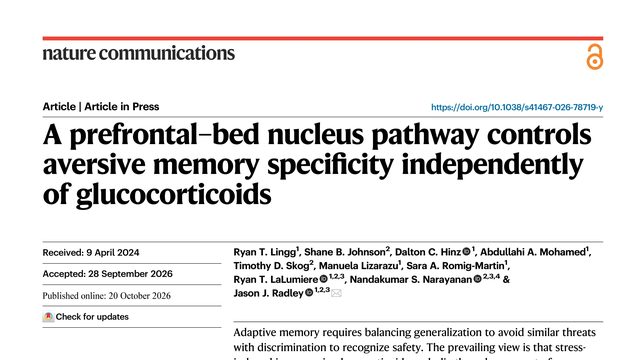
Ryan T. Lingg, Shane B. Johnson, Dalton C. Hinz, Abdullahi A. Mohamed, Timothy D Skog, Manuela Lizarazu, Sara A. Romig‐Martin, Ryan T. LaLumiere, Nandakumar S. Narayanan, Jason J. Radley
A frightening memory can protect you, or make a safe place feel dangerous. This study finds that the brain can change how widely fear spreads without changing how strong the fear itself is.What if a fear memory could become broader or more specific without stress hormones being the thing that controls it? This study identifies a prefrontal circuit that separates memory specificity from memory strength.
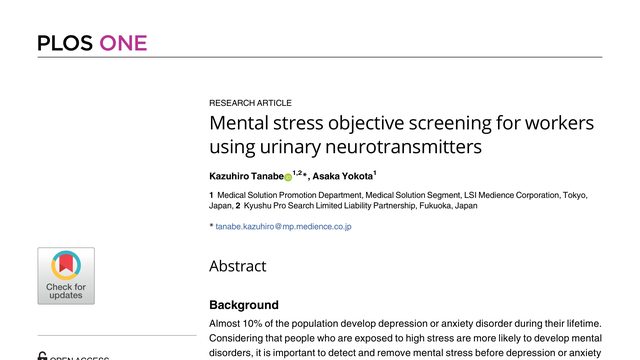
Stress can be affecting a worker before they call themselves unwell. This study asks whether a urine sample could reveal that hidden strain early enough to act on it.What if an ordinary urine sample could help reveal mental stress before it develops into depression or anxiety? This study tests that idea by combining six urinary neurotransmitters into a stress index.
 4:51