Starvation transforms signal encoding in C. elegans thermoresponsive neurons and suppresses heat avoidance via bidirectional glutamatergic and peptidergic signaling
Overview5:03CCAI
paperi.ai
0:00 / 0:00
Saurabh Thapliyal, Parvathi Sushama Gopinath, Dominique A. Glauser
What if hunger could turn down an animal’s heat alarm, not just making the warning quieter, but changing the alarm’s pattern so escape is no longer the default?
Animals must continuously adapt their behavioral outputs in response to changes in internal state, including nutritional state. Here, we show that starvation induces a profound and progressive suppression of thermonociceptive behavior in Caenorhabditis elegans. The thermoresponsive sensory neurons AWCs mediate robust heat-evoked reversals over a broad range of stimulus intensities via glutamate and FLP-6 neuropeptide signaling, each covering distinct heat intensity ranges. After six hours of food deprivation, heat-evoked reversal responses are nearly abolished, independently of any external food odor cues. Prolonged food deprivation triggers a switch in AWC heat-evoked activity patterns, transitioning from a predictable, stimulus-locked response mode to a heterogeneous and stochastic regime. This switch relies on ASI neurons, proposed to work as internal state-sensing neurons. INS-32 and NLP-18 neuropeptide signals from ASI switch from a reversal-promoting to a reversal-inhibiting effect. Glutamatergic transmission from non-AWC neurons is also engaged to suppress reversals. Our findings define a circuit logic by which nociceptive responsiveness gating by internal nutritional state is linked to dynamic modulation of sensory neuron activity patterns and orchestrated by bidirectional glutamatergic and neuropeptidergic signals. More broadly, this study illustrates how sensory systems integrate metabolic information to prioritize behavioral outputs under changing physiological conditions, providing mechanistic insight into the plastic coupling between sensation, internal state, and action selection.
Transcript
What if hunger could turn down an animal’s heat alarm—not just making the warning quieter, but changing the alarm’s pattern so escape is no longer the default? To ensure survival, animals must detect and avoid noxious stimuli, such as harmful chemicals, toxic gases, or extreme temperatures.
These avoidance behaviors are essential for minimizing damage and guiding appropriate behavioral responses. The nematode Caenorhabditis elegans can produce robust innate escape behaviors and modulate these responses according to external and internal regulatory cues.
Animals must continuously adapt their behavioral outputs in response to changes in internal state, including nutritional state. In Caenorhabditis elegans, starvation induces a profound and progressive suppression of heat-avoidance behavior. The thermoresponsive sensory neurons called AWCs mediate robust heat-evoked reversals over a broad range of stimulus intensities.
They use two signals, each covering distinct heat-intensity ranges. Prolonged food deprivation led to a striking progressive reduction in heat-avoidance responses, with responses after six hours of starvation approaching the animals’ usual spontaneous reversal rate. This suggests a robust inhibition of danger-avoidance behavior.
The reduction in heat-avoidance response persisted even when food odor was present, indicating that the effect is driven by the internal starvation state rather than external smell. The setup makes the comparison clear: each longer food-free interval is tested against the same steadily increasing heat challenge, while the starting spontaneous movement is measured separately.
The ASI neurons are specifically required for starvation-dependent modulation of heat-avoidance behavior. Under these conditions, AWC neurons are the primary driver of heat-evoked reversals during early food deprivation, while ASI neurons selectively mediate their suppression during prolonged starvation.
Under early food deprivation, AWC neurons respond consistently to heat, but under prolonged starvation they enter a heterogeneous and less predictable response mode. Starvation does not simply attenuate AWC calcium responses; it fundamentally alters their dynamics, shifting from a largely deterministic excitation profile to a heterogeneous regime characterized by decreased and variable responses.
This transformation in thermal encoding might underlie the behavioral plasticity observed during starvation. Prolonged starvation transforms heat-evoked AWC calcium responses from a stereotyped, intensity-dependent activation pattern to a heterogeneous, less predictable regime.
This shift is not merely a quantitative attenuation but a qualitative reorganization of response states, including frequent calcium downregulation or variable traces. In the same animal, a single stimulus train can include both calcium increases and decreases.
In an early food-deprived state, AWC neurons may signal heat intensity in a consistent and reliable manner to promote aversion. Under prolonged starvation, dampened and variable AWC responses may bias the animal away from escape behaviors, prioritizing food-seeking over threat avoidance.
Starvation profoundly modulates heat-avoidance behavior by engaging distinct neurons, altering neural response dynamics, and mobilizing opposing signal pathways. This behavioral change depends on a shift in the internal state that is not rescued by food-associated olfactory cues.
AWC and ASI neurons work to integrate thermal and nutritional cues into an adaptive behavioral output. In the face of acute harmful stimuli, animals typically favor rapid escape to minimize injury. However, under prolonged food deprivation, that protection may come at the cost of missed opportunities for locating food.
By reducing the sensitivity or reliability of danger-avoidance pathways, particularly through changing AWC output, Caenorhabditis elegans may adopt a more exploratory behavioral mode, tolerating greater risk to increase the chances of finding food. This trade-off between protection and exploration mirrors similar state-dependent shifts observed in other species, suggesting that internal metabolic needs can reshape threat evaluation and behavioral responses.
In hungry worms, the nervous system weakens and reshapes heat avoidance, apparently favoring exploration for food over perfect protection. The finding shows how body needs can change both what a danger signal means and what action follows.
A derivative work by Paperi · AI-generated script, voice and captions
· pages and figures unaltered
Made with Paperi.
Drop in a research PDF — get a narrated video walkthrough like this one,
with highlights that follow the narration. Free to start.
When you look at a group of objects, your brain can estimate their average size almost instantly. But that estimate is not fixed: another group nearby can quietly make the first group look larger or smaller.Your visual system can average a whole crowd of objects almost instantly, but those averages are not independent. Put a larger crowd beside one group, and the other group can look smaller.
Enrique Vázquez-Mendoza, Carol Alejandra Olmos-Pastoresa, Donají Chi-Castañeda, María Leonor López‐Meraz, Luis Beltrán‐Parrazal, Consuelo Morgado‐Valle
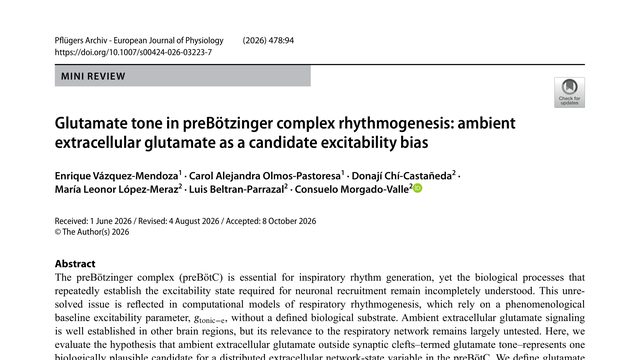
Breathing depends on a tiny brain network that repeatedly gathers enough strength to trigger each inhale. This paper asks whether the chemical background around those cells helps decide when that gathering can begin.What if the brain’s breathing rhythm is influenced not only by synapses firing, but by a quiet background of glutamate between them? This paper proposes that this “glutamate tone” could bias neurons toward the next breath, without generating the burst itself.
Ryan T. Lingg, Shane B. Johnson, Dalton C. Hinz, Abdullahi A. Mohamed, Timothy D Skog, Manuela Lizarazu, Sara A. Romig‐Martin, Ryan T. LaLumiere, Nandakumar S. Narayanan, Jason J. Radley
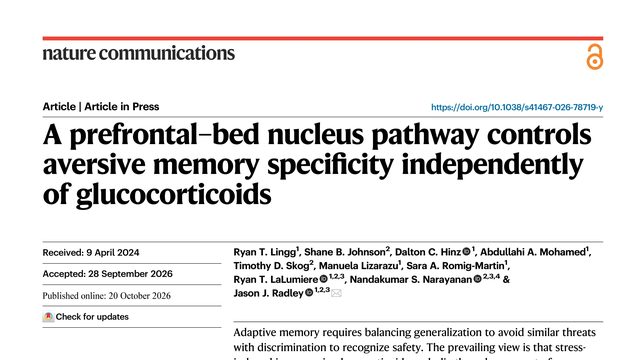
A frightening memory can protect you, or make a safe place feel dangerous. This study finds that the brain can change how widely fear spreads without changing how strong the fear itself is.What if a fear memory could become broader or more specific without stress hormones being the thing that controls it? This study identifies a prefrontal circuit that separates memory specificity from memory strength.
 3:15