Relationship between cognitive functioning and physical fitness in regard to age and sex
Overview3:45CCAI
paperi.ai
0:00 / 0:00
Francisco Tomás González-Férnandez, Gabriel Delgado‐García, Jesús Siquier-Coll, Ana Filipa Silva, Hadi Nobarı, Filipe Manuel Clemente
Could a child’s physical fitness be linked to how well they focus? This study found a connection, but the pattern changed with age, sex, and the kind of attention being measured.
The aim of this study was to analyze the relationships among physical cognitive ability, academic performance, and physical fitness regarding age and sex in a group of 187 students (53.48% male, 46.52% female) from one town of Norwest of Jaén, Andalusia (Spain), aged between 9 and 15 years old (M = 11.97, SD = 1.99). The D2 attention test was used in order to analyze selective attention and concentration. Physical fitness, reflected on maximal oxygen uptake (VO2max), was evaluated using the 6 min Walking Test (6MWT). The analysis taken indicated a significant relationship between physical fitness level, attention, and concentration, as in the general sample looking at sex (finding differences between boys and girls in some DA score in almost all age categories [p < 0.05]) and at age category (finding some differences between the younger age category groups and the older age category groups in some DA scores (p < 0.05), not finding any significant interaction between sex and age category (p > 0.05). In sum, the present study revealed that students with better aerobic fitness can present better-processed elements and smaller omission errors. Moreover, girls and older students seem to present better cognitive functioning scores than boys and younger. Our findings suggest that more research is necessary to elucidate the cognitive function between ages, sexes, and physical fitness and anthropometry levels of students.
Transcript
Could a child’s physical fitness be linked to how well they focus? This study found a connection—but the pattern changed with age, sex, and the kind of attention being measured. Current sedentary behavior of children over the last decade has created a huge problem for society.
Levels of physical activity are reported to be lower than in previous years and continue to decline. This study found lower cardiovascular values and body composition in sedentary children compared to groups of children practicing in different sports.
So the question becomes: could movement also be connected with how children think and focus? The study analyzed relationships among cognitive ability, academic performance, and physical fitness regarding age and sex in students aged between nine and fifteen years old.
To examine attention, students completed a task requiring them to quickly select relevant details while ignoring irrelevant ones. Physical fitness was reflected on maximal oxygen uptake, evaluated using a six-minute walking test. The attention task was like sorting a pile of mail: find the important letters quickly and leave the rest alone.
It was used to analyze the visual ability to select relevant aspects of a task while ignoring irrelevant ones quickly and accurately. Students had to mark as many of the required letters as possible, and the results included processed elements, successes, omissions, and errors.
The relationship between physical fitness and attention was not identical at every age. A positive moderate correlation appeared for some attention scores in students aged eleven to twelve and in the nine-year-old group. Among fifteen-year-old students, physical fitness showed positive large correlations with TR, TR-plus, and TR-minus, with correlation coefficients of zero point five nine, zero point five three, and zero point five two, respectively.
Among fifteen-year-olds, stronger attention-test scores tended to accompany greater aerobic fitness, with the clearest relationship explaining about three-fifths of the variation. This suggests the link between physical fitness and attention may be especially noticeable in this age group.
Across the wider comparison, the analysis found differences between boys and girls in some attention scores in almost all age categories, and differences between younger and older age groups in some scores. The study also reported that girls and older students seemed to have better cognitive functioning scores than boys and younger students.
The current research revealed that students with better aerobic fitness can present better-processed elements and smaller omission errors. That is the central link between fitness and attention in these results.
But the relationships were not global for all ages, and differences between sexes and ages were not always significant for every cognitive functioning score. The study had an observational character, allowing it to correlate age, sex, physical fitness, and cognition, but not to test the effect of improving aerobic capacity on cognition.
For someone outside research, this finding is a clue rather than a prescription: because the study was observational, it showed correlations, not whether improving aerobic capacity would change cognition; future studies should evaluate that possible influence. The study links better aerobic fitness with some signs of stronger attention, especially among older students, while girls and older students generally scored better.
But it cannot show that exercise caused the difference.
A derivative work by Paperi · AI-generated script, voice and captions
· pages and figures unaltered
Made with Paperi.
Drop in a research PDF — get a narrated video walkthrough like this one,
with highlights that follow the narration. Free to start.
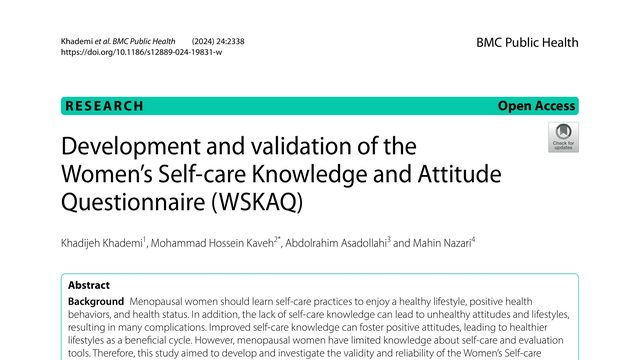
Khadijeh Khademi, Mohammad Hossein Kaveh, Abdolrahim Asadollahi, Mahin Nazari
Menopause is a normal life stage, yet studies found very limited self-care knowledge and activity among affected women. This study asks whether a short questionnaire can make that gap visible.What if a questionnaire could turn a broad idea like menopausal self-care into just thirteen measurable items? This study tests whether that short tool is valid, reliable, and useful for Iranian menopausal women.
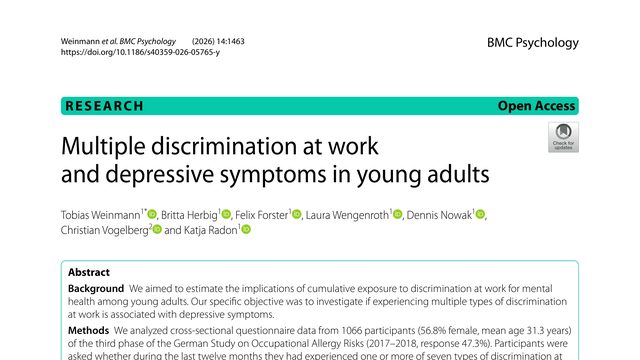
Tobias Weinmann, Britta Herbig, Felix Forster, Laura Wengenroth, Dennis Nowak, Christian Vogelberg, Katja Radon
What happens when unfair treatment at work is not just one experience, but several at once? This study links that accumulation with a much higher chance of depressive symptoms.What happens when workplace discrimination is not a single experience, but several at once? In this study of young adults, multiple types of discrimination were linked with substantially higher odds of depressive symptoms.
When someone dies without stable housing, the death may be hard to explain, not because nothing happened, but because the evidence needed to tell the story is often missing.In Milan, nearly six out of ten autopsied deaths among people experiencing homelessness had no definitive cause. The striking part is that limited post-mortem testing may be helping hide what happened.
 3:32