When someone dies without stable housing, the death may be hard to explain, not because nothing happened, but because the evidence needed to tell the story is often missing.
When someone dies without stable housing, the death may be hard to explain—not because nothing happened, but because the evidence needed to tell the story is often missing. Homelessness is associated with substantially elevated rates of premature and preventable mortality.
People experiencing homelessness face multiple, intersecting barriers to healthcare, including financial constraints, discrimination, fragmented service provision, and complex health problems that compete with basic needs such as food and shelter. Consequently, individuals living without stable housing are exposed to a markedly higher risk of premature death than the general population.
Italy has had little systematic post-mortem investigation of deaths among homeless individuals, so those deaths remain poorly characterized, limiting evidence-based policymaking. A forensic autopsy can help determine how someone died, identify preventable risks, and support accountability in cases involving violence or crime.
But limited information, delayed discovery, advanced decomposition, and restricted access to additional examinations can lead to underdiagnosis, misclassification, or failure to detect violent or criminal acts. The study provides a systematic forensic analysis of mortality among people experiencing homelessness in Italy.
It examines deaths in Milan over a ten-year period to describe who died, the circumstances, the causes, and the manner of death, while evaluating the investigation itself. The study reviewed all eligible cases in the Milan forensic database from 2014 to 2024, and all included cases underwent a complete medico-legal autopsy.
Homelessness was defined as the absence of a stable residence, including people living on streets, in public spaces, abandoned buildings, or temporary shelters. The annual number of autopsies involving homeless individuals gradually increased from 2017 onward, reaching a plateau in 2023 and 2024.
This trend matters because it shows that these deaths were not a static problem across the period examined: cases fluctuated, increased gradually from twenty seventeen, and plateaued in twenty twenty-three and twenty twenty-four. The visual makes the change especially clear: health-authority requests remain occasional, while prosecutor-ordered examinations account for nearly all of the late-period rise.
Undetermined deaths were the largest category: the cause could not be assigned to a specific diagnosis from what was visible during the autopsy. Some cases had no relevant visible disease, while others had abnormalities that were not suddenly fatal or sufficient by themselves to explain death.
Among homeless individuals, undetermined deaths made up a significantly larger share than among the non-homeless autopsy population: fifty-nine point six percent compared with sixteen point three percent. Toxicological analyses were performed in only a small number of cases, but in three cases they changed the initial diagnosis by identifying substances that directly contributed to death.
Without toxicological analysis, all three deaths would likely have remained classified as unclear or presumed natural deaths. The study concludes that barriers to healthcare and delayed diagnosis allow potentially treatable conditions to progress, while limitations in autopsy practices frequently result in undetermined causes of death.
Homelessness-related mortality appears to follow identifiable and, in many cases, potentially preventable patterns rather than reflecting random misfortune. Sustainable improvement requires proactive outreach, continuity of care, broader social support, and comprehensive post-mortem examinations, including testing for substances and disease changes.
The Milan study shows that homelessness is linked to identifiable, potentially preventable deaths, while incomplete care and incomplete examinations can leave those deaths unexplained. Better outreach and fuller investigations can make people safer and their deaths visible.
A derivative work by Paperi · AI-generated script, voice and captions
· pages and figures unaltered
Made with Paperi.
Drop in a research PDF — get a narrated video walkthrough like this one,
with highlights that follow the narration. Free to start.
Heechan Lee, Niccoló Loret, Sara Antignani, F. Bochicchio, David B. Richardson
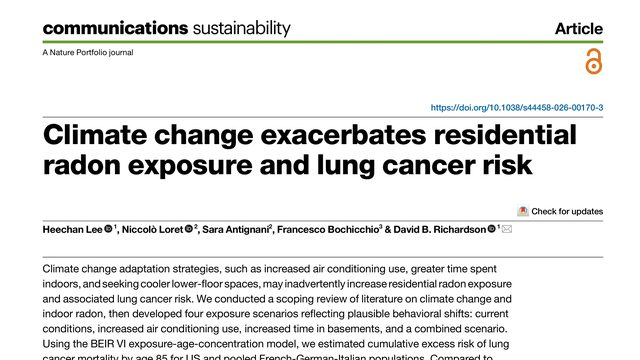
Staying indoors and turning up the air conditioning can protect people from heat. But this study suggests those same choices may quietly increase exposure to radon, a gas linked to lung cancer.Staying cool during a warming climate sounds protective, but this paper identifies a hidden tradeoff: more air conditioning, more indoor time, and more time in lower floors could increase radon exposure and lung cancer risk.
Dawn J. Sowers, Savanna Brittlebank, Krista M. Wilkinson
For a child who cannot reliably speak or point, the hardest part may not be finding words. It may be finding a way to select them, and research shows that the right access method can change communication itself.AAC can support communication across very different abilities, but the way a child accesses a system may determine whether the technology actually opens meaningful participation. This review shows both how far the field has moved and how much evidence is still missing.
A health clinic can report a dangerous disease quickly and still be unprepared for the next pandemic. In Lebanon, that contradiction is exactly what this study uncovered.Lebanon’s primary care centers were very good at reporting disease, yet no center reported a formal way to systematically address community concerns. That contrast is the central surprise of this preparedness study.
 3:39