Development and validation of the Women’s Self-care Knowledge and Attitude Questionnaire (WSKAQ)
Overview3:32CCAI
paperi.ai
0:00 / 0:00
Khadijeh Khademi, Mohammad Hossein Kaveh, Abdolrahim Asadollahi, Mahin Nazari
Menopause is a normal life stage, yet studies found very limited self-care knowledge and activity among affected women. This study asks whether a short questionnaire can make that gap visible.
Background Menopausal women should learn self-care practices to enjoy a healthy lifestyle, positive health behaviors, and health status. In addition, the lack of self-care knowledge can lead to unhealthy attitudes and lifestyles, resulting in many complications. Improved self-care knowledge can foster positive attitudes, leading to healthier lifestyles as a beneficial cycle. However, menopausal women have limited knowledge about self-care and evaluation tools. Therefore, this study aimed to develop and investigate the validity and reliability of the Women’s Self-care Knowledge and Attitude Questionnaire (WSKAQ) in Iranian menopausal women. Methods This cross-sectional study was conducted on 249 menopausal women, aged between 45 and 65 years and at least one year post-menopause, with a minimum literacy level of elementary education. Validation properties included construct validity, exploratory (EFA), and discriminant validity. Reliability was further established through Cronbach’s α and McDonald’s Omega. PASS 15 and SPSS 27 software were used to select centers, calculate sample size and analyze the data, respectively. Results The initial stage of construct validity involved the Kolmogorov–Smirnov test and EFA, resulting in a 6-item self-care knowledge subscale, 47.29% of the total data variance, and 7-item self-care attitude subscale, 55.50% of the total data variance. Independent t-test indicated that menopausal women with education level equal to or higher than diploma have significantly higher self-care attitude scores than those with lower than diploma (p = 0.007). Additionally, significant correlations were observed between self-care knowledge and attitude (r:0.30). Cronbach’s α and McDonald’s Omega coefficients of the 13-item WSKAQ were 0.77 and 0.78, respectively. Conclusions Based on the results, the WSKAQ, consisting of 13 items, was validated and reliable for assessing the self-care knowledge and attitude of Iranian menopausal women. Keywords Self Care, Knowledge, Attitude, Validation, Menopause
Transcript
Menopause is a normal life stage, yet studies found very limited self-care knowledge and activity among affected women. This study asks whether a short questionnaire can make that gap visible. Menopause is a normal stage in a woman’s life, marked by the end of menstruation after twelve months without a period, and its symptoms can affect health and quality of life.
But despite the importance of self-care to menopausal women’s health and quality of life, studies report limited knowledge and activity about self-care. In one study, only zero point eight percent of Iranian menopausal women performed appropriate self-care activities.
The relationship between self-care knowledge, attitude, and health is apparent, but studies examining women’s self-care knowledge and attitude specifically for menopausal women appear to be lacking. So the study aimed to develop and evaluate the Women’s Self-care Knowledge and Attitude Questionnaire, or WSKAQ, a short questionnaire suitable for the menopause community and covering self-care knowledge and attitudes.
The questionnaire was tested by looking for groups of knowledge questions that belonged together. The knowledge questions formed two groups, explaining forty-seven point two nine percent of the differences in answers. The groups were named by health-promotion experts as lifestyle and screenings, with three items in each, using a scientific reference framework for the self-care component.
The questions in the self-care attitude subscale formed one group, explaining fifty-five point five zero percent of the differences in the questionnaire answers. The results revealed two components in self-care knowledge: lifestyle and screenings.
The lifestyle questions covered fruit and vegetable consumption, physical activity, and social support for decreased stress. The screening questions covered the timing of cervical screening, breast self-examination, and visits to a gynecologist or midwife. Self-care activities described in scientific papers also include healthy food, physical activity, preventive care, and stress control.
Self-care attitude was represented by one component that included seven items. The results also showed that menopausal women with education at diploma level or higher had higher self-care attitude scores than women with lower education levels.
The final questionnaire showed consistent results: its two overall reliability values were zero point seventy-seven and zero point seventy-eight. Its knowledge section reached zero point seventy-nine, and its attitude section reached zero point eighty-one.
Knowledge and attitude scores were strongly related to the questionnaire’s total score, while the relationship between the two sections was medium, at zero point thirty. But the findings do not apply equally to everyone. The study took place in urban health centers and focused only on urban women, so future research is needed in rural health centers and with rural women.
Only women with at least primary education were included, which limits how well the findings apply to women who cannot read. The answers were also self-reported, so errors and emotional state may have affected them. The study produced a thirteen-question tool covering self-care knowledge and attitudes, and found it consistent enough for Iranian menopausal women.
It offers a structured way to identify where support may be needed, though its reach is limited.
A derivative work by Paperi · AI-generated script, voice and captions
· pages and figures unaltered
Made with Paperi.
Drop in a research PDF — get a narrated video walkthrough like this one,
with highlights that follow the narration. Free to start.
Tobias Weinmann, Britta Herbig, Felix Forster, Laura Wengenroth, Dennis Nowak, Christian Vogelberg, Katja Radon
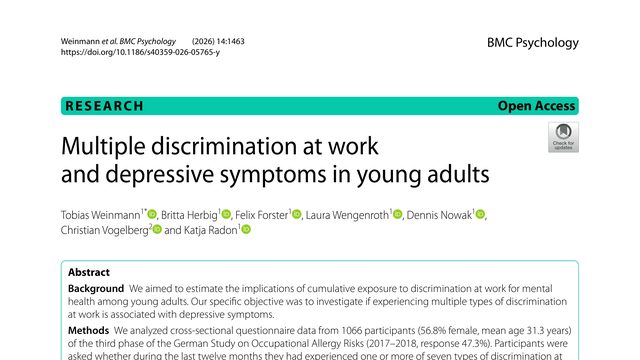
What happens when unfair treatment at work is not just one experience, but several at once? This study links that accumulation with a much higher chance of depressive symptoms.What happens when workplace discrimination is not a single experience, but several at once? In this study of young adults, multiple types of discrimination were linked with substantially higher odds of depressive symptoms.
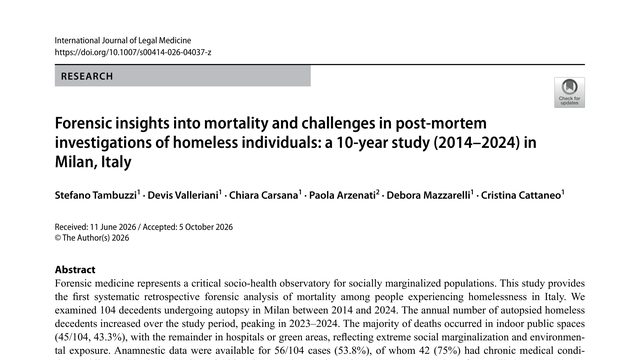
When someone dies without stable housing, the death may be hard to explain, not because nothing happened, but because the evidence needed to tell the story is often missing.In Milan, nearly six out of ten autopsied deaths among people experiencing homelessness had no definitive cause. The striking part is that limited post-mortem testing may be helping hide what happened.
Heechan Lee, Niccoló Loret, Sara Antignani, F. Bochicchio, David B. Richardson
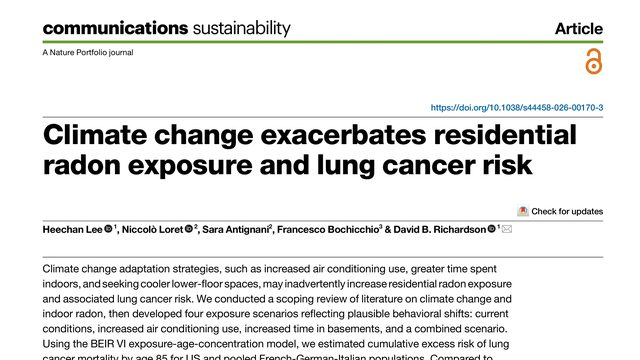
Staying indoors and turning up the air conditioning can protect people from heat. But this study suggests those same choices may quietly increase exposure to radon, a gas linked to lung cancer.Staying cool during a warming climate sounds protective, but this paper identifies a hidden tradeoff: more air conditioning, more indoor time, and more time in lower floors could increase radon exposure and lung cancer risk.
 3:40