Pain control based on oscillatory brain activity using transcranial alternating current stimulation: An integrative review
In depth9:14CCAI
paperi.ai
0:00 / 0:00
Naoyuki Takeuchi
What if pain control is partly a problem of timing? This review asks whether gently steering the brain’s rhythms, and even synchronizing two brains, could open new routes to relief.
Developing effective tools and strategies to relieve chronic pain is a high-priority scientific and clinical goal. In particular, the brain regions related to pain processing have been investigated as potential targets to relieve pain by non-invasive brain stimulation (NIBS). In addition to elucidating the relationship between pain and oscillatory brain activity, transcranial alternating current stimulation (tACS), which can non-invasively entrain oscillatory brain activity and modulate oscillatory brain communication, has attracted scientific attention as a possible technique to control pain. This review focuses on the use of tACS to relieve pain through the manipulation of oscillatory brain activity and its potential clinical applications. Several studies have reported that tACS on a single brain reduces pain by normalizing abnormal oscillatory brain activity in patients with chronic pain. Interpersonal tACS approaches based on inter-brain synchrony to manipulate inter-brain communication may result in pain relief via prosocial effects. Pain is encoded by the spatiotemporal neural communication that represents the integration of cognitive, emotional-affective, and sensorimotor aspects of pain. Therefore, future studies should seek to identify the pathological oscillatory brain communication in chronic pain as a therapeutic target for tACS. In conclusion, tACS could be effective for re-establishing oscillatory brain activity and assisting social interaction, and it might help develop novel approaches for pain control.
Transcript
What if pain control is partly a problem of timing? This review asks whether gently steering the brain’s rhythms—and even synchronizing two brains—could open new routes to relief. Developing effective tools and strategies to relieve chronic pain is a high-priority scientific and clinical goal.
Brain regions related to pain processing have therefore been investigated as potential targets for non-invasive brain stimulation. Transcranial alternating current stimulation, or tACS, can non-invasively entrain oscillatory brain activity and modulate oscillatory brain communication.
This review focuses on using tACS to relieve pain through manipulation of oscillatory brain activity and its potential clinical applications. Several studies have reported that tACS on a single brain reduces pain by normalizing abnormal oscillatory brain activity in patients with chronic pain.
Interpersonal tACS based on inter-brain synchrony may also result in pain relief through prosocial effects. Because pain is encoded by spatiotemporal neural communication integrating cognitive, emotional-affective, and sensorimotor aspects, future studies should identify pathological oscillatory brain communication as a therapeutic target for tACS.
In conclusion, tACS could re-establish oscillatory brain activity, assist social interaction, and help develop novel approaches for pain control. Neurophysiological studies using electroencephalography and magnetoencephalography have associated theta, alpha, beta, and gamma oscillatory frequencies with pain processing.
Elucidating neural oscillations may help diagnose and classify chronic pain, and may also help develop a target for therapeutic strategies. tACS has attracted attention as a promising technique for pain control by targeting neural oscillations. tACS is a non-invasive method that applies a weak oscillatory current through the scalp to entrain neuronal activity into certain frequency patterns.
The stimulation shifts neural membrane potential toward slightly more depolarized or hyperpolarized states. Depolarized neurons are more likely to fire in response to other neurons, providing a potential mechanism for entraining oscillations time-locked to the stimulation frequency.
This review explores tACS for pain control by modulating oscillatory brain activity. It first focuses on studies targeting a single brain to normalize oscillatory activity. It then reviews inter-brain synchrony related to pain processing during social interaction, measured through hyperscanning, a neuroimaging technique that measures the activity of multiple brains simultaneously.
The review discusses a potential dual-brain approach using tACS to reduce pain through prosocial effects, and considers how concurrent manipulation of brain activities may clarify inter-brain oscillatory communication in pain processing. Because dual-brain stimulation of a clinician is unrealistic in clinical settings, the review discusses brain-to-brain interfaces and network-level abnormalities of oscillatory communication in chronic pain.
Accumulating evidence shows that chronic pain is closely associated with altered neural oscillations, with an increase in theta oscillations described as the most noticeable change in patients with chronic pain. In the thalamocortical dysrhythmia model, abnormal nociceptive input induces thalamic theta oscillations, which entrain thalamocortical loops.
At the cortical level, abnormal theta oscillations might result in abnormal gamma oscillations. Abnormal alpha oscillations are also associated with chronic pain. Systematic reviews have reported increased low-alpha oscillations, and beta oscillations are reported to increase during chronic pain.
However, abnormalities in these oscillations have not always been observed, and seemingly conflicting results have reported that suppression of alpha oscillations correlates with pain severity. Neural oscillatory modulation using tACS can investigate the relationship between pain and specific frequency patterns across different pathologies and may consequently become a promising therapeutic tool for chronic pain.
The literature search covered PubMed, Scopus, and Web of Science, using tACS and pain-control search terms. Searches were limited to papers published in English before April two thousand twenty-two. No inclusion or exclusion criteria were established because the search found only five studies that modulated experimental and chronic pain using tACS.
In healthy individuals, alpha-tACS over bilateral sensorimotor cortices reduced subject-reported pain when the intensity of upcoming pain was uncertain, but another study found no effect on experimental heat pain. In patients with chronic low back pain, one study reported reduced pain intensity compared with sham stimulation, while increasing alpha oscillations after tACS positively correlated with pain reduction.
Another study found twice as many pain-reduction responders in the tACS groups compared with the sham condition. Alpha-tACS over the sensorimotor cortex may represent a potential approach to relieve chronic pain. However, tACS studies for pain control are limited, and the hypothesis is strongly influenced by publication and reporting biases.
The alpha-tACS effect on experimental pain in healthy individuals is inconsistent, and personalized frequency-location parameters might reduce variability in the tACS response. Appropriate tACS parameters considering pathological factors, such as disease and duration of onset, could yield important insights into the neural mechanisms of chronic pain.
The review now shifts from tACS approaches targeting a single brain to tACS based on inter-brain communication between two brains during interpersonal interactions. Neural coupling during interpersonal interaction may cause or be caused by behavioral entrainment, emotional sharing, and common understanding, and these factors may jointly promote analgesia.
Artificial induction of inter-brain synchrony therefore has the potential to promote analgesia through prosocial effects, and tACS is currently the main type of non-invasive brain stimulation used for dual-brain stimulation in human studies. In a previous study, synchronous beta-tACS over M1 in dyads performing a finger-tapping task enhanced interpersonal movement synchrony compared with desynchronous or sham stimulation.
Phase coupling across the two individuals’ M1s supports interpersonal alignment of sensorimotor processes that regulate rhythmic action and facilitate synchronous interpersonal movement. Higher movement synchronization between patient and clinician has been reported alongside lower patient-reported pain to heat stimulation and higher trust in the clinician.
Beta-band hyper-tACS over M1 might therefore promote the therapeutic alliance. Despite the translational potential of tACS based on oscillatory brain activity for pain control, the methodology remains in its infancy and poses several issues requiring greater innovation.
Neuroscientific knowledge of intra- and inter-brain communication related to pain processing is instrumental in developing optimal tACS approaches as non-pharmaceutical alternatives for treating chronic pain. The reported studies point toward possible pain reduction from alpha-tACS over bilateral sensorimotor cortices, but the same block also reports no effect for experimental heat pain in healthy participants.
In chronic low back pain, reduced pain intensity, a positive correlation between increased alpha oscillations and pain reduction, and twice as many responders in tACS groups compared with sham were reported. Synchronous beta-tACS over M1 enhanced interpersonal movement synchrony compared with desynchronous or sham stimulation in dyads performing a finger-tapping task.
Higher movement synchronization between a patient and clinician has been reported with lower patient-reported pain to heat stimulation and higher trust in the clinician. tACS looks promising for pain control by targeting abnormal oscillatory activity and possibly interpersonal synchrony, but the evidence is limited and inconsistent, so better, more personalized studies are still needed.
A derivative work by Paperi · AI-generated script, voice and captions
· pages and figures unaltered
Made with Paperi.
Drop in a research PDF — get a narrated video walkthrough like this one,
with highlights that follow the narration. Free to start.
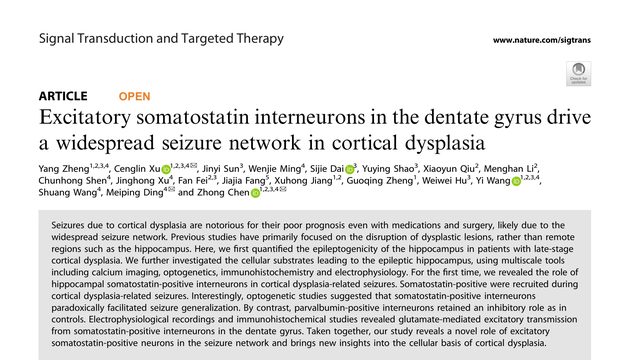
Some brain cells are supposed to act like brakes during seizures. But in a form of epilepsy linked to abnormal brain development, one group of those supposed brakes may instead help a seizure spread.What if a neuron class famous for inhibiting brain activity actually helps seizures spread? This study links a remote hippocampal circuit to widespread seizures in cortical dysplasia, and identifies somatostatin-positive interneurons as an unexpected driver.
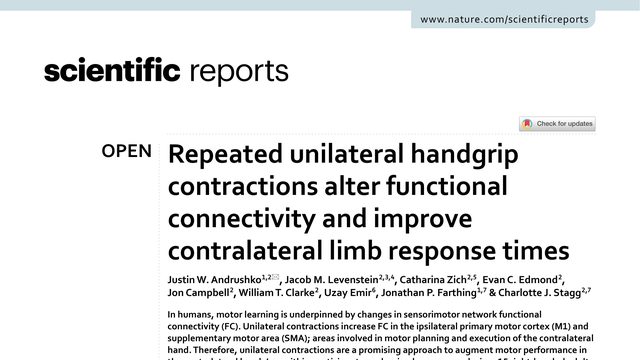
Justin W. Andrushko, Jacob M. Levenstein, Catharina Zich, Evan Edmond, Jon Campbell, William T. Clarke, Uzay E. Emir, Jonathan P. Farthing, Charlotte Jane Stagg
What if tiring out one hand could make the other hand respond faster? This study found that repeated squeezing with the right hand was followed by better performance in the left.What if tiring out your right hand for nine minutes could make your left hand respond faster and grip harder? This study tested that counterintuitive possibility with behaviour, functional connectivity, and brain chemistry.
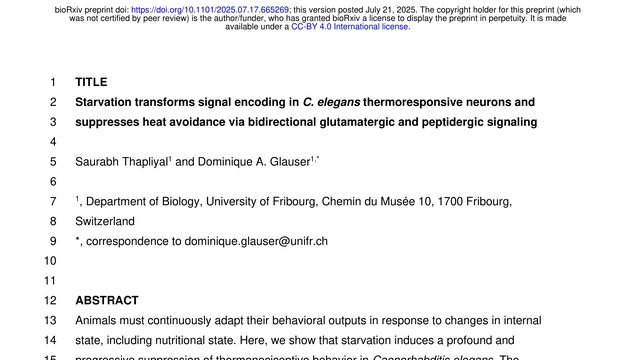
Saurabh Thapliyal, Parvathi Sushama Gopinath, Dominique A. Glauser
What if hunger could turn down an animal’s heat alarm, not just making the warning quieter, but changing the alarm’s pattern so escape is no longer the default?When a worm gets hungry, it does not simply turn down its heat alarm. Starvation changes the alarm’s neural code, and flips several signals from promoting escape to suppressing it.
 3:50