Effectiveness of External Precooling and Vibration Induced by BUZZY on Pain and Anxiety During Inferior Alveolar Nerve Block Injection in Children
Curious4:11CCAI
paperi.ai
0:00 / 0:00
Reyhane Narimany, Reyhaneh Faghihian, Mehdi Jafarzadeh Samani
A small device combines cooling and vibration to make a dental injection less frightening for children. But when it was tested, the reassuring sensation did not clearly reduce either pain or anxiety.
Purpose: Children’s fear of the injection of local anesthetic agents affects their cooperation in pediatric dentistry. Different techniques are available to decrease the injection pain, including the use of precooling agents or vibrators. The present study investigated the effectiveness of Buzzy (Buzzy MMJ Labs, Atlanta, GA, USA). This device transfers cold and external vibration to the injection site during the inferior alveolar nerve block (IANB) injection. Materials and Methods: The present self-control, randomized, and double-blind clinical trial evaluated 30 children aged 6–12, who had bilateral mandibular permanent or primary carious molar teeth. On one side, the BUZZY was applied before and during the IANB injection, and the other side was considered as control. On both sides, a topical anesthetic gel was applied before injection. The pain severity and children’s anxiety were determined using Wong–Baker, face, leg, activity, cry, consolability (FLACC) scales, and the heart rate. Results: The mean age of the participants was 7.18 Æ 1.5 years, with 12 girls and 18 boys. The Wong–Baker scale and FLACC scale did not show any statistically significant difference between BUZZY and control (p value = 0.9 and 0.15, respectively). In addition, BUZZY tool did not significantly decrease pain and anxiety during injection, assessed through the heart rate difference (p ¼ 0:38). Conclusion: Under the limitations of the present study, a combination of precooling and vibration using the BUZZY device did not decrease pain and anxiety in children during the IANB injection.
Transcript
A small device combines cooling and vibration to make a dental injection less frightening for children. But when it was tested, the reassuring sensation did not clearly reduce either pain or anxiety. A dental injection hurts, but it is needed to make treatment painless and help children stay comfortable and cooperative.
Fear of that injection is also a major source of fear in dentistry. A painful experience can make children more afraid at later visits, creating a vicious circle. Better pain control can support cooperation, trust, and less fear and anxiety.
That is why dentists keep looking for ways to control children’s pain and stress before and during treatment. The idea behind vibration is that it travels through A-beta fibers, which block the A-delta and C fibers carrying pain, so the patient feels less pain.
In the body, vibration is thought to block some signals that carry pain, so the patient may feel less pain. It may also speed the anesthetic’s movement into the bloodstream and reduce swelling. But earlier dental studies reached contradictory results, so the promise of vibration was still unsettled.
Because earlier studies of BUZZY had important limits, and because managing pain and stress matters in children’s dentistry, the study was designed to test whether the device helped during this injection. The researchers designed a split-mouth study to evaluate whether the Buzzy device affected pain and anxiety during IANB injections in children.
The study tested precooling and external vibration during inferior alveolar nerve block injections in children aged six to twelve years. The intervention was assigned in the first session for one group and in the second session for another, creating different visit orders. When the device side was compared with the control side, the pain ratings, behavior ratings, and pulse-rate changes did not show significant differences within the groups.
Comparing first and second visits, the study found no significant period effects for FLACC behavior ratings or changes in pulse rate. However, the Wong-Baker pain score showed a statistically significant difference in the analysis of session order reported by the study. A significant difference also appeared in FLACC behavior scores when Buzzy was applied in the first rather than the second session.
This flow makes clear why the final comparison is based on thirty children: after exclusions and missed visits, fifteen completed each treatment sequence. Each child therefore experienced both approaches, allowing a fairer comparison of pain and anxiety during the injections.
Looking across the whole study population, there were no significant differences between the device and control conditions in the pain ratings, behavior ratings, or pulse-rate changes. So across the full sample, the device did not produce significant differences in pain ratings, behavior scores, or pulse-rate changes.
The findings apply only to cooperative children receiving this particular injection, and they cannot be extended to younger children, children who are not cooperative, or children needing other injections. The person recording pulse rates and asking about pain was not blinded, which is another limitation of the study.
Future research should further evaluate BUZZY among younger children, especially those aged three and a half to six years old. Researchers should also use additional measures, including SEM, behavioral, and children’s fear scales, to assess pain and fear more fully.
The study’s conclusion is clear: BUZZY did not significantly decrease dental pain in children aged six to twelve during this injection. In this study, the BUZZY tool did not significantly decrease dental pain during injections in children aged six to twelve. For the children studied, cooling and vibration did not significantly reduce pain during this dental injection.
That does not settle every child or every injection, but it warns against assuming that a comforting gadget will work for everyone.
A derivative work by Paperi · AI-generated script, voice and captions
· pages and figures unaltered
Made with Paperi.
Drop in a research PDF — get a narrated video walkthrough like this one,
with highlights that follow the narration. Free to start.
Bilun Jin, Heng Chen, Peiqi Liu, Yijie Wang, Yi Guo, Chenxu Wang, Yue Jia, Rui Zou, Lin Niu
Tea is often treated as a healthy choice for your mouth. But this study found a genetic clue pointing in the opposite direction for gum disease—while finding no link with cavities.Tea is often discussed as either helpful or harmful for oral health. This study uses genetic evidence to test whether drinking more tea is actually linked to cavities, periodontitis, or tooth loss.
Ferdinando Ruiz, Pietro Venezia, Vincenzo Ronsivalle, Calogero Lacagnina, Cristina Conforte, Gaetano Isola, Rosalia Leonardi, Antonino Lo Giudice
Orthodontic treatment can move teeth, but the bone at the front of the lower jaw sets a boundary. This study asks whether that boundary naturally reshapes during the teenage years—and finds a reason not to count on it.A teenager’s mandibular symphysis may look different depending on facial growth pattern—but this study found that age and sex themselves did not significantly change its form between twelve and fifteen.
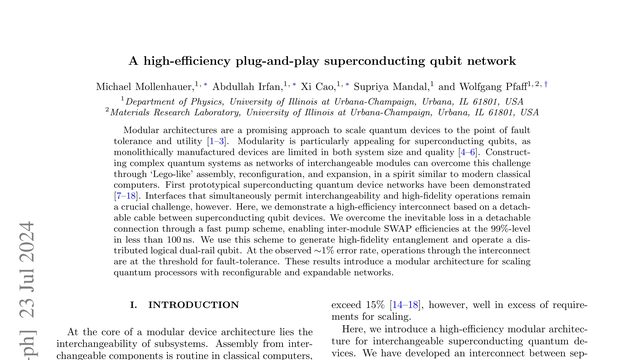
Michael Mollenhauer, Abdullah Irfan, Xi Cao, Supriya Mandal, Wolfgang Pfaff
What if a quantum computer did not have to be built as one giant, delicate object? This experiment shows that separate quantum devices can be connected by a cable, unplugged, and still exchange information with about one percent loss.What if scaling a quantum computer looked less like fabricating one enormous chip—and more like plugging together replaceable modules? This paper shows a detachable cable moving quantum information with roughly one-percent loss in under one hundred nanoseconds.
 3:34
3:34