Impostor phenomenon short scale (IPSS-3): a novel measure to capture impostor feelings in large-scale and longitudinal surveys
Overview4:08CCAI
paperi.ai
0:00 / 0:00
M. Jansen
Many people can succeed and still feel like frauds. The challenge is finding out how common those feelings are, and whether social circumstances help shape them, without making people answer a long questionnaire.
The Imposter Phenomenon (IP) is gaining increasing attention in academia, not only as an overall attractive research topic but also as a concern that especially affects members of minority groups. Nevertheless, there is little evidence for the occurrence and socio-structural correlates of the IP. Against the backdrop of a pressing need to contextualize the IP, this paper provides (1) an overview of the existing empirical evidence on the IP from a perspective that incorporates the role of social contexts, (2) highlights shortcomings in both existing theoretical approaches and methodological tools, (3) introduces the Impostor Phenomenon Short Scale (IPSS-3) as a novel, time-efficient and universally applicable IP measure, and (4) underscores that the IP, in fact, does not occur in a social vacuum but is closely intertwined with socio-structural characteristics. To this end, the paper draws on three distinct data sets gathered among German adolescents and adults for the development of the IPSS-3 (Study 1: n = 271), its validation (Study 2: n = 427), and to assess the IP’s socio-structural correlates (Study 3: n = 865). The findings demonstrate that the IPSS-3 represents the first time-efficient and universally applicable instrument suitable for capturing the IP in large-scale and longitudinal research designs, e.g., initiated in adolescence. Thus, the IPSS-3 can address key open questions related to age effects, the role of transitions in the life course, and systematic variations in IP intensity among different social groups.
Transcript
Many people can succeed and still feel like frauds. The challenge is finding out how common those feelings are, and whether social circumstances help shape them, without making people answer a long questionnaire. Impostor feelings are receiving increasing attention, especially because they may affect members of minority groups.
Yet there is little evidence about how often they occur or which social conditions are linked to them. The IPSS-3 was introduced as a time-efficient, universally applicable way to measure impostor feelings, with the aim of studying social context rather than treating those feelings as if they existed in a vacuum.
The findings present the IPSS-3 as suitable for large-scale and longitudinal research, including research that begins in adolescence, so researchers can examine age, life transitions, and differences among social groups. Key questions about the long-term evolution of impostor feelings and their social correlates remain open.
In other words, the field still does not know enough about how these feelings change over time or who experiences them more intensely. That gap matters because broad claims about the far-reaching psychological effects of impostor feelings have been based on a limited body of large-scale evidence.
The IPSS-3 was developed to address the lack of a universally applicable measure of impostor feelings. Think of it like replacing a long health questionnaire with a short check-in: the goal is to keep the signal while making repeated checks practical.
It was based on an established questionnaire and on a recently developed shorter version, chosen because it was already brief and designed to represent one underlying pattern of impostor feelings. The IPSS-3 showed high reliability, with alpha and omega both zero point eighty, only marginally below the five-item ISCQ-5; its three-item length made the lower reliability acceptable.
Because the IPSS-3 uses merely three items instead of five, the decline in reliability was regarded as acceptable. In the second study, the IPSS-3 showed high loadings on a single factor, meaning the three questions mainly captured one shared pattern.
Its reliability was lower but still acceptable, and its links with three validation scales were significant and in the expected direction, suggesting a definite and reasonable association. The reported comparisons found significant differences in impostor-feeling intensity by gender, with the female and diverse group showing higher values, and between people with and without a migrant origin, with the group possessing a migrant origin showing higher values.
However, no significant difference in impostor-feeling intensity was found between people with and without a university degree. The results point to the relevance of social and demographic characteristics in how impostor feelings are experienced. The gender difference was consistent with numerous other studies, suggesting that this pattern is not isolated to this study alone.
The findings have limits: the data concern only the German version, and the study recommends using only that version until English or other language versions are validated. All findings came from self-reports, so the study did not provide links with real-life measures or other sources of information, and the participants were not drawn in a way that supports generalizing to the whole population.
Large-scale evidence is still missing, so larger data collections using the IPSS-3 remain an important next step for understanding who experiences impostor feelings and how those feelings change. This study presents a three-question measure for tracking impostor feelings in larger and longer studies.
It also suggests those feelings differ across some social groups, while education alone did not separate people in the reported comparison.
A derivative work by Paperi · AI-generated script, voice and captions
· pages and figures unaltered
Made with Paperi.
Drop in a research PDF — get a narrated video walkthrough like this one,
with highlights that follow the narration. Free to start.
Don Passey, Jean Gabin Ntebutse, Manal Yazbak Abu Ahmad, Janet Cochrane, Simon Collin, Asmaa Ganayem, Elizabeth Langran, Sadaqat Mulla, Ma. Mercedes T. Rodrigo, Toshinori Saito, Miri Shonfeld, Saunand Somasi
A laptop or internet connection can look like a ticket into education. But this paper argues that access alone may leave people just as excluded, because the surrounding choices can quietly reproduce the barriers they were meant to remove.What if putting devices and Internet connections into schools still failed to create educational inclusion? This paper argues that access is only one layer of a much larger problem involving agency, power, design and lived context.
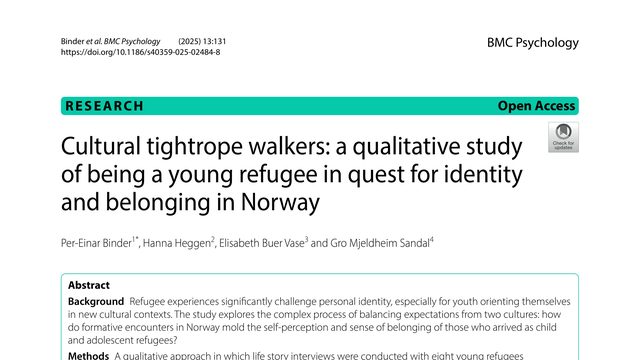
Per‐Einar Binder, Hanna Heggen, Elisabeth Buer Vase, Gro Mjeldheim Sandal
Imagine growing up with one set of expectations at home and another outside, and feeling like a stranger in both places. This study finds that painful position can also become a source of unusual strength.What happens when belonging to one culture does not cancel out belonging to another? This study finds that young refugees in Norway can feel like outsiders in both worlds, yet that tension can also create a uniquely open perspective.
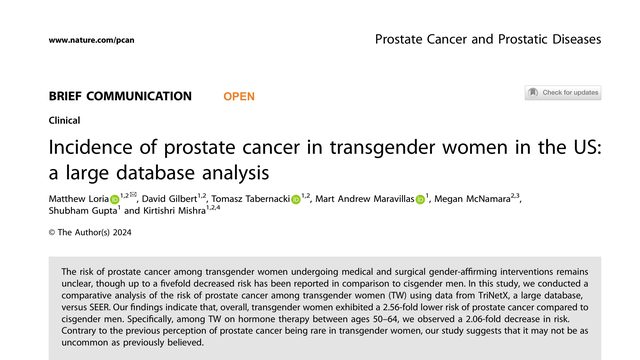
Matthew Loria, DAVID R. GILBERT, Tomasz Tabernacki, Mart Andrew Maravillas, Megan Ann McNamara, Shubham Gupta, Kirtishri Mishra
For transgender women, gender-affirming surgery does not remove the prostate. This study finds prostate cancer is less common than in cisgender men, but still common enough that it cannot simply be ignored.The prostate remains after gender-affirming surgery, so prostate cancer risk does not disappear. Yet the incidence in transgender women has been poorly understood, and this large analysis finds lower risk, but not zero risk.
 4:39