Populations Digitally Excluded from Education: Issues, Factors, Contributions and Actions for Policy, Practice and Research in a Post-Pandemic Era
In depth11:43CCAI
paperi.ai
0:00 / 0:00
Don Passey, Jean Gabin Ntebutse, Manal Yazbak Abu Ahmad, Janet Cochrane, Simon Collin, Asmaa Ganayem, Elizabeth Langran, Sadaqat Mulla, Ma. Mercedes T. Rodrigo, Toshinori Saito, Miri Shonfeld, Saunand Somasi
What if putting devices and Internet connections into schools still failed to create educational inclusion? This paper argues that access is only one layer of a much larger problem involving agency, power, design and lived context.
This conceptual paper draws on a wide range of research and policy literature, providing a contemporary view of issues, factors and practices that affect education for digitally excluded populations. Concern for how education for digitally excluded populations can be supported is focal to this paper, with different sections offering key related perspectives. From an analysis of issues, factors and practices, actions for policy, practice and research are identified. Given a key finding that power issues can have major effects on plans, implementation processes and outcomes when addressing needs of education for digitally excluded populations, the paper concludes by offering frameworks to support and enable key discussions, to involve representatives from an excluded population as well as those from policy (government and industry), practitioners (teachers and learners) and researchers.
Transcript
What if putting devices and Internet connections into schools still failed to create educational inclusion? This paper argues that access is only one layer of a much larger problem involving agency, power, design and lived context. This conceptual paper draws on a wide range of research and policy literature to provide a contemporary view of issues, factors and practices that affect education for digitally excluded populations.
Its analysis identifies actions for policy, practice and research. A key finding is that power issues can have major effects on plans, implementation processes and outcomes when addressing the needs of education for digitally excluded populations. The paper concludes by offering frameworks for discussions involving representatives from an excluded population, policy, practitioners and researchers.
The research question asks what issues, factors, practices and actions need to be considered when addressing educational digital exclusion of populations in a post-pandemic era. Before the pandemic, populations in rural areas, low-income areas and ethnically isolated communities were digitally excluded.
Although the pandemic encouraged online digital uses, the post-pandemic period still sees digital exclusion in similar populations. For agencies and groups addressing this exclusion, identifying key issues and factors and deploying appropriate work practices are important for successful forward movement.
Existing research has often focused on inclusion for individuals, but evidence shows that educational exclusion with digital technologies has multiple dimensions. Access therefore needs to go beyond physical technology access and include digital accessibility, agency and empowerment.
This definition of access focuses on individuals developing digital agency, capabilities and abilities, selecting applications appropriate to purpose, and creating applications for purpose. Inclusion should not be implemented as an imposition from an external power structure, because some populations may not wish to use digital technologies or may have concerns about them.
Defining digital exclusion and inclusion is challenging because the gap between those who have access to and use Internet connectivity, digital literacy skills and Internet-enabled devices and those who do not varies across the world. That variation reflects social, economic and cultural inequalities such as gender, age, race, income and capabilities.
Access to digital technologies is therefore multi-dimensional and needs to be considered through physical, spatial, cultural, demographic, socio-economic, human and environmental aspects. Digital technologies have strong potential for digital and wider inclusion.
Distance learning can facilitate education and training for learners in rural areas, full-time workers, learners temporarily displaced in refugee camps and learners affected by medical conditions that would otherwise prevent in-person attendance. Assistive technologies can support learners with learning disabilities and cognitive or physical disabilities, including dyslexia.
The state of the actual gives a more realistic portrait of digital technologies for educational inclusion than their potential alone. The inclusive potential of digital technologies is often challenged by social, political and historical contexts that shape those technologies.
Social and educational inequalities appear through unequal digital access, usage, skills and outcomes between educational environments and learners. Digital technologies can perpetuate or amplify patterns of inclusion and exclusion, which can be influenced by power structures.
Material access to digital resources is an essential first step for alleviating deprivation and exclusion, but mere provisioning does not necessarily lead to meaningful engagement or empowerment. Because of design, features and costs, digital tools and media can be inaccessible and unaffordable, leading to exclusion and digital divides.
Digital access therefore needs to provide accessibility, foster agency and empower learners and teachers. Accessibility means that digital tools, technologies and services work for all people, including people with diverse physical and cognitive disabilities.
Digital Agency, consisting of digital competence, confidence and accountability, refers to an individual’s ability to control and adapt to a digital world. When digital access is designed to foster Digital Agency, it empowers learners with power to exercise choice and freedom.
When access to devices and digital resources is complemented by support structures enabling teacher and learner agency, digital access is actualized as a holistic enabler. The economic situations of disadvantaged populations can prevent individuals and communities from accessing digital world benefits.
The digital divide concerns the readiness of individuals and societies, in terms of access, skills, attitudes, usage, power structure and culture, to benefit from technology. Those with socio-economic advantage tend to enjoy digital inclusion and its related benefits, while socio-economically marginalised people tend to be digitally excluded.
Despite rapid growth in Internet connectivity worldwide, people’s educational uses of and benefits from digital information, services and products are neither equal nor equitable. Digital inclusion aims to increase digital world access for disadvantaged groups, including those with disabilities.
International educational policies can promote inclusive curricula that provide suitable accommodations. A key barrier is whether disadvantaged populations have required infrastructure, such as electricity supply and Internet provision. People with special needs in low socio-economic situations, rural areas or underserved areas may lack sufficient infrastructure for Internet access and digital devices.
Power structures can influence digital access and accessibility. Network power is exercised not by excluding individuals but by setting inclusion rules, so dominant socio-economic groups are more likely to influence those rules. Understanding power structures requires considering disparities in how different groups benefit from the Internet.
More access does not necessarily equate to true benefits for socially vulnerable people, who might become mere tools in a digital world shaped by influential groups. Design and interface are important access factors, and tools need to include and represent diverse populations, cultures, languages and ways of learning.
Refugees and foreign minorities can be supported through native-language interfaces and lessons, subtitles during online learning, target-language literacy lessons and visuals. Offline or affordable Internet browsing, icon-based interfaces and Internet lite can help overcome connectivity barriers.
Second-chance programs can support school drop-outs by developing basic and complementary ICT skills. The pandemic forced sudden shifts to online and emergency remote teaching as schools and educational institutions closed their doors. This revealed great variation in teachers’, students’ and infrastructure preparedness for online learning.
The crisis accelerated online pedagogies training, acquisition of new hardware and platforms, and development of new educational technology solutions. Remote and hybrid instruction increased access to collaborative learning across geographic boundaries and expanded intercultural exchanges while reducing travel costs.
Post-pandemic, educational institutions have taken varying approaches: rejecting technologies, retaining online practices, or blending online tools with in-person instruction. Infrastructure improvements such as public technology hubs continue providing Internet access to previously excluded populations.
Access alone does not address all equity issues. Digital inequality manifests on two levels: access and abilities to fully utilize technology. Table 1 presents a framework from the critical review, grouping key aspects of digital inclusion under three concerns: approach, technological, and supportive.
It connects human-centric educational goals with income, age, disability, affordability, and power independence; technological infrastructure and connectivity; and support through policy, training, social capital, and digital skills. The authors argue that these aspects matter for confronting digital exclusion and require policy, practice, and research to work together.
Government regulatory mechanisms should ensure the development of digitally inclusive and responsible technologies for education of digitally excluded populations. Those mechanisms should consider ethical collection and use of data while respecting power independence, privacy and individual choice.
Addressing educational exclusion, digital inequality and digital divides in the post-pandemic period requires more nuanced approaches to policy, practice and research. Factors and contributions should be considered more holistically, importantly involving excluded populations with people in policy, practice and research.
Identifying and agreeing on factors and contributions should rely on shared discussions among the four stakeholder groups. These details should inform planning and implementation from the outset rather than being considered later, because later consideration is often counter-productive.
Table two maps factors and contributions for preliminary cross-stakeholder discussions across four groups: excluded population representatives, policy stakeholders, practice stakeholders, and research stakeholders. It covers infrastructure, skills, attitudes, usage, privacy, accessibility, digital agency, power independence, and the physical and social context of populations.
The table matters because it frames digital inclusion as a shared responsibility spanning policy, educational practice, and research, while keeping affected populations central to the discussion. Table two presents a framework of key factors and contributions intended to support more effective implementation for people experiencing educational digital exclusion.
The authors emphasize that power structures can shape these processes in negative and unintended ways. This matters because the framework is designed to help policy, practice, and research recognize those dynamics and involve excluded populations more meaningfully.
Digital inclusion cannot be treated as simple provisioning. Effective action requires shared planning among excluded populations, policymakers, practitioners and researchers, with power, accessibility, agency and local conditions considered from the outset.
A derivative work by Paperi · AI-generated script, voice and captions
· pages and figures unaltered
Made with Paperi.
Drop in a research PDF — get a narrated video walkthrough like this one,
with highlights that follow the narration. Free to start.
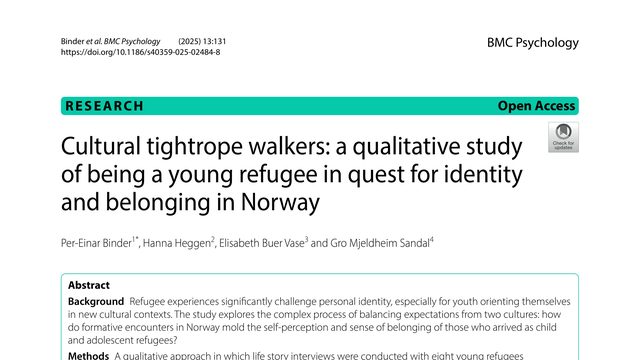
Per‐Einar Binder, Hanna Heggen, Elisabeth Buer Vase, Gro Mjeldheim Sandal
Imagine growing up with one set of expectations at home and another outside, and feeling like a stranger in both places. This study finds that painful position can also become a source of unusual strength.What happens when belonging to one culture does not cancel out belonging to another? This study finds that young refugees in Norway can feel like outsiders in both worlds, yet that tension can also create a uniquely open perspective.
Matthew Loria, DAVID R. GILBERT, Tomasz Tabernacki, Mart Andrew Maravillas, Megan Ann McNamara, Shubham Gupta, Kirtishri Mishra
For transgender women, gender-affirming surgery does not remove the prostate. This study finds prostate cancer is less common than in cisgender men, but still common enough that it cannot simply be ignored.The prostate remains after gender-affirming surgery, so prostate cancer risk does not disappear. Yet the incidence in transgender women has been poorly understood, and this large analysis finds lower risk, but not zero risk.
Mai SeifElDin Abdeen, Mostafa Ahmad Hashim, Marwa Mohamed Ghanem, Nouran Yousef Salah, Zeinab Mohamed El Nagar
During the pandemic, official reports of child harm went down, but that did not necessarily mean children were safer. A survey of Egyptian parents found a much darker picture inside the home.During the COVID-19 pandemic, official reports of child maltreatment went down even as concerns about risk went up. This study asks parents directly what happened inside Egyptian homes.
 2:44