A summer in the greater Paris: trophic status of peri-urban lakes shapes prokaryotic community structure and functional potential
Overview4:30CCAI
paperi.ai
0:00 / 0:00
Pierre Foucault, Sébastien Halary, Charlotte Duval, Midoli Goto, Benjamin Marie, Sahima Hamlaoui, Ludwig E. Jardillier, Dominique Lamy, Émilie Lance, Emmanuelle Raimbault, Fayçal Allouti, Marc Troussellier, Cécile Bernard, Julie Leloup, Sébastien Duperron
A lake can look calm while its invisible life is changing dramatically underneath. Around Paris, the amount of nutrient pollution helped determine not only which microbes lived in each lake, but what those microbes could do.
With more than 12 million inhabitants, the Greater Paris offers a “natural laboratory” to explore the effects of eutrophication on freshwater lake’s microbiomes within a relative restricted area (~ 70 km radius). Here, a 4-months survey was carried out during summertime to monitor planktonic microbial communities of nine lakes located around Paris (Île-de-France, France) of comparable morphologies, yet distinct trophic statuses from mesotrophic to hypereutrophic. By thus minimizing the confounding factors, we investigated how trophic status could influence prokaryotic community structures (16S rRNA gene sequencing) and functions (shotgun metagenomics). These freshwater lakes harbored highly distinct and diverse prokaryotic communities, and their trophic status appears as the main driver explaining both differences in community structure and functional potential. Although their gene pool was quite stable and shared among lakes, taxonomical and functional changes were correlated. According to trophic status, differences in phosphorus metabolism-related genes were highlighted among the relevant functions involved in the biogeochemical cycles. Overall, hypereutrophic lakes microbiomes displayed the highest contrast and heterogeneity over time, suggesting a specific microbial regime shift compared to eutrophic and mesotrophic lakes.
Transcript
A lake can look calm while its invisible life is changing dramatically underneath. Around Paris, the amount of nutrient pollution helped determine not only which microbes lived in each lake, but what those microbes could do.
Over the last decades, lakes have been particularly affected by human activities, species invasion, increased surface temperatures and heat-waves associated with global change. These pressures add to natural seasonal variations and enhance eutrophication, ultimately leading to major changes in lake ecosystem functioning worldwide.
The resulting blooms of microscopic plant-like life have tremendous consequences and are predicted to worsen over the next decades, making this link a priority for people who protect lakes. The study asked whether lakes with different levels of nutrient enrichment harbor different microbial communities, both in which organisms are present and in what those organisms can do.
The Greater Paris offers a useful natural laboratory: nearby lakes formed in old quarries have distinct enrichment levels while sharing much of their climate, geology, size, depth, and water chemistry. That is like comparing several nearby kitchens with similar rooms and equipment, but different amounts of ingredients, then asking how the menus change.
The lakes were followed through summer to compare their microbial communities and abilities. These nine lakes, all within about seventy kilometres of Paris, span from moderately nutrient-poor to extremely nutrient-rich waters. That range matters because the balance between larger photosynthetic organisms and tiny oxygen-producing ones shifts from lake to lake and month to month, setting the ecological backdrop for everything that follows.
The lake communities formed different groups, and the main pattern separating them was the lake’s nutrient status, not the month or the distance between lakes. The most nutrient-loaded lakes also changed more within the summer than the moderately enriched and less enriched lakes, which showed similar levels of variation.
VSS, one of the hypereutrophic lakes, stood out with particularly high intra-summer heterogeneity, showing how widely its community changed over the season. The researchers also compared the microbes’ possible roles in the major chemical cycles that keep lakes functioning.
These abilities separated the lakes according to nutrient status. The nutrient conditions were also linked to what the microbial communities were equipped to do, as their functional potentials separated according to trophic status along the second axis. The clearest functional difference involved phosphorus: two microbial processes that handle stored phosphorus together explained most of the contrast between less enriched and extremely enriched lakes.
The genes linked to both processes were more abundant in the less enriched lakes, while no difference was detected in genes involved in nitrogen processing. The two extremely nutrient-loaded lakes had the fewest consistently present organisms, the greatest turnover in organisms, and the greatest summer variation in both organisms and genes.
They also differed from each other. One was dominated by cyanobacteria for most of the summer, while the other was dominated by eukaryotes. Because different plant-like communities release different amounts and kinds of food and nutrients, they could help explain why the bacterial communities in these two lakes were so different.
Across the nearby Paris lakes, nutrient status affected both community structure and the abilities those communities carried during summer. But the communities’ possible abilities were much more stable than the exact mix of organisms, and most of those abilities were shared among all the lakes.
Nutrient status was linked to deeper changes in lake living systems, affecting both community structure and functional potential during the summer. Future monitoring must test other seasons and factors beyond nutrient status alone, since winter and spring may reveal whether its effects continue, and trophic status cannot explain every observation.
The study shows that nutrient enrichment reshapes lake microbes and their working abilities, with the most overloaded lakes changing the most through summer. That matters for how polluted urban waters are understood and managed.
A derivative work by Paperi · AI-generated script, voice and captions
· pages and figures unaltered
Made with Paperi.
Drop in a research PDF — get a narrated video walkthrough like this one,
with highlights that follow the narration. Free to start.
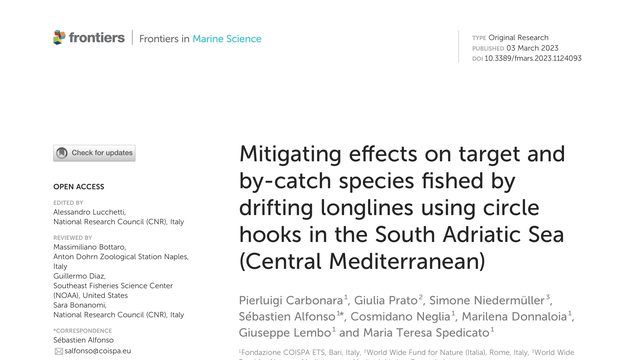
Pierluigi Carbonara, Giulia Prato, Simone Niedermüller, Sébastien Alfonso, Cosmidano Neglia, Marilena Donnaloia, Giuseppe Lembo, María Teresa Spedicato
What if a small change to a fishing hook could help sharks survive, without reducing the fishers’ catch? In the South Adriatic, researchers found a striking difference in the condition of blue sharks brought aboard.What if changing the shape of a fishing hook could leave swordfish catches unchanged, but send more blue sharks back in healthy condition? This study tests that idea in the South Adriatic Sea.
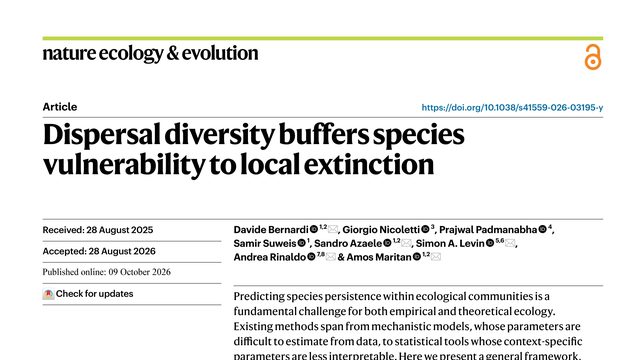
Davide Bernardi, Giorgio Nicoletti, Prajwal Padmanabha, Samir Suweis, Sandro Azaele, Simon A. Levin, Andrea Rinaldo, Amos Maritan
A species can look safe simply because it is numerous, but that headcount can miss the real danger. Its chances may depend on how differently its members move through space, and on the other species around them.A species can be rare without being especially vulnerable. This study argues that extinction risk depends not just on how much abundance a species has, but on how its dispersal strategy fits into the entire community.
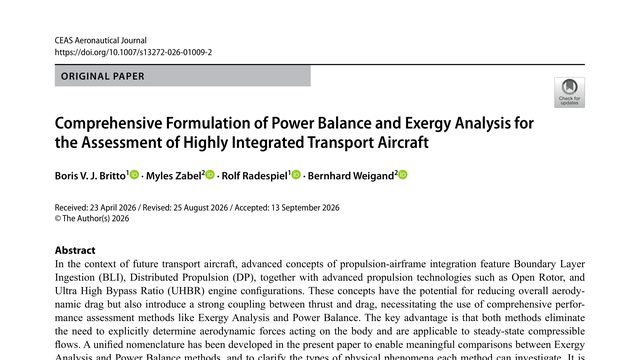
Boris Britto, Myles Zabel, Rolf Radespiel, Bernhard Weigand
Future aircraft may save energy by making the engine and the wing work as one. But that very integration makes a basic question surprisingly hard: where does the engine’s push end and the aircraft’s drag begin?Future aircraft may cut drag by tightly integrating propulsion with the airframe, but that integration makes ordinary thrust bookkeeping ambiguous. This paper shows that two powerful assessment methods are closely related, with one emerging as a restricted form of the other.
 3:47