Climate change exacerbates residential radon exposure and lung cancer risk
Overview3:39CCAI
paperi.ai
0:00 / 0:00
Heechan Lee, Niccoló Loret, Sara Antignani, F. Bochicchio, David B. Richardson
Staying indoors and turning up the air conditioning can protect people from heat. But this study suggests those same choices may quietly increase exposure to radon, a gas linked to lung cancer.
Climate change adaptation strategies, such as increased air conditioning use, greater time spent indoors, and seeking cooler lower-floor spaces, may inadvertently increase residential radon exposure and associated lung cancer risk. We conducted a scoping review of literature on climate change and indoor radon, then developed four exposure scenarios reflecting plausible behavioral shifts: current conditions, increased air conditioning use, increased time in basements, and a combined scenario. Using the BEIR VI exposure-age-concentration model, we estimated cumulative excess risk of lung cancer mortality by age 85 for US and pooled French-German-Italian populations. Compared to current conditions, the combined hypothetical scenario yielded an additional 46 lung cancer deaths per 10,000 persons in the US, and 42 in Europe. These findings highlight an unrecognized pathway through which climate change adaptation may amplify population-level cancer risk, if available countermeasures are not taken.
Transcript
Staying indoors and turning up the air conditioning can protect people from heat. But this study suggests those same choices may quietly increase exposure to radon, a gas linked to lung cancer. Climate change adaptation strategies, such as increased air conditioning use, greater time spent indoors, and seeking cooler lower-floor spaces, may inadvertently increase residential radon exposure and associated lung cancer risk.
The study compared current conditions with increased air conditioning, more time in basements, and a combination of both, then estimated how those changes could affect lung cancer deaths. These estimates were not meant to predict that whole populations will behave in exactly the same way.
Instead, they were meant to illustrate the possible change in radon-related lung cancer risk that an individual may face after adopting these behavior patterns in response to a warming climate. The scenarios used a reference house with more radon in the basement than on the first floor, then changed how much time people spent indoors, used air conditioning, or stayed in the basement.
These scenarios were not intended to represent average behavior across entire populations, but to show how lifetime radon-related lung cancer risk may change if an individual adopts a particular pattern in response to climate change. Here is the surprising part: in the United States, the combined scenario was linked to about 46 additional lung cancer deaths per 10,000 people by age 85, compared with current exposure conditions.
The increase was larger when both changes occurred together than when air conditioning or more time indoors and downstairs was considered alone. The review identified multiple pathways through which climate change and the ways people adapt to it may increase exposure to indoor radon.
The results suggest that increased radon exposure caused by climate change could lead to significant increases in lung cancer. The researchers compared several ways of estimating risk, and their results differed: PUMA estimates were higher than EAC estimates, while the Darby model produced lower estimates.
Even so, all three models consistently showed increased lung cancer mortality risk across all four behavioral adaptation scenarios, preserving the same direction of change. The estimated size of the risk increase varied across models, with PUMA higher than EAC and the Darby model lower by comparison.
That consistency supports the main conclusion: all three models showed increased lung cancer mortality risk across the four behavioral adaptation scenarios, so the direction remained the same. The scenario analysis was not designed to produce precise national estimates or to predict that entire populations would adopt these behaviors uniformly.
It showed that behavioral changes alone, without any change in the underlying geology or building stock, could measurably increase lung cancer mortality risk. These projected increases are not inevitable. Available measures in homes can partially or substantially offset them.
Climate change adaptation should therefore be accompanied by greater attention to indoor radon, including more home testing and mitigation. Climate change can change not only the weather outside, but also how much radon people breathe indoors. Testing homes and using available fixes could help prevent that added risk.
A derivative work by Paperi · AI-generated script, voice and captions
· pages and figures unaltered
Made with Paperi.
Drop in a research PDF — get a narrated video walkthrough like this one,
with highlights that follow the narration. Free to start.
Dawn J. Sowers, Savanna Brittlebank, Krista M. Wilkinson
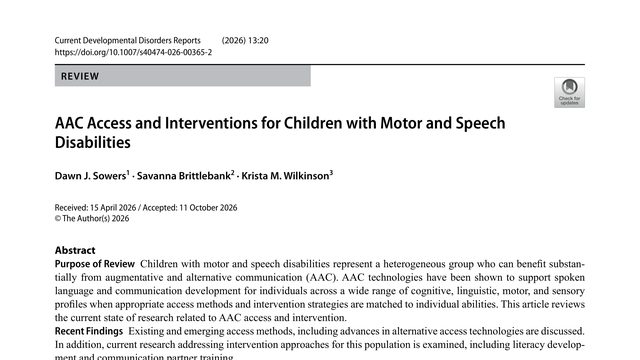
For a child who cannot reliably speak or point, the hardest part may not be finding words. It may be finding a way to select them, and research shows that the right access method can change communication itself.AAC can support communication across very different abilities, but the way a child accesses a system may determine whether the technology actually opens meaningful participation. This review shows both how far the field has moved and how much evidence is still missing.
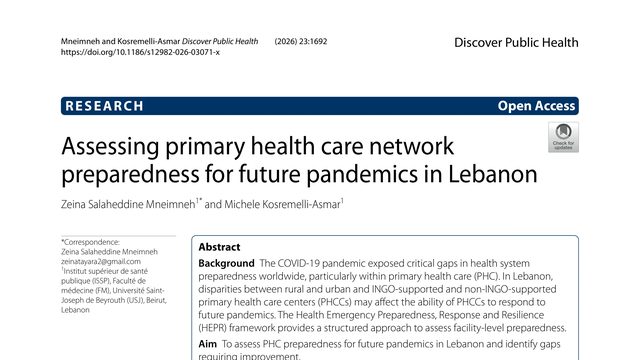
A health clinic can report a dangerous disease quickly and still be unprepared for the next pandemic. In Lebanon, that contradiction is exactly what this study uncovered.Lebanon’s primary care centers were very good at reporting disease, yet no center reported a formal way to systematically address community concerns. That contrast is the central surprise of this preparedness study.
Beibei Xiong, Christine Stirling, Daniel X. Bailey, Melinda Martin‐Khan
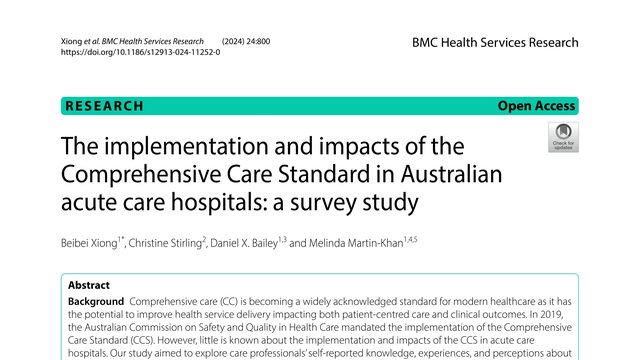
A hospital can have skilled professionals, a national care standard, and still fail to give every patient one joined-up plan. This study found that confidence was high, but the support needed to make care consistent was not.Australian hospital professionals generally felt confident delivering comprehensive care, but the weakest point was creating one shared care plan, and nearly one in five reported that none of their unit’s patients had one.
 4:17