Cerebellar contributions across behavioural timescales: a review from the perspective of cerebro-cerebellar interactions
In depth8:32CCAI
paperi.ai
0:00 / 0:00
Ellen Boven, Nadia L. Cerminara
The cerebellum is usually cast as the brain’s millisecond specialist. This review argues that its longer-range timing may emerge through conversations with the cerebral cortex, potentially linking fast motor control to seconds-long learning and planning.
Performing successful adaptive behaviour relies on our ability to process a wide range of temporal intervals with certain precision. Studies on the role of the cerebellum in temporal information processing have adopted the dogma that the cerebellum is involved in sub-second processing. However, emerging evidence shows that the cerebellum might be involved in suprasecond temporal processing as well. Here we review the reciprocal loops between cerebellum and cerebral cortex and provide a theoretical account of cerebro-cerebellar interactions with a focus on how cerebellar output can modulate cerebral processing during learning of complex sequences. Finally, we propose that while the ability of the cerebellum to support millisecond timescales might be intrinsic to cerebellar circuitry, the ability to support supra-second timescales might result from cerebellar interactions with other brain regions, such as the prefrontal cortex.
Transcript
The cerebellum is usually cast as the brain’s millisecond specialist. This review argues that its longer-range timing may emerge through conversations with the cerebral cortex, potentially linking fast motor control to seconds-long learning and planning. Timing is crucial for wide-ranging behaviours, from catching a ball and crossing a road to perceiving music or planning a commute to work.
The ability to encode temporal information across a wide range of time scales is essential for generating adaptive behaviour that is key to survival. Adaptive behaviour depends on learning while interacting with an environment whose states dynamically evolve across different timescales, from slowly changing contextual states to fast trajectories of bodily movement.
Neural circuits are known to process temporal intervals during behaviour, but how temporal information processing enables adaptive goal-directed behaviour remains unclear. Successful adaptive behaviour relies on processing a wide range of temporal intervals with certain precision.
The traditional dogma says that the cerebellum is involved in sub-second processing, while emerging evidence shows that the cerebellum might also be involved in suprasecond temporal processing. The review examines reciprocal loops between the cerebellum and cerebral cortex, focusing on how cerebellar output can modulate cerebral processing during learning of complex sequences.
Its proposal is that millisecond timing might be intrinsic to cerebellar circuitry, whereas supra-second timing might result from cerebellar interactions with other brain regions, such as the prefrontal cortex. The traditional view involves two main circuits for temporal information processing.
The cerebellum is thought to track durations between events in the range of milliseconds, or sub-second timing, and is classically linked to sensorimotor skills requiring precise millisecond timing of the motor response. Studies in animals and humans have shown that the cerebellum is required for sub-second timing tasks such as finger tapping, eye blink conditioning, and temporal discrimination tasks.
The basal ganglia and cerebral circuits are thought to support perception of more slowly evolving events, at the scale of seconds to minutes, guiding behaviours such as foraging and decision making. Interval timing includes thalamo-cortical-striatal circuits, with cortical regions including the prefrontal cortex and posterior parietal cortex.
Figure one maps temporal information processing from microseconds to circadian timescales, linking increasingly complex functions and behaviours to proposed biological mechanisms. The “old view” separates subsecond cerebellar timing from supra-second corticostriatal timing, whereas the “new view” emphasizes broader, brain-wide feedback loops, including cortical, subcortical, and cellular processes.
This matters because the figure frames recent evidence as challenging a sharp division between sub- and supra-second timing systems. More recent studies provide evidence for cerebellar involvement in the supra-second timing range, including overestimation and underestimation of supra-second intervals in cerebellar patients with damage to lateral cerebellar areas.
Studies have also observed co-activation of the cerebellum with the prefrontal cortex during supra-second timing tasks, and stimulation of cerebellar projections to prefrontal cortex can rescue timing deficits in schizophrenia. Timing can be explicit in timing studies, but in decision-making and working memory tasks it can be implicit because it involves prediction of events.
The current research suggests a broader role for the cerebellum in event timing, including processing longer timescales. Purkinje cell simple spike discharge includes short- and long-range representations of upcoming and preceding behaviour, and Purkinje cells can use prediction errors to acquire an internal model of supra-second stimulus timing.
A computational model of cerebro-cerebellar interactions was developed for temporal credit assignment. The proposed function of the cerebellar circuit during learning is to provide a feedback signal that enables the cerebral cortex to acquire adaptive representations by increasing the temporal information available to each cerebral network.
A cerebellar feedforward network communicates with a cerebral recurrent network, forming a two-learner system in which the cerebellar network learns to provide internal feedback signals to the cerebral network. The main network integrates these internal feedback signals, while the cerebellar signal contains information about future feedback received by the cerebral cortex and influences activity patterns for precise behaviour.
The cerebellar feedforward network predicts future feedback from the current state of the cerebral recurrent neural network, making feedback available beyond the intrinsic scale of the cerebral network. Figure three depicts a recurrent cerebral area receiving sensory input and external sensory feedback, while a feedforward cerebellar network predicts the cerebral feedback expected from the current cerebral activity.
Granule cells and Purkinje cells form the cerebellar pathway, and the inferior olive computes a prediction error by comparing predicted feedback with actual cerebral feedback. The model matters because these moment-to-moment cerebellar predictions can provide richer temporal information, helping the cerebral network learn adaptive representations across different timescales.
The cerebro-cerebellar model suggests that the cerebellum mediates behaviour by predicting feedback across a range of time scales. When trained in sensorimotor tasks, the model shows faster learning and reduced dysmetria-like behaviours, and cerebellar feedback signals facilitate learning especially when environmental or internal body-state feedback is limited.
The model was also applied to a recreating sentence task based on work in cerebellar patients, who showed poor semantic descriptions of images compared with healthy subjects. In the task, the model receives a low dimensional representation of a natural image, and recurrent neural networks are trained to predict the next word from the compressed sensory input and previous word.
The cerebellar enhanced model generates richer captions, particularly longer captions, suggesting that it can learn richer visuo-language contextual information. Future studies are required to understand the neural circuit mechanisms by which the cerebellum supports encoding of supra-second intervals.
Because the cerebellum has a mainly feedforward structure, computation for behaviour over a longer time scale could possibly be broken down into sub-second time scales. The cerebellum may make predictions and provide feedback over multiple time horizons, from milliseconds for motor control to seconds or more for decision-making and long-term motor planning.
Millisecond timing might be intrinsic to cerebellar circuitry, while supra-second timing might result from cerebellar interactions with other brain regions, such as the prefrontal cortex. Connections between the cerebellum and basal ganglia provide an additional substrate in timing that was not considered in this review.
A computational model of cerebro-cerebellar circuits is useful as a first step toward a mechanistic understanding of cerebellar contributions to interval timing. The overarching idea is that a cerebral recurrent neural network connects to a cerebellar network, which receives a copy of recurrent neural network activity and returns a prediction of the desired task outcome or feedback signals necessary for learning.
Future experimental studies could consider this network architecture while implementing timing tasks. The central takeaway is that cerebellar timing may span multiple horizons: millisecond precision can be intrinsic to cerebellar circuitry, while supra-second timing may depend on interactions with regions such as the prefrontal cortex.
A derivative work by Paperi · AI-generated script, voice and captions
· pages and figures unaltered
Made with Paperi.
Drop in a research PDF — get a narrated video walkthrough like this one,
with highlights that follow the narration. Free to start.
Lu Zhou, Yun Tian, Sizhe Zhang, Bin Jiao, Xinxin Liao, Yafang Zhou, Qiao Xiao, Jin Xue, Ranhui Duan, Beisha Tang, Lu Hua Shen
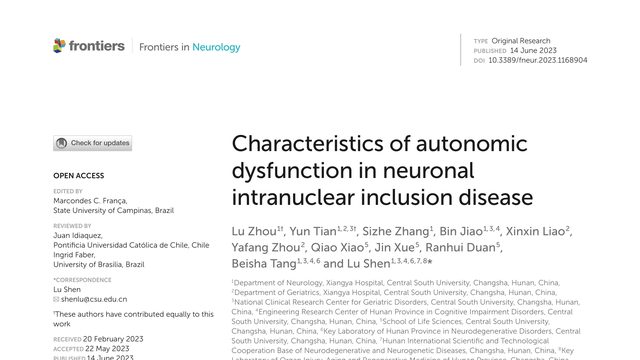
Some body functions run without permission: digestion, urination, temperature, and heartbeat. In this disease, those automatic systems may be sending one of the clearest clues that something deeper is wrong.What if a questionnaire for autonomic symptoms could reveal a major signature of a rare neurodegenerative disease? In this study, autonomic dysfunction affected nearly all patients with NIID.
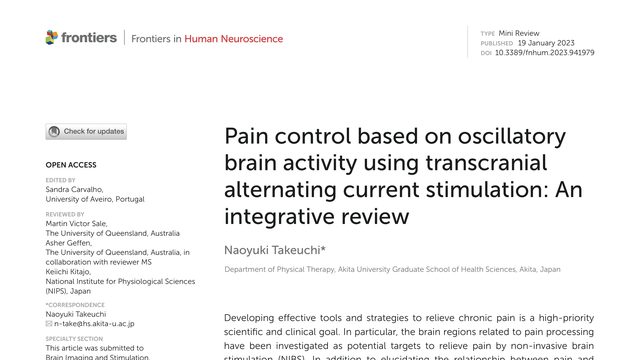
What if chronic pain is not only an alarm in the body, but also a rhythm in the brain? This review explores whether gently matching or reshaping those rhythms could turn the volume down.What if pain control is partly a problem of timing? This review asks whether gently steering the brain’s rhythms, and even synchronizing two brains, could open new routes to relief.
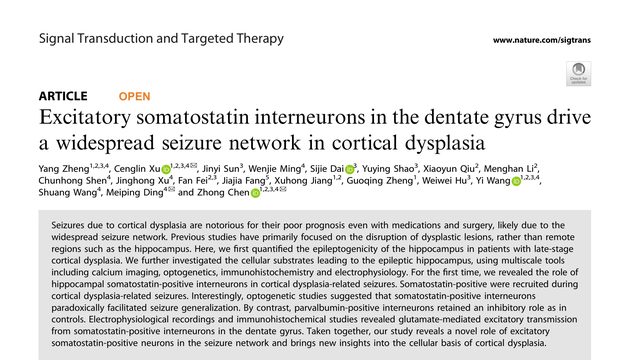
Some brain cells are supposed to act like brakes during seizures. But in a form of epilepsy linked to abnormal brain development, one group of those supposed brakes may instead help a seizure spread.What if a neuron class famous for inhibiting brain activity actually helps seizures spread? This study links a remote hippocampal circuit to widespread seizures in cortical dysplasia, and identifies somatostatin-positive interneurons as an unexpected driver.
 3:58